
Diversification is not just a defensive strategy but an offensive one too. 2025 was a perfect example, from the start, of how portfolios benefit from both.
The defensive side stepped up early with the U.S. markets poor start and tariff panic in April. The offensive side took over with the recovery. Especially, international and emerging markets, which fared better than the U.S. market in April and went on to produce a blowout performance on the year.
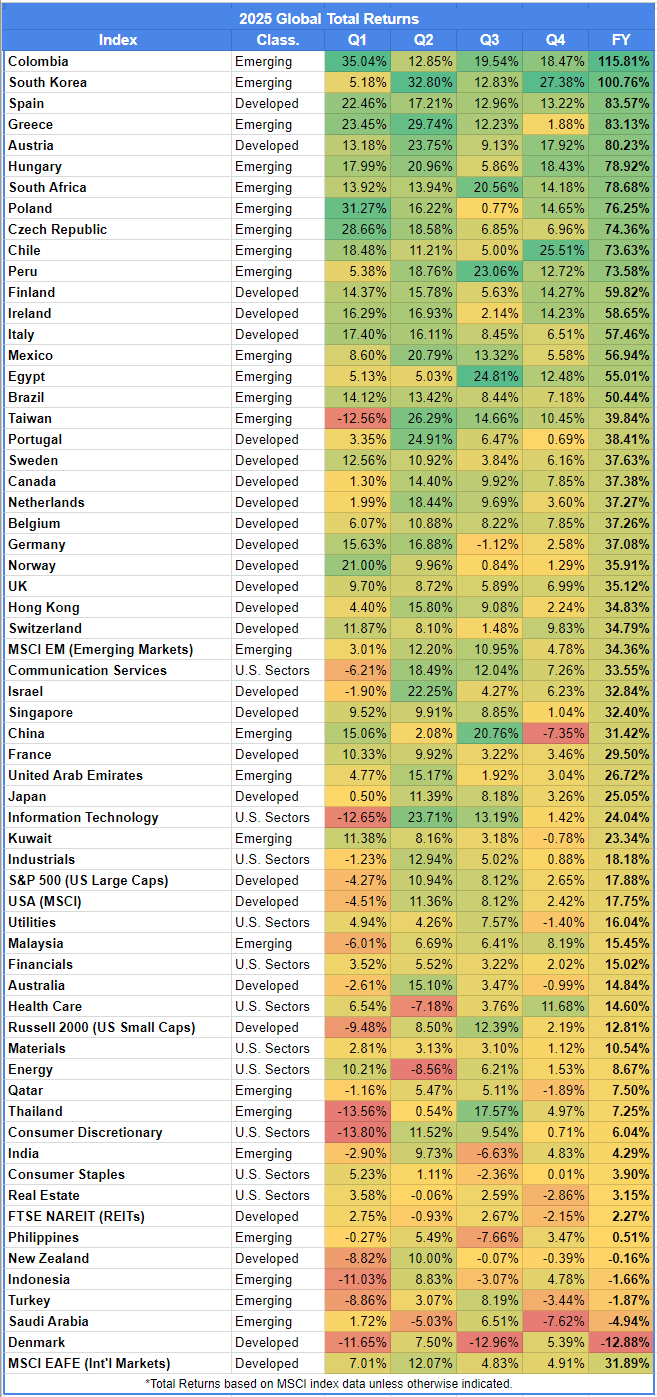
By the end of 2025, emerging markets led with a 34.4% total return (almost double the S&P 500 on the year). International markets followed closely behind at 31.9% total return.
The last time emerging markets outpaced everything, was 2017. Prior to that, it was 2009 (then 2007, 2005, 2003).
In fact, from 2000 to 2009 — while the S&P 500 experienced its lost decade averaging a 0.95% annual loss — emerging markets were only outpaced by U.S. REITs, by a slim margin (REITS at 10.6%/yr, EM at 10.1%/yr). The returns from emerging markets and REITs made up for the drag produced by U.S. stocks, in a diversified portfolio, over that 10-year period.
Since then, the U.S. market has been on a hot streak. It’s 14% return since 2010 is well above its long-run average. The risk in any bull market is we reset expectations around recent returns and ignore the historic trend. The risk grows as consensus believes above-average returns are the “new norm.”
Historically, thoughts of permanency have been thwarted by the market cycle. The benefit of diversification is never having to guess when bull markets end. You benefit from any continued bull market performance but are prepared when the cycle turns. In addition, the built-in flexibility diversification offers protects you from unexpected events.
A note before the 2025 data. The asset class, sector, international markets, and emerging market return quilts are up-to-date through for 2025. Hit the links for each one.
You’ll find four tables below. U.S. sector, developed markets, and emerging markets tables show monthly returns for 2025. The last table breaks down quarterly returns for all three. Click the images to super-size it.
Here’s a few highlights and commentary on all the charts:
- All broad asset classes finished positive on the year. It’s the third year in a row this happened. The last time this happened, it was the three-year period ending in 2006.
- Columbia was the best performing market in 2025. And yet, its 115.8% return fell short of its best return historically. That happened in 2004 — a 133% return that year.
- South Korea was the only other market with a triple-digit return in 2025 at 100.8%.
- The last time any global market experienced a return in excess of 100% was half the BRICs (Brazil and India) and Indonesia in 2009.
- Four markets — Spain, Austria, UK, South Africa — experienced gains in each of the 12 months of 2025.
- Communication Services led U.S. sectors, almost outpacing emerging markets, with a 33.6% total return. It also led U.S. sectors in 2024.
- No U.S. sector has led for three years straight going back to 2003 (farthest back I have data for). Energy is the only sector to lead two years in a row twice since 2003. Comm Services and Info Tech have each done it once. Repeat performances are rare.
- More surprising is the performance of the Info Tech sector. From the start of the year through April 8 it fell 24.1%, then recovered and gained 24.0% to finish the year.
- The Info Tech sector is a great example of how quick markets can change and why discipline is a repeated mantra in investing.
- Denmark, Indonesia, and New Zealand are the only markets in a losing streak. Each has experienced two consecutive losing years. Historically, three consecutive losing years are not out of the ordinary for emerging markets and less so for developed markets. However, four losing years in a row are rare.
- Despite experiencing five straight years of gains, the Greece market averaged a 6.8% annual loss over the past 15 years. The worst performing market over that period.
- Greece is not alone. Brazil, Chile, Egypt, and Turkey — all emerging markets — also have annualized losses over the last 15 years. That’s 5 good reasons why diversifying across emerging markets is important.


Related Reading: