
It was a mediocre start to the year for U.S. markets then it got worse. The S&P 500 dropped 4.6% in first three months of 2025. On the bright side, international and emerging markets rose.
A diversified portfolio was likely flat over the first quarter. So not great or horrible, considering its only three months and performance over the last two years.
That changed on April 2nd. Liberation Liquidation Day started the worst selloff since March 2020. The announcement of massive widespread tariffs — an average of 24% — not seen since the 1930s wiped out any gains over the last three months and added to the losers. It’s moronic, self-inflected, and unnecessary.
If there is a lesson in all of this, it is:
- Never underestimate the power one idiot has over the global economy.
- Diversification matters.
The three months to start the year, and especially the last week, bring the point home. We may have little control over the idiocy of those in public office (beyond elections), but we do control how we manage that risk in our portfolios.
The point of investing is as much about protecting the money you’ve already made as it is about growing your money further. Diversification does both…and more.
Most important, diversification removes the need to predict these events in advance because your portfolio is already prepared for it. Maybe not this specific circumstance, but surprises that lead to market declines.
In addition, diversification cushions the blow as markets react to chaotic policies. Higher volatility is never fun, but a diversified portfolio offers some protection that makes whipsawed markets easier to stomach.
Finally, diversification has you covered when the inevitable market recovery begins. Again, no need to guess or attempt to time it. Your portfolio is ready to take advantage of the recovery, whenever it happens. The key word being “whenever.” Nobody knows what happens next.
What we do know is that this is not normal. Economists across the board (the smart ones) agree that broad sweeping double-digit tariffs are a horrible idea. It’s a huge tax. It raises costs for businesses. It raises prices for consumers. It crushes confidence and demand drops.
If things spiral expect retaliatory tariffs, reduced spending across the board, worsening business, and the potential negative feedback loop as businesses downsize or shutdown and push people out of work. The economic effects won’t be immediate but rather a slow decline over months and quarters. It’s not a pretty picture. It failed horribly the last time it was tried a century ago. The odds it works this time are low.
The upside is that saner minds prevail before we ever reach that point. Until then, don’t panic, stick with your investment plan, and let diversification work.
And if you’re tempted to “buy the dip” don’t be shocked if market rallies lead to lower lows. Bear markets can be good buying opportunities if you stomach near-term pain and keep a long-term perspective.
A quick note before the first-quarter highlights. The asset class, sector, international, and emerging market returns are up to date through March 31, 2025. Hit the links for each.
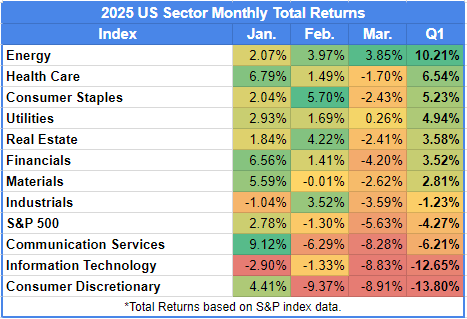
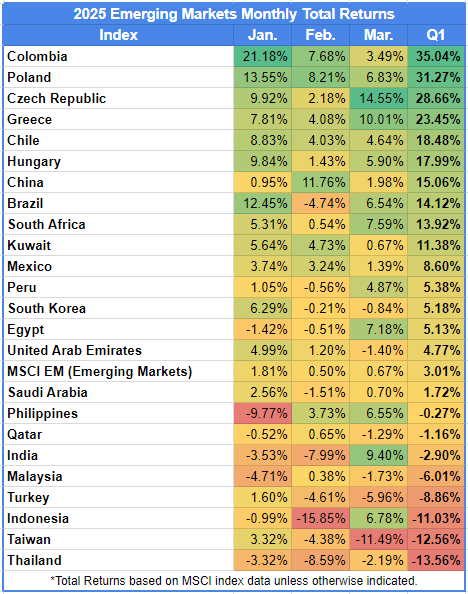
There are three tables below. A U.S. sector, developed markets, and emerging markets tables break down the first quarter total returns by month. Here are a few highlights:
- The three worst performing U.S. sectors in Q1 had returns of over 30% in 2024. All three fell more than the S&P 500.
- The Info Tech and Consumer Discretionary sectors fell double digits. Info Tech was the only sector with losses in each of the first three months.
- Energy was the only sector up double-digits to start the year, almost double its return last year. It was also the only sector with gains in each of the first three months.
- The U.S. was the third worst performing developed market. Only New Zealand and Denmark performed worse. The U.S. was the 8th worst globally. Five emerging market performed worse.
- Denmark, the worst performing developed market in Q1, was the second worst performer in 2024.
- Only five developed markets and eight emerging markets experienced losses in Q1. New Zealand and Thailand were the only markets to see losses in each of the first three month.
- Ten developed markets and ten emerging markets gained over 10% in the Q1. Spain and Norway exceeded 20% returns in three months. Columbia and Poland topped 30% in Q1. In fact, Columbia had a great year in January with 21% return that month.
- Eight countries saw double-digit gains in a single month. Three — Denmark, Indonesia, Taiwan — experienced double-digit losses in a single month.

Related Reading: