
Buy the Book: eBook
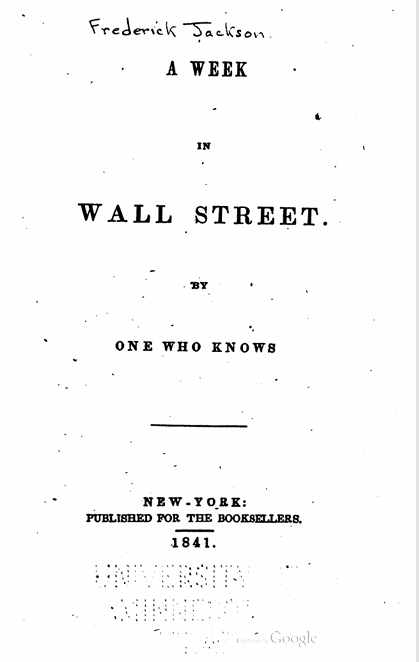
Published four years after the Panic of 1837, the author’s often satirical view of Wall Street describes the stock manipulations and other typical workings of Wall Street from the bubble years through the panic.
The Notes
- The book was published in 1841, during a depression that began after the Panic of 1837 which involved state’s defaulting on debts and widespread bank failures.
- The author, in part, tells of the stock manipulations and the typical workings of Wall Street through the story of the “Morrison Kennel.” It’s (loosely?) based on the Morris Canal and Bank Company, Nicholas Biddle, and the US Bank of Pennsylvania.
- “That there is existing, at the present time, a demoralised condition of principle, feeling, and practice, pervading the country throughout, in regard to pecuniary transactions and engagements, deserving a severe castigation, will not I believe be denied by any one…”
- “The proper correction of public morals is public opinion; but so long as public opinion is indifferent to the innovations that have grown up, and so long as pecuniary credit, and the posts of honor, trust and profit, are so frequently accorded to the most successful in their negotiations or their intrigues, without regard to the principles, or practices, that have placed them where they are — so long we may expect nothing but the increase of those mischiefs, of which so many now complain.”
- “The idea of a Stock Company…the principal virtue of which is, to replenish the fortunes of those who plan and conduct it, as is more than suspected, since most of the money generally stops short of its intended application, and can only be accounted for by mistakes in the original estimates, or expenses preliminary to the commencement of the real work.”
- “Herein is seen the peculiar virtue and particular wisdom of those contrivances called Corporations, and Joint Stock Companies… An ingenious device, wherein an imaginary body alone is made accountable for the acts of its members; while the real actors may hide behind it, as long as it has power to protect them, and scamper off without fear, when it has not. It has also this peculiar property, that, when the directors have taken to their heels, like the ignis-fatuus, the farther you pursue it the farther it recedes; and he who follows it long will, very likely, get stuck in the swamp from whose foul vapours it has been generated; and, at most, if fairly got hold of, it is never found to consist of any thing more than a worthless bit of parchment.”
- “A Bear means a man who has no shares in the Stocks — one stripped — in an embarrassed condition, and that a Bull means a man who has more shares than he can keep, and has gored his neighbour to procure them.”
- “Dr. Johnson’s definition of the word broker, viz: ‘A negociator between two parties who contrives to cheat both.’”
- The author shares management uses public funds to enrich themselves. They create a “safe” investment — banks, insurance, and trust companies — to lure “widows and orphans” for the dividend income, sell shares at a premium, cut the dividend after a year or two, and buy back the shares at a deep discount.
- “I will lay it down as a rule, therefore, that whoever distrusts the integrity and good intentions of those gentlemen, who get up a stock company, and collect within its vaults the widow’s mite and the orphan’s support, is no better than the gentleman before alluded to, whose perversion of the luxuries of taste flowed from the impurity of his own mind.”
- “Whenever any company is attempted to be established for purposes of public improvement, it is always a prerequisite of success, that in the programme, the expense should be set down at one half, and the profits and advantages at double — and this mode of stating things, although it varies from the actual result only three hundred percent, is sure to convince, and the public will eagerly catch at the enterprise. The reason of this necessity is, that if the truth were told in the first place, there would be little chance for management in the stock, and none whatever of its being all taken up.”
- “Money is good, fame is good, but to know how to improve the follies of others is better than either.”
- “The advantages to a stock company of a judicious choice of a name, are incalculable; not the least of which arises from properly compounding it, so as to mean more things than one… One peculiar advantage of this last is, that as the projectors are not always certain what they will do, but intend to be governed by their success, they are thereby enabled to shift their course to suit the breeze.”
- “There is a set of proscribed men in Wall Street, who were once brokers, professionally, and are now broken in reputation, credit and finances — having no means but what they have kept from their creditors, and being expelled from the exchange board for defalcation or bad conduct — they still linger round their old haunts, and carry on a system of gambling in what are termed fancy stocks, through which they contrive occasionally to entrap and empty the purse of some new comer, or filch each other of their ill retained means, until each in his turn gets placed on the ‘black list,’ which is the final seal of reprobation, and in Wall Street signifies — ‘that whoever deals with that man, shall himself not be dealt with by any one.’”
- “All of them are Loafers. They have neither wit enough to contrive, nor credit enough to carry out, a speculation: but when one has begun…they may be seen flocking in and out of the brokers’ offices — examining the stock books — talking wisely of the nation’s affairs — each one pretending to know more of finance than even Mr. Woodbury himself; and their exuberance of knowledge is almost as luminously exhibited. Like flies round a honey pot, each one is anxious for a sip, and according to his slender means, pledges a hundred dollars, more or less, and orders his broker to buy as many shares as he will upon this security. They thus materially aid the great speculators; but the result to themselves generally is, that their families or friends suffer precisely the amount they have risked.”
- “If the mischiefs arising from this species of gambling were confined to those who set that kind of speculation on foot, or who make it the business of their lives, there would be nothing to lament. But such is not the fact. The whirlwind naturally sweeps everything within its influence, and over which it has power, to its centre. Hundreds, nay thousands, allured by the success of a few, are induced to embark in the rash adventure. They are unacquainted with the real character or causes of the fluctuations, and even if they are not ignorant, they are liable to be outwitted by some of the hundred minds that are continually plotting against them.”
- “It will be found to be a necessary consequence, that in all such speculations…if one is made rich, a hundred are made poor. In no country in the world, is the hazard of stock gambling, so great as in this, where there is such a multitude of stocks, based upon the schemes of individuals, and affected by the ever-changing prosperity of our growing, yet comparatively unsettled condition.”
- “Among the many schemes of finance that have disgraced our country, and been fruitful sources of peculation, deserving the severe censure of justice, and the ridicule of wit, there are none more prominent than the bubble of state stocks.”
- The 1830s saw US states and territories raise funds via bond offerings for internal improvements (railroads and canals) and banks. Wall Street pushed the offerings on the public for a commission. The bonds were bought on margin, compounding the amount of debt issued. When the economy weakened and the states could no longer pay interest and defaulted, the bond prices dropped and lead to national panic.
- “The maxim, that credit is the life of business. This maxim formerly meant, that a credit, well sustained, gave success to enterprise — but by its misapplication and misuse, it has come to a different signification, viz: that the more one owes, the more he has to sport with.”
- “If stockholders’ will not look after their own interest, if they will allow their agents to pursue their own pleasure without supervision, or accountability — if they will not employ as their agents, such men as will have some reference to a good conscience, and common sense, something besides selfishness in the performance of their duty to their principals, and the public, they deserve to lose their money.”
- “For the benefit of those who may have a little money left to invest, I will give them, in few words, the experience of thirty years. Every institution, established for the purpose of creating capital, instead of investing that already possessed — every one established for the purposes of speculation, or monopoly, of any kind — or for the promotion of the interest of any particular individuals — every one which contracts debts against itself beyond the immediate means of paying, and thus loses its independence of character — and every one which perverts its means from the legitimate use, which, on a fair construction, was contemplated in its creation — either has ruined. or sooner or later will ruin, itself, its stockholders, and its customers.”
- “There are a few men of property, not brokers, who occasionally buy fancy stocks in Wall Street, when money is scarce, and sell again when it is more plenty, and reap a profit by it; but their number is so small, that they have never attained the respectability of any distinguishing name.”
- “Cornering — which means, that they first get the control of some particular stock, and then, by making a great many contracts on time, compel the parties to pay whatever difference they choose – or rather, I should say, whatever difference they can get — for they sometimes overrate the weight of the purse of those they contract with.”
- “There is another, and a much larger class, who, deceived by appearances, come into the market without any knowledge of it, and generally lose what they invest. These are called Flunkies.”
- “A very large portion of the stocks termed ‘fancies,’ and in which they mostly deal, are entirely worthless in themselves; unlike articles of merchandise, which may be seen and examined by the dealer, and which always have an intrinsic value in every fluctuation of the market, these stocks are wholly wrapped in mystery; no one knows any thing about them, except the officers and directors of the companies, who, from their position, are not the most likely men to tell you the truth. They serve no other purpose, therefore, than as the representative of value in stock gambling, which might just as well be wholly imaginary.”
- The author takes a dig at stock price manipulation and how those “transactions are published in all the commercial newspapers, and go forth to the world as the evidences of value, and the condition of the money market, to deceive the unwary.”
- “Time-contracts of ‘buyer’s option,’ of ‘seller’s option,’ which means, that the person to whom the option is given, may, at any time within the period of the term of sale, by giving one day’s notice, call for the stocks, and this enables them to take advantage of any temporary fluctuation which may happen, or which the parties interested may be able to create. These circumstances easily explain the reason why fortunes are often so suddenly made or lost in stocks. No system could be devised better calculated than this is, to excite a gambling propensity, and afford an opportunity for the exercise of ingenuity and cunning.”
- “Bad Times — which in business parlance, in its proper construction, means, that period of time when the mischiefs designed by one party, or arising from the follies and imprudences of the other, are in course of developement.”
- “When men of business become dependent on borrowing, to meet their engagements, the daily supply becomes as necessary as daily food.”
- “They know enough of human nature to know, that, he who has once been a stock gambler, will be again, as soon as he has the means of becoming so.”
- “In my opinion, a chance, which may be operated upon in so many ways, as may the rise or fall of property, or the success of speculation of any kind — and, instead of being governed by any such natural laws as may be supposed to belong to chance, wherein the aggregate results must be always the same, although we do not know before hand how they will come up particularly, is overruled and affected, more or less, by the changing opinions and volition of almost every one in the community — deserves not the name, even of chance, and, in my opinion, involves the certainty and necessity of failure.”
- “The first step from the path of duty inevitably leads to ruin, unless immediately retraced.”
- “A panic is one of those things in nature, which have existence without entity — something which may be felt, but can neither be traced nor followed. It has the power of motion and flight exceeding that of all cognoscible beings for it can pass from city to city, on the wings of a single rumor. It has the power of making itself invisible, and can stalk through the streets in the day time unseen, frightening every body by its presence. It has the advantage of Archimedes’ lever, for it has a fulcrum in the credulity of the man; and you may easily turn the world upside down with it. It is, in fact, a kind of moral element, and, like the fire, a single spark may kindle into a conflagration, which the whole nation cannot extinguish; and it must be left to go out of itself, when it has no more fuel to nourish it. It may be called forth by a whisper, but a multitude cannot bind it. It is, therefore, one of the most important of agents, but like fire also it is dangerous to handle. It is a very good servant, but a very hard master, and sometimes consumes those who kindle it.”
- “The causes of panic, must not be sought for among natural phenomena no science of alchymy is necessary to compound it. It may be made up of truth, composed of falsehood, or combined from both. It may be produced by hatred, jealousy, or envy. It may arise from curiosity, or the love of the marvellous, or, from a more villainous cause still, the desire to profit by its effects. And with this knowledge of its causes, if men were wise, they would give less heed to it.”
- “In great commercial cities, a panic is a different thing, and first indicates its approach in a different way… Like great and pestilent diseases, it generally has premonitory symptoms, which commonly exhibit themselves in plethora, and a wasteful indulgence in luxury. And like those diseases also, it never attacks or alarms those of regular habits, and an equal mode of living.”
- “When a panic comes in Wall Street, if any man will take a position, a little above the heads of the multitude, where he can see their folly, he may safely enjoy a hearty laugh, instead of suffering a fright.”
- “What makes a character in Wall Street, does not make one out of it. Here the standard is money, but elsewhere, it requires some other ingredients to arrive at any level much above the lowest; and a man destitute of education, intellect, genius, principle, morals and religion, (though last here, yet not least,) can hardly arrive at a condition of respectability, much beyond his own conceit of himself.”
- “A panic, then, serves to hasten changes of property from one to another, and thereby acts in accordance with the spirit of our institutions, which encourages rotation.”
- “When a panic in money matters begins, there seems to be a predisposition in the bystanders, either from want of employment, the love of storytelling, or the desire of mischief, to aid all they can in spreading it. I might add, too, that many newspapers are not among the least, in bestowing their influence in this way.”
- “Experience is sometimes a very hard, but always an efficient teacher; and those who have suffered will have the satisfaction to know better hereafter, who to trust and what to trust, and taught to rely more on themselves. And if afraid of a panic in future, he will be able to prepare himself on the first appearance of the ‘premonitory symptoms,’ and when he sees it coming on the wings of the wind, like the man in the simoon, he may then safely turn his back, hold his breath, and let it pass by.”
Buy the Book: eBook