
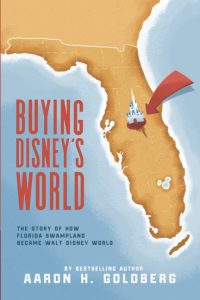
 Buy the Book:
 Walt Disney wanted a second chance to recreate Disneyland the right way — bigger, better, and with total control of the surrounding environment. He found that opportunity in Florida. The story of Walt Disney World is one of big dreams, secrecy, and financial ingenuity.
The Notes
- Walt Disney ran the Disney Co. with his brother Roy. Walt was the innovator. Roy was the financial genius behind the company.
- “We were novices and operating on a shoestring. We really did not know what we were doing. He did the dreaming. I did the building. We learned with Disneyland. That was the start of this idea Walt had. As we went along, he got other ideas, and I guess I really never doubted that we would someday be here at Walt Disney World.” — Roy Disney, 1970
- Walt Disney World was the largest private construction project in the U.S. in 1970 with over 10,000 workers. Almost 10 million cubic yards of earth were moved to build the theme park and two cities.
- In 1966:
- 196.6 million people lived in the US.
- 240 million people saw a Disney movie.
- 100 million per week watched a Disney TV show.
- 80 million read a Disney book.
- 150 million read a Disney comic strip.
- 7 million visited Disneyland.
- Walt and Roy Disney were born in Chicago. Their father, Elias, was a carpenter who moved the family from Florida to Chicago in 1890 for job opportunities with the upcoming World’s Fair.
- The idea of Disneyland came to Walt from spending Saturdays with his two daughters. He took them to the merry-go-round and got the idea of creating a family park where kids and parents could have fun together.
- “I’d be sitting there trying to figure out what I could do. It took many years. I started with many ideas, threw them away, and started all over again. And eventually, it evolved into what you see today at Disneyland.” — Walt Disney
- Disneyland
- About 160 acres of land was purchased in 1953.
- Disneyland opened in July 1955 and cost over $17 million (at major financial constraints). Its success led to explosive growth in Anaheim, especially around the park. Liquor stores, motels, restaurants, and retail shops popped up and Walt hated it.
- “One of the things I’ve learned from Disneyland is to control the environment. Without that we get blamed for the things that someone else does. When they come here, they’re coming because of integrity that we’ve established over the years, and they drive for hundreds of miles and the little hotels on the fringe jump their rates three times. I’ve seen it happen and I just can’t take it because, I mean, it reflects on us. I just feel a responsibility to the public when I go into this thing that we must control that, and when they come into this so-called world, that we will take the blame for what goes on.” — Walt Disney
- The major issue with Disneyland was the company’s financial inability to buy extra land before construction began to ensure expansion/growth and lack of control on encroaching businesses.
- “By nature I’m an experimenter. To this day, I don’t believe in sequels. I can’t follow popular cycles. I have to move on to new things.” — Walt Disney
- “I happen to be kind of an inquisitive guy and when I start to see things I don’t like, I start thinking, why do they have to be like this and how can I improve them?” — Walt Disney
- “I see only mistakes we made. It’s like going over a theme you wrote in grade school.” — Walt Disney
- “A picture is a thing that once you wrap it up and turn it over to Technicolor, you’re through. Snow White is a dead issue with me. The last picture I just finished—the one I just wrapped up a few weeks ago—it’s gone; I can’t touch it. There’s things in it I don’t like. I can’t do anything about it.” — Walt Disney
- “I wanted something live, something that could grow, something I could keep plussing with ideas, you see? The park is that. Not only can I add things but even the trees will keep growing; the thing will get more beautiful every year. And as I find what the public likes—and when a picture’s finished and I put it out—I find out what they like, or they don’t like, and I have to apply that to some other thing; I can’t change that picture, so that’s why I wanted that park.” — Walt Disney
- “Ideas come from curiosity. When I settle one idea, my confidence takes command; nothing can shake it, and I am constant to it until it comes a reality.” — Walt Disney
- “I can never stand still. I must explore and experiment. I am never satisfied with my work. I resent the limitations of my own imagination.” — Walt Disney
- Walt wanted another project after Disneyland. He considered a planned Disney community in West Palm Beach, a Disney attraction at Riverfront Square in St. Louis, and a bowling alley/sports complex in Denver, Colorado.
- Celebrity Sports Center
- 12,000 new bowling alleys opened in the US in the early 1960s (the bowling bubble!).
- Walt partnered with Jack Benny, George Burns, Gracie Allen, Burl Ives, Bing Crosby, Charles Laughton, Spike Jones, Art Linkletter, and John Payne.
- It opened in 1960 at $6 million in Denver, Colorado.
- It had 80 bowling lanes, seated 500, a billiard room, a game room, a restaurant, a lounge, a Hofbrau room, a pro shop, and a barber shop.
- Walt bought out the celebrities, unhappy with management issues, and fully controlled it under Walt Disney Productions (the company name before it became Walt Disney Company) by 1962. It was sold in 1979.
- “A common theme of Walt Disney’s career is that he routinely bet big on himself. He didn’t care that most people doubted him. History shows he was often short on cash to get his projects going but long on confidence and ingenuity.”
- Mary Poppins debuted in 1964, was a massive success, received 13 Academy Award nominations, and gave Disney a financial cushion for their next project.
- Walt did three location surveys on the East Coast — in 1958, 1959, and 1961 — for future Disney projects. Walt’s two requirements were the ability to “buy a lot of land, something between 5,000 and 10,000 acres” and not be close to the ocean. Central Florida met the requirements.
- November 1963, Walt met in secret with trusted executives to share his idea and discuss the needs for the property:
- Adequate size: 5,000 to 10,000 acres
- Usable land, not swampland
- Access to major highways
- Full control over the development of accessways
- Local government open to the project development
- Lake and attractive indigenous vegetation was a big bonus
- Everything was done in secret to avoid a land rush before the needed property was acquired. Memos were avoided, calls from Florida were rerouted through New York to California, names were changed, flights were routed through Midwest cities, shell companies were used, any association with Disney was removed.
- Land Acquisition
- Since multiple large parcels and hundreds of small parcels needed to be bought, Robert Foster pushed Walt to buy options on any property. If they couldn’t acquire all the properties, options allowed them to walk away with a small loss that wouldn’t hurt the company.
- They hired a local Florida attorney, Paul L. E. Helliwell, to help with the land purchases. Helliwell had ties to the CIA. He brought in Roy Hawkins for his real estate expertise.
- 16 possible sites for the project were originally considered, 3 were proposed to Walt in May 1964, and 2 — Demetree property and Bronson property — were Walt’s picks.
- Demetree Property
- 12,400 acres — 5.5 miles by 3 miles wide lot in Orange County.
- The mineral rights needed to be bought separately. Tufts University owned the mineral rights on over 20,000 acres but Wilson Cypress Inc. held a 99-year lease to cypress trees on the property and Hercules Powder Company held rights to timber and stumps.
- The first purchase — bought “as is” with a 6-month option of $25,000 with a purchase price of $145/acre.
- Rights held by Wilson Cypress and Hercules Powder were easily bought for cash.
- Tufts University sold the mineral rights for $15,000. It came with the chance to sell additional rights to neighboring properties at a higher price.
- Bay Lake Property
- Needed to avoid encroachment as it bordered the Demetree property.
- 1,250 acres, including the lake.
- Owned by a social-sporting group of 13 couples.
- Sold for $250,000.
- Hamrick Property
- Also bordered the Demetree property.
- 2,700 acres.
- Bought in September 1964 for $623,523.
- Munger Farms
- 65 small 5-acre parcels sold under Munger Farms from 1911 to 1913, bordered the Demetree property, that needed to be bought.
- The parcels were sold out of magazine and newspaper ads around the country. So owners were spread across the US. Owners were contacted by mail, phone, or showing up at the their door.
- Most parcels were bought for cash.
- An owner from Iowa got cash plus a day at Disneyland.
- Another owner got cash and a lifetime pass to Disneyland and Disney World.
- It took a year and a half to purchase the lots at an average price of $350/acre.
- Bronson Property
- 8,000 acres across from the Demetree property but in neighboring Osceola County.
- Bought at $100/acre.
- By 1965 Disney bought 43 square miles of land (the size of San Fran or twice the size of Manhattan) for $5 million or $183/acre. Yet, smaller adjacent properties still needed to be bought.
- 5 shell companies were used to buy the land. The shell companies were owned by Compass East Corp.
- Local newspapers didn’t report on the land purchases until May 4, 1965. Early rumors were a manufacturing plant. Emily Bavar, reporter for the Orlando Sentinel, was the first to connect the land to Disney on October 16, 1965. Disney went public as the purchaser a month later on November 15. The early leak pushed land prices higher.
- Reedy Creek Drainage District
- Surveys showed up to 75% of the land could be underwater during the summer.
- Florida law allowed Disney to create a drainage district to control the excess water through canals, levees, etc.
- No legislation was needed to form a district and each district could sell bonds to fund development.
- Disney wanted to
- Formed in May 1966.
- It was the 1st step in Disney fully controlling the property.
- Reedy Creek Improvement District (RCID) — a Super District that gave Disney full control of:
- Roads, bridges, and related structures, along with the power to connect them to public roads.
- Water, sewer, and public utility systems.
- An airport, transportation systems, and parking facilities.
- Mosquito and pest-control facilities and areas of conservation.
- Fire protection and waste collection and disposal services.
- A limited right of eminent domain, as provided in state statutes on drainage and water control systems.
- Exempt for state statutes, county ordinances and regulations around planning, zoning, and construction codes.
- Be independent from the Florida Public Utilities Commission.
- The authority for the district to issue bonds to finance development, levy taxes, and impose liens on unpaid taxes.
- Creation of 2 municipal corporations: the City of Bay Lake and the City of Lake Buena Vista.
- Creation of the Reedy Creek Improvement District that encompassed the entire property.
- The bill to create the district, along with everything Disney wanted, passed legislation with full support on May 5, 1967. Governor Kirk Jr. signed it on May 12.
- Voting rights within RCID are assigned by acreage — 1 acre, 1 vote. Walt Disney Company owns 68.8% of the land in the RCID, with the RCID owning 28.8%.
- Walt Disney died on December 15, 1966, at age 65. Roy changed the name of the project to Walt Disney World.
- Funding
- Initial estimates put the project at $600 million. Phase 1 was the theme park at $100 million. Phase 2 was EPCOT and other ideas.
- Corporate sponsors were one source of funding for the theme park.
- A minimum of $40k/year for leased space to be aligned with Disney, not including construction costs.
- A $100k/year, plus construction, got their own building to promote their products.
- GAF — the official film of Walt Disney World for $1 million over 5 years.
- Gulf Oil — 10-year deal for fuel and service centers.
- Borden Inc. — contract for milk and ice cream.
- Smuckers
- Coca-Cola
- RCA
- Eastern Airlines
- US Steel — paid about $50 – 60 million to build the Contemporary Resort Hotel and the Polynesian Village Resort. Disney would lease and operate the resorts from US Steel. Construction problems led Disney to buy out US Steel and finish it themselves.
- $40 million in convertible debt due January 1993 with a $65 conversion price, issued in 1968.
- $50 million in convertible debt due March 1994 with a $65 conversion price, issued in 1969.
- Debt was converted in 1970 when Disney stock hit $65.
- Revolving credit line of $50 million — $41 million from Bank of America and $9 million from local Florida banks.
- Stock offering in 1971.
- RCID issued tax-exempt muni bonds to cover roads, sewers, water lines, and other infrastructure.
- No taxpayer money or tax concessions funded the project.
- The Magic Kingdom theme park came to a total cost of $400 million and opened with practically no debt.
- Construction
- The official groundbreaking was May 30, 1967.
- 2,500 acres was cleared for just the theme park.
- Modeled after the hub-spoke design of Disneyland by Marvin Davis.
- Used 50 miles of canals, 22 miles of levees, 24 water control structures, and 1,000s of acres for holding basin to control the groundwater level.
- Over 1/3 of the total land was set aside as a wildlife conservation area. Another 1/3 is still undeveloped.
- The 450-acre Bay Lake, over 3.5 billion gallons of water, was drained, dredged, layer of white sand added around the perimeter, refilled, and stocked with bass.
- Seven Seas Lagoon, a 200-acre manmade lake, was dug to 10 feet and filled with water. Over 8 million cubic yards of dirt were removed and used in the foundation for the Magic Kingdom, raising the park over 14 feet.
- A concrete aqueduct connects Bay Lake and Seven Seas Lagoon to allow boats to navigate between the two.
- The park was built on top of utilidors, a system of utility tunnels, that house water, power, telephone, cables, compressed air, heating/cooling system for the theme park. It also allows waste pickup, deliveries, and cast members to move throughout the park unnoticed by guests.
- J.B. Allen Contracting Company was initially hired as the general contractor. Cost overruns plagued the project, theft was frequent, and subcontractors padded the books. J.B. Allen was fired in October 1970. Disney formed the Buena Vista Construction company to finish the project.
- The Preview Center, the 1st finished building, opened January 1, 1970. It presold $11 million in tickets to the park.
- Over 60,000 trees were planted. Over 500 football fields worth of sod was laid.
- 337 beams for the monorail were trucked from Tacoma, Washington.
- 1,637 handmaid figures went into the most annoying attraction, It’s a Small World.
- 9 tons of clay went into the 20 bears in the Country Bear Jamboree.
- Main Street buildings were constructed using the illusion of forced perspective: the scale of the building is reduced the higher up it goes — the second floor is smaller than the first, and the third floor smaller than the second. The buildings appear further away.
- All utilities and power services were built on-site, separate from public utilities.
- The first automated waste disposal system, Automated Vacuum Assisted Collection (AVAC), was installed in the park that moves trash through pneumatic tubes, compacted, and incinerated.
- Digital Animation Control System (DACS) controlled 1oos of audio-animatronic characters, hotel reservations, security/safety, air-conditioning, and music in hotel lobbies.
- The Magic Kingdom opened on October 1, 1971.
- The month of October was used as a slow open to work out any bugs in the system.
- The Grand Opening was from October 23 to 25. A 90-minute special (infomercial) was broadcast on TV. 52 million people watched.
- Over 2 million people visited in the first 4 months.
- Roy Disney died on December 20, 1971, at age 78.
- Opening Day Stats:
- Adult admission, $3.50; junior admission, ages 12 – 17, $2.50; and children 3 – 11, $1.00.
- Individual attractions were 10 cents to 90 cents.
- Family Fun Vacation package included 3 days, 2 nights at a hotel with park admission for three and tickets for 21 attractions: $61.50 for an adult, $25.00 for a junior, and $23.50 per child. Single occupancy was $100.50.
- Hotels were $25 to $44/night.
- The Fort Wilderness Campsite: $11/night.