
Buy the Book: Print
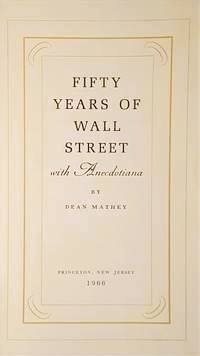
Dean Mathey was an investment banker on Wall Street. His autobiography primarily relays his experience and lessons from his start selling bonds in 1912 through the Great Depression.
The Notes
- Only 101 copies of the book were printed.
- Mathey was a director for The Equitable Life Assurance Society starting in November 1953.
- Mathey suggested the directors hold a dinner the night before board meetings, so the directors could get to know each other. James Oates, then President, made it a tradition but with added custom that one director speak at the dinner about their calling in life or any other subject.
- This autobiography was an outline of Mathey’s speech at one of those dinners.
- Mathey grew up in Cranford, New Jersey.
- He graduated from Princeton in 1912.
- Wm. A Read & Co. (renamed Dillon, Read & Co.)
- Mathey worked for Wm. A. Read & Co. out of college as a bond salesman for $15/week. Made partner in 1924.
- Mathey changed how he approached clients after selling a bad railroad bond at par to a client. The bond fell 65% after the railroad went into receivership. He didn’t know if someone at Wm. A Read & Co. knew about the pending bankruptcy or not but vowed to study the companies behind the bonds before he ever sold to clients again.
- “In this competitive bond-selling game I had made up mind that I should concentrate on my best prospects. To focus my efforts I had what I called my ‘first ten’ – my Decalogue of people I planned to do business with during that particular year.”
- William A. Read founded the investment bank after running Vermiyle & Co. in the 1890s.
- Charles Dillon took over in 1916, at William Read’s death.
- Mathey retired from Dillon, Read in 1945.
- Railroad Bonds
- About 75% of the investment business was tied to railroad bonds in 1912.
- “It was an accepted investment doctrine that if a first mortgage railroad bond was followed by a second and third mortgage bond issue the underlying bonds were well-nigh impregnable.”
- Most bond houses subscribed to the White & Kemball Service, that offered maps of the corporate structure of every railroad company in the U.S. It showed indebtedness per mile, every outstanding bond issue, its main line and branches, and outstanding mortgages per mile for each branch.
- Princeton Finance Committee
- Mathey was elected to the finance committee in 1927.
- 67% of the endowment portfolio was in prime railroad bonds at the time.
- Louis A. Mathey (father)
- His father worked the curb market.
- The “Curb” was an unregulated exchange of brokers that met outside 25 Broad Street that dealt in corporate stocks, mostly mining companies, that were too speculative for the NYSE.
- It was common on the curb for brokers to “scalp” or take an extra 1/8th or 1/16th percent on transactions for themselves.
- On Saturdays, Mathey would sometimes go with his father to work and run messages to his father’s clients.
- “Dad was always having ups and downs on the ‘Street,’ but he did have as clients several good brokerage houses which were members of the New York Stock Exchange.”
- The Panic of 1907 almost bankrupted his father.
- Panic of 1907
- The panic was due to a money shortage.
- “This in turn was caused by the custom of all the country banks of the nation, including the so-called interior banks, such as Cleveland, Chicago, New Orleans, San Francisco, etc., to keep their reserves in the large New York banks. Each autumn the interior banks would draw on these reserves quite heavily, to move crops, causing a seasonal shortage of credit.”
- The panic was started with the failure of the Columbia Trust Bank and the Knickerbocker Trust Company.
- When the “country banks” and “interior banks” heard the news, they withdrew their reserves from NY banks. The NY banks could not meet demand causing a panic.
- “Money itself, not credit, commanded a premium at one time of something like 150% and dollars in currency were almost as precious as diamonds at the height of the panic.”
- JP Morgan stepped to restore stability to banking system and end the panic.
- The bill creating the Federal Reserve System was signed by President Woodrow Wilson on December 23, 1913. It was a result of the panic.
- Wall Street was dead set against the bill.
- WWI
- Began in the summer of 1914.
- Wall Street shut down until the spring of 1915.
- Mathey took a teaching job at Princeton Prep School with Wall Street closed.
- He returned to his job after Wall Street reopened.
- JP Morgan & Co. was the leading investment bank at the time, followed by Kuhn Loeb & Co., then everyone else.
- JP Morgan & Co. was the financial agents for the British and French governments. The two countries funded their war purchased thanks to a $500 million Anglo-French loan at 5%, led by JP Morgan & Co.
- JP Morgan & Co. took advantage of the demand for smaller investment banks to be on its syndicate list, by opening it to every bond dealer in the country to ensure the full $500 million loan was a success.
- Congress declared war on Germany on April 17, 1917.
- Bernad Baruch was named chairman of the War Industries Board. Some on Wall Street disliked that idea and tried to hold up the nomination by claiming Baruch was speculator. Baruch called himself a “Wall Street speculator” at the start of the nomination committee hearing. He was unanimously approved.
- Mathey enlisted in the Reserve Officers Training Corps in May 1917. He returned to Wall Street after his tour in July 1919.
- Mathey represented the US in the Interallied Tennis matches in Paris and the World Tennis Championships in Wimbledon.
- Panic of 1922
- The US was prosperous coming out of the war and people went on a spending spree as war rationing of ended. Luxuries and basic necessities were now available.
- Businesses had built also built a significant inventory based on war-time demand that no longer existed.
- Commodity speculation was rampant. For example, crude rubber went 30 cents to $2 a pound the dropped to 15 cents. Tire companies were at risk of bankruptcy.
- Mathey’s firm (now called Dillon, Read & Co.) reorganized Goodyear Company to avoid receivership and worsening panic.
- Dodge Motor Company
- Ford, General Motors, and Dodge were the leading auto companies in 1924.
- After the Dodge brothers’ death, it was decided the company be put up for sale.
- Mathey’s firm, Dillon, Read & Co., negotiated to buy it.
- JP Morgan & Co. also wanted to buy it for General Motors. (Mathey notes this would have violated antitrust laws years later.)
- “New laws and fresh court decisions put some of us old time ‘ruggest individualists’ in a bad light.”
- Dodge was eventually bought by a large syndicate headed by Dillon, Read & Co. for $146 million.
- Late 1920s Bubble and Crash
- United States and Foreign Securities Co.
- One of the early closed end investment trusts.
- Dillon, Read & Co. underwrote it.
- More trusts were formed later in the decade as speculation rose with the bull market: Lehman Corporation, Tricontinental, Goldman Sachs Trading Co., Atlas Corporation, Bue Ridge Alleghany, and Shenandoah.
- Utility holding companies with the consolidation of electric power companies through complex pyramid scheme of holding company on top of holding company, issuing stocks and bonds to fund further purchases and maintain control.
- “This was all very fine until October of 1929 came along, when the price of stocks came tumbling down and the security behind holding companies bonds became worthless with no dividends to support the debt. From the 1930s on, many of these great pyramided companies went into receivership and bankers as well as the public lost their shirts.”
- Another catalyst to the 1929 bubble and bust were banks entering the investment banking business. All the major banks and even some smaller ones had investment banks as subsidiaries by the end of the decade, which help fuel the speculative frenzy.
- “Take it from me, as both an investment banker and later a commercial banker, those who say that the New York banks and Investment bankers don’t compete with one another are promoting the hoax of a century. The fact is that the competition of the New York bankers to outdo one another was a big factor in bringing on the panic of 1929.”
- “When one looks back on this, the way in which the speculative fever invades what was supposed to be the wisest and most conservative of Wall Street bankers, it all seems fantastic.”
- “There is one rule every good commercial banker is supposed to abide by and it is a fundamental precept — NEVER BORROW SHORT AND LEND LONG.”
- “Obviously, in hindsight, we can see why there were approximately 10,000 banks in the United States that failed in period 1930 to 1933 and some of the big ones, too. One can see how the banks BORROWED SHORT ON THEIR DEPOSITS AND HAD LENT LONG BY THE PURCHASE OF LONG TERM BONDS AND COMMON STOCK UP TO THEIR EARS. So when October 19, 1929 came along the scene was set for the holocaust. And it came!”
- Blue Chip Stocks Prices – September 3, 1929, vs June 1, 1932
- Packard Motor – $148 3/8 vs $1 7/8
- Allis Chalmers – $316 1/2 vs $4 1/2
- General Electric – $391 vs $9 1/8
- Canadian Pacific – $233 1/2 vs $8 1/4
- New York Central – $253 vs $9
- Johns Manville – $207 vs $10
- Kennecott Copper – $92 1/2 vs $5
- Bethlehem Steel – $136 3/4 vs $7 3/4
- National Cash Register – $125 3/4 vs $7
- Macy – $253 3/8 vs $22
- United States Steel – $257 5/8 vs $26
- Union Carbide – $135 7/8 vs $16
- General Motors – $71 7/8 vs $8 1/2
- Dupont – $215 vs $25 7/8
- Allied Chemical – $354 vs $48 7/8
- “Off Beat Stocks” Prices – September 3, 1929, vs June 1, 1932
- Coca-Cola – $152 1/2 vs $88 7/8
- Amerada – $27 vs $13
- Reynolds Tobacco – $58 vs $26 7/8
- Hershey Chocolate – $124 1/2 vs $47
- Liggett & Myers Tobacco – $96 vs $35 1/4
- American Home Products – $71 3/4 vs $25 1/2
- Wrigley – $76 vs $25 1/4
- Standard Oil (N.J.) – $70 3/4 vs $22 1/4
- Standard Oil (Calif.) – $76 3/4 vs $15 1/2
- OTC Bank Stocks Prices – September 3, 1929, vs June 1, 1932
- National City Bank – $442 vs $29 1/2
- Manufacturers Trust Co. – $271 vs $19
- Chase National Bank – $230 vs $24 1/4
- Guaranty Trust Co. – $1,025 vs $200
- Chemical Bank – $125 vs $29
- Only 3 stocks on the NYSE rose from September 3, 1929 to June 1, 1932: Filen’s of Boston and two gold stocks, Homestake and Alaska Juneau.
- “It is interesting to note that with few exceptions the lions were slaughtered along with the lambs.”
- The solution to the depression, from economists and business leaders, was to cut costs, lower wages (fire employees if needed), to avoid losing money from falling sales.
- Politicians promoted the “theory of saving ourselves out of the depression by lowering costs and tightening belts both corporate and personal.”
- “I close this phase of my Wall Street history not knowing how right this policy was or how wrong it was, but convinced that such an approach to living through any future depression would be politically impossible.”
- United States and Foreign Securities Co.
- Great Depression
- “Even the people who never pay their bills have stopped buying.” — Al Jolson
- “Roosevelt’s telegram to the banks declaring a bank holiday and a debt moratorium seemed to electrify our business morale and turned the tide. The country seemed inspired by his leadership.”
- Wall Street investigations began under Ferdinand Pecora.
- “Most of the leaders of Wall St. went down with their own ships even though steering them unknowingly on the rocks.”
- Pecora’s investigation eventually led to new regulations on banking and financial markets. As Mathey put it, it switched from “let the buyer beware” to “let the seller beware.”
- “So out of Washington came the Securities and Exchange Act of 1933 as amended in 1934. And what a cry went up on Wall Street by many of the old Wall Street crowd. ‘Government in Business — Practically Socialism,’ ‘Free Enterprise System is Dead,’ ‘Bureaucracy,’ were some of the epithets that were hurled at Washington.”
- Public Utility Holding Company Act of 1935 regulated and broke up electric holding companies. A similar cry went up from Wall Street only for investment banks to make money funding continued growth of power companies.
- “There is a great cry for free enterprise until free enterprise gets into trouble. Then the leaders turn to the government for help.”
- “The fact is, unfortunately, these regulatory agencies of our government are necessary to prevent our business leaders from their own excesses and lack of business ethics. Whether business likes it or not, these agencies are here to stay and instead of abusing them ‘in being’ it seems to me that our business leaders should lend their combined efforts to seeing the chief executives of these agencies are well chosen for their competency rather than their politics.”
- “The Pecora investigation prompted Congress to pass the Glass Steagall Act which, among other things, forbade banks of the United States to pay interest on demand deposits. The reason for this was that banks were so anxious for deposits in the Twenties that they outbid each other in interest rates to get them. This led to the banks buying speculative securities in order to get sufficient return on the deposits to still earn a profit.”
- 1960s
- “I believe it was Hegel, the philosopher, who said, ‘The only thing we learn from history is that we don’t learn anything.’ I am afraid we are building up in this decade the same pressures that we did in the ‘Roaring Twenties.’”
- Mathey observed NY banks trying to outdo each other in growth via merger, branch expansion, lower loan standards, and unsecured loans out of fear that if they don’t do it their competition will get the business. In one ad, loans were pushed as a way for customers to take a vacation.
- “‘Play now and pay later’ is hardly the basis for a good loan.”
- Negotiable CDs (Certificates of Deposit)
- To get around regulations on demand deposits, banks introduced negotiable CDs (Certificates of Deposit).
- Competition led to gradually higher rates from 4% to 4.5% to 5.5% (at the time the book was written).
- These CDs also came with lower reserve requirements at 4% versus 16.5% on demand deposits.
- To cover the cost of higher interest rates, banks 1) lowered loan standard, 2) longer term loans at higher rates and buying long term (mostly) muni bonds that fluctuate widely in price i.e. borrowing short and lending long like in the 1920s.
- The “Next” 1920-1930 Decade
- “No matter how much the present situation resembles the excesses of the 1920-1930 decade, there will be no prolonged depression as followed the panic of 1929.”
- “Instead of the classic approach to the remedies for previous depression, ‘Save ourselves out of it’ will be the Keynesian doctrine of ‘Spend yourself out of it.’”
- “The cure for our inflationary policy for the past years…will be more and more deficit financing and more and more inflation. This is the price we will pay for our free enterprise excesses and this is why the country will have to sit by and allow government to take on more and more functions which most of us would profoundly like to see avoided.”
- “And how bad will inflation be? Enough to make up for the deficits which will continue to grow, for after all, inflation is nothing more than a sales tax… It is generally considered by tax experts that a sales tax is the easiest and most efficient of all taxes, but they are not popular with the voters so why not have bigger and bigger deficits and let the dollar depreciate?”
- “Will we survive all this? Yes I believe so. For it is not quite as bad as you might think in spite of my Jeremiads.”
- Charles Hayden
- Ran the investment bank, Hayden, Stone & Co. in the 1920s that financed mining companies.
- He sat on 66 corporate boards in 1929.
- At death, his over $50 million estate went to the Hayden Foundation to help youth organisations.
- Everett Lee DeGolyer
- Geologist by training and later an oil executive in early 1900s.
- Started with the Mexican Oil Company owned by Lord Cowdray. Cowdray sold it to the Royal Dutch Shell group and used part of the proceeds to start Amerada Company and kept DeGolyer on.
- Texas did not allow foreign-controlled oil companies to operate in the state. DeGolyer convinced Cowdray to sell 51% of Amerada to the public via Dillon, Read & Co. The contract gave Dillon, Read & Co. control of the 51% for 10 years with the right to name a majority of the board.
- Cowdray was forced to sell his share after the start of WWII for $6 million. Those shares were worth around $165 million 20 years later.
- Introduced the seismograph to the oil industry.
- “To find oil one needs two things, the very best scientific approach, geological and geophysical, and then luck. If you must choose one or the other — take luck!” – DeGolyer
- “You might just as well make up your mind to it, finding oil is a crap-shooting game.” – DeGolyer
- He left Amerada and started the oil consulting firm, DeGolyer and MacNaughton in 1936.
- Leroy W. Baldwin
- Founded the Empire Trust Company in 1902 and controlled 40% of it.
- He bought only bonds from Mathey, which led to Mathey later being named to his board.
- “Here was a man who, I believe, had elements of greatness in him. Like many other Wall Street bankers, he went broke in the depression. Not his bank, but he personally. And he went broke because he told many of his friends who bought a certain stock which he recommended to them, ‘I’ll buy it back if you ever want me to.’ This was an indiscretion, but by God he did!”
- Jim Forrestal
- Was convinced by Mathey to work at Wm. A Read & Co. and later became its president.
- Left the company to serve in WWI.
- Was the Secretary of the Navy in WWII.
- Lessons from the Depression
- “That once in about every 7 to 10 years there is a period of excessive general speculation culminating in a severe panic or depression when the man that is borrowing money is at a great disadvantage and he who has ready cash stands like a tower, four square to the ill winds to blow.”
- “Extreme situations do not last, no matter what the apparent justification. No ladder is high enough to reach to Heaven. While we may have ‘new eras,’ old laws will still operate.”
- “Avoid commitments, particularly of the delayed variety, they are more insidious. These birds may be depended upon to come home to roost when they are least welcome. Also, be definite about commitments made to you by others. When the storm comes, misunderstandings are so easy and so natural. What a joy a good clear record is in such a predicament!”
- “Both in 1920 and 1929 the so-called ‘big fellows’ in general said everything was o.k. But if the big fellows in general thought otherwise the stage could not be set for the unexpected. Panics occur because the leaders themselves have lost the way. And panics on Wall Street are notoriously periodic.”
- “Never borrow money, without continuously reviewing and questioning your ability to pay it back under the worst conditions. Never borrow short-term money on unmarketable collateral.”
- “It’s right to be an optimist, but be prepared for the worst.”
- “Make a practice of not giving GRATUITOUS ADVICE ABOUT THE PURCHASE OF SECURITIES.”
- “People borrow money in good times and pay it back in bad times — just the opposite of what they should do.”
- “The public are just as blind to recognizing the bottom of a depression as they are in recognizing the top of a boom. While there is no ladder that reaches to Heaven, the ladder that reaches all the way down to Hell in a country like America is just as fantastic.”
- Idioms Mathey picked up over the years.
- “Bulls make money in Wall Street, and bears make money in Wall Street, but hogs never do.”
- The ideal partnership in New York brokerage house consists of one bull, one bear, and one S.O.B.”
- “When the subject of diversification in one’s portfolio came up for discussion, Charles Dillon used to say that if you diversified enough you were sure to get something bad.”
- “Old bankers never die. They just lose their interest.”
Buy the Book: Print