
Buy the Book: Print
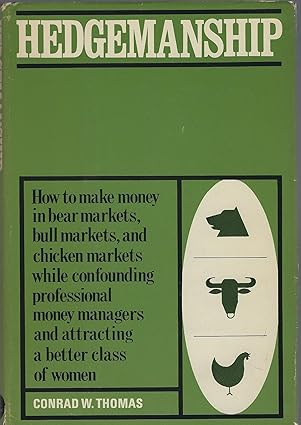
Hedgemanship provides an account of the rise in popularity of hedge funds in the 1960s. The early success of Alfred Winslow Jones, the basic hedge fund philosophy, and the losses in the 1969 bear market are covered.
The Notes
- Published in 1970.
- “What characterizes a chicken market is that no one knows where it is going. It might be holding fairly still (roosting, one might say), jumping up and down in about the same spot, edging sideways, or simply about to run off unpredictably in any direction… The chicken market is — and always has been — the type of market which prevails most of the time. This is particularly true for the shorter term, and it applies even more specifically to any trading day which an investment decision must be made — a decision which calls for projecting the current market into the future.”
- “Bear markets and bull markets, especially as to duration, are usually identified only after they have ended… Retrospective market identification, or 20/20 hindsight, is of little value in the buy or sell decision-making process; all that really matters is what will happen in the future. Even the most sustained bull and bear markets will reach an end in the course of a single trading day. Every day brings the same question: Is today that day? Oddly enough, investor opinion on this important matter is about evenly divided. Every day the number of shares bought exactly equals the number of shares sold.”
- Alfred Winslow Jones
- Ran what is believed to be the first “hedge fund.”
- His performance was made public in a 1966 Fortune article, “The Jones Nobody Keeps Up With” written by Carol Loomis.
- Jones was running his fund for 17 years before the article was published.
- The 5-year period up to the article, his fund earned 325%. The leading mutual fund over that period, Fidelity Trend, earned 225%.
- The 10-year period, his fund earned 670%. The leading mutual fund over the period, Dreyfus Fund earned 358%.
- His returns for both periods is after fees.
- About 60 investors in Jones’ two funds in 1966, with average share of $460,000.
- “Our market judgment really hasn’t been good in the last few years, but our stock selections have made up for it.” — A.W. Jones
- He had a tendency, incorrectly, to gradually increase his short positions as a bull market went higher and hurt his returns.
- Half of the trading commissions Jones produced went to the brokerage executing the orders. The other half went to other brokers for investment research and ideas. They paid for “instant access to information for Street sources.”
- Prior to 1966, his only losing year was 1962. His fund saw gains in 1967 and ’68. Big losses came in 1969. The two funds were down 30% and 40% by October 1, 1969.
- Jones cut back on his short positions in 1969. He admitted to being caught up in the market euphoria.
- Early Hedge Fund History
- Only a handful of private hedge funds existed in 1966: A. W. Jones ran two, two of Jone’s associates left to start their own (City Associates and Fairfield Partners (run by Barton Biggs)), Fleschner Becker Associates, John Hartwell ran three funds, and a few others run by family operations and other brokerages.
- Public hedge funds for the masses:
- Hubshman Fund was the first open-ended mutual fund approved by the SEC that used “hedge fund techniques.” It started in November 1966.
- Harwell & Campbell Fund, Blair Fund, and Heritage Fund came in 1967.
- Hedge Fund of America was started in 1968 and was “the first nationwide fund to capitalize on the hedging concept in a big way.” — NY Times
- Competitive Associates was started in March 1968.
- Berger-Kent Special Fund, Tudor Hedge Fund, Dreyfus Leverage Fund, and more arrived in 1969.
- Private hedge funds grew at a faster rate than the public versions. The number doubled in 1967, was 5x in 1968, and over 300 in 1969 with between $1 and $2 billion in assets.
- “I think it’s the result of the performance cult. A lot of wealthy people suddenly discovered that their money was being managed very poorly by banks and old-line advisors.” — Barton Biggs
- 1969 American Stock Exchange study showed that 158 officers and 80 firms out of its 580 member firms participated in 125 funds. A 90% overlap between NYSE member firms and American Stock Exchange firms existed.
- Most early hedge funds had no research staff. Investment research was outsourced.
- “By hedging our positions, what we’re really doing is using speculative techniques to conservative ends. What this really means is that we’re not gambling on the market.” — Barton Biggs
- “One big fallacy to hedge funds is that people think you can’t lose with them. Obviously you can. You can lose with a vengeance, and you can lose not only in a bad market but in a good market, too.” — Barton Biggs
- “One striking thing about many of the more aggressive fund operators is that they have no firsthand knowledge of the memorable sell-off of 1962. Many of today’s funds, in short, are dominated by 25-year-olds fresh out of Harvard Business School or the equivalent — bright, hard-working youngsters who are too new at the game to remember 1962, to say nothing of earlier market setbacks. One hedger, at 42, confessed: They make me feel like an old man.” —Dun’s Review
- 1969 Bear Market
- Hedge funds performed poorly, on average, during the 1969 bear market. The author blamed “misuse, ignorance, or abandonment” for the poor performance.
- “Some alleged hedge funds…have actually managed to turn in performances, failing even to match the Dow Jones Industrial Average in a bear market, where the odds are in their favor.”
- The Dow was down 14% through July. The average mutual fund was down 18%. Losses of 25% to 35% were common for private hedge funds. Public hedge funds saw losses ranging from 20% to 40%. Returns were worse, across the board, by the end of November.
- Many of the private funds closed in 1969 due redemptions because of poor performance.
- “Hedging is vastly overrated as a concept. People argue that there is psychological comfort in having a short position… I stopped believing it after we got bloody and beaten from short selling.” — John M. Hartwell
- Private Hedge Funds
- Consist of 1) general partners that manage the fund and 2) limited partners who are only investors.
- Fees at the time were upwards of 4 and 20. Up to 4% of assets managed and 20% of net gains.
- The fund of the 1960s were designed to avoid regulations common to mutual funds.
- Public Hedge Funds
- The early public funds attempted to run a similar strategy as private hedge funds but were limited by regulations.
- Most registered as open-ended investment management companies.
- Limitations via regulation or stated allocation limits upon registration set limits on leverage, short positions, options, warrants, and commodity futures.
- Most of the early funds had incentive-based compensation fees with a range of 1.5% to an upper limit as high as 4% of net assets.
- Front-end loads ranged from 7.5% to 8.75%, for funds that charged it. Not all did.
- At least one early fund charged a redemption fee.
- Hedge Fund Priniciples
- “A hedge fund is a private or public pool of investment capital which seeks to minimize risk by ‘hedging’ its long positions in some stocks by taking short positions in other stocks, and which usually pursues its goal of maximum capital appreciation by employing leverage to maximize performance.”
- A true hedge involves using securities from the same company like common stock and convertible preferred stock or convertible bonds. A true hedge might be long the convertible preferreds and short the common. It’s a type of arbitrage play.
- A hedge fund applies two concepts: the hedge or the ability to take long and short positions and leverage.
- The long/short positions moderate portfolio volatility.
- Leverage is more important in the potential of outperformance.
- The hedging in hedge funds cannot eliminate risk. It can reduce it or magnify it.
- The goal is to minimize risk by adjusting the percentage of longs and shorts with changes in market risk. The issue is selection and timing.
- In theory the ability to use leverage, stay fully invested, and adjust the funds long/short weighting allows it make money in any market environment and perform better than the typical mutual fund.
- Short Selling
- A bet that the price of a security will drop.
- For stock, shares are borrowed, sold in the market, with the intention of buying the shares back at a lower price. The difference between the price sold and the price bought (less commission and borrowing costs) is the profit or loss.
- The uptick rule no longer exists but it was enforced, after the 1929 crash, to limit the depressing effect of short selling on prices. The rule required shorts sales to only be made on the “uptick” or at least one-eighth of a point higher than the preceding transaction in the stock.
- The general view at the time with shorting was hedge funds were “lucky to break even on their short portfolios.” — Fortune
- Some managers viewed the short portfolio as a chance to be more aggressive on the long side.
- The risk of short selling is the stock rises. Unlimited losses are possible.
- “Twenty years ago it was believed that if the total short interest on the Big Board exceeded an average day’s sales, it would touch off a ‘short covering rally’ in which the short sellers would be massacred. Over the years since then, the short interest, expressed in terms of average daily sales, has increased to the point where it is nearing, and has even on occasion exceeded, twice the daily average, which itself has increased beyond Wall Street’s most sanguine projections.”
- At the time, over half of the total short interest was due to arbitrage trades.”
- Short sales are subject to margin requirements.
- Dividends payouts on borrowed stock for short positions are paid by the short seller to the burrower.
- “When there is great demand for the stock, the lender my even demand a premium. Stock for which a premium is required should be avoided by the short seller; if the supply is that tight, it indicates the danger of a ‘squeeze’ at the time of covering.”
- “As the short position gets greater in relation to the number of shares outstanding, the risk of a short-covering squeeze increases.”
- Short Selling Don’ts:
- “Lay off the volatile high-fliers while they’re flying, even if you know they’re overvalued on a fundamental basis.”
- The author defines “high-fliers” as highly volatile, high turnover stocks, high valuations ratios, and often high short interest.
- Avoid stocks with high short interest.
- Avoid stocks with small number of shares outstanding.
- Avoid stocks with low trading volume.
- Avoid take-over candidates (unless the take-over is doomed).
- Avoid large short position, relative to the portfolio, in a bull market.
- Short Selling Do’s:
- Look for stocks with a history or lower volatility or recent subdued volatility.
- Look for stocks with moderate daily volume. High-volume down days are okay.
- Stock should be trending down with no indication of a reversal in the fundamentals.
- Large number of shares outstanding, trading at high valuation, and overall market is falling.
- “It is not necessary to catch a stock near its high in order to make a good short sale.”
- “In sum, the gliders, or the shot-down high-fliers, are much preferable to the active high-fliers as short sale candidates. This is because there is some fundamental logic behind, some factual basis for, the behavior of the gliders, while there is literally no way to predict to what peaks emotional trading will push a popular stock, nor what the extent of wild gyrations will be for either the ascent or the descent which will follow.”
- Leverage
- Margin Loans
- Allow a fund or investors to buy a security for a fraction of the total cost.
- 1969 margin requirements allowed borrowing of 20% of the cost of a stock or an 80% margin requirement. It was 60% on bonds. Margin loans charged about 10%.
- The Fed set margin loan requirements.
- Options
- Options allow much higher amount of leverage and offer more risk control than margin.
- Calls
- Option to buy 100 shares of a stock at a specific price within a specific time period.
- Calls are bought with the expectation of a rise in the stock’s price. It’s a way to leverage a long position.
- Better to sell the call than exercise it.
- Calls expire worthless if the stock’s price is below the exercise the price at the end of the time period.
- Puts
- Option to sell 100 shares of a stock at a specific price within a specific time period.
- Puts are bought with the expectation of a fall in the stock’s price. It’s a way to leverage a short position.
- At the time of writing, over half of all options expired worthless.
- CBOT’s Option Exchange, the first market for listed options, opened in 1973.
- Wide price swings are required to produce large gains from options.
- “A straddle is really two options — a put and a call at the same strike price. A spread, like the straddle, is a combination of a put and a call, but the strike price for the put is below the current market, while that for the call is above it. A strip is in effect three options — two puts and one call. A strap is one put and two calls.”
- Warrants
- Option to buy yet to be issued stock for a specific price by an expiration date.
- The value of a warrant depends on the current market price of the stock, the conversion price of the warrant, and time.
- The warrant has no value if the market price of the stock is below the conversion price.
- Futures
- Futures, like options, allow for much higher leverage than margin.
- Commodity futures have daily limits on change in prices.
- 1969 Daily Price Limits
- Copper was 2 cents a pound or $1,000 a contract.
- Soybeans was $500 a contract.
- 1969 margin requirements on futures contracts allowed for massive leverage.
- One copper futures contract, for 50,000 lbs. of copper, could be bought for $1,500. Copper futures ranged from 66 cents to 75 cents a pound. Leverage of 2,200%.
- Soybeans allowed for 2,300% leverage.
- Pork bellies for 1,800% leverage.
- Wheat for 1,300% leverage.
- Silver for 900% leverage.
- “Over 70% of all commodity speculators are said to lose money, which indicate a high capability for misinterpretation of the available information.”
- Higher leverage equals more risk.
- Margin Loans
- “Risk” or Long/Short Ratio
- The author defines “risk” as the difference between long and short positions as a percentage of unleveraged capital.
- The author defines “velocity” as volatility: price volatility relative to standard measure like the S&P 500. Velocity is then used to determine the “risk” of the fund. So, beta.
- Of course, how fund managers measured volatility differed. Some used 5-year comparison. A.W. Jones used a 6-month comparison.
- “There is no inherent magic in merely being hedged. A hedge fund with a constant ‘risk,’…will perform better in some markets than an equally leveraged fund invested all long; in other markets it will perform worse. In the long run, such hedging takes away as much as it gives.”
- “The farther back any volatility measure goes, the less relevant it is.”
- Precision, to the hundredth decimal place, becomes pointless as the base-period grows.
- Risk
- “Risk is a two side coin; the other side is exposure to gain.”
- “Volatility is therefore not merely a measure of risk, but also of opportunity. Furthermore, neither risk nor opportunity are measured accurately or completely by any velocity or volatility factor, even if it could remain constant for a particular stock.”
- “Equally important is the price at which the stock is purchased. This factor can vary the risk and opportunity over a wide range, even though the volatility remains unchanged.”
- The author uses a Risk-Opportunity Factor score that measures the riskiness of a stock based on where its current price sits in relation to its 52-week high and low. The short version is that stocks trading above their 52-week average price are “riskier” than those trading below their average price. For shorts, it would be the reverse. The author admits its limitations and suggests using standard deviation and projected price i.e. value as other possibilities. The idea is to size positions based on riskiness.
- Stock Selection
- “The most important factor in hedge fund performance is stock selection and timing.”
- Value Line Investment Survey
- Started by Arnold Bernhard
- “By sticking to Bernhard’s principles, Value Line has been pretty consistently wrong about the stock market since the mid-Fifties.” — Forbes, October 1, 1969.
- Bernhard started two mutual funds in starting in 1950. Value Line Fund and Value Line Income Fund, based on his strategy, fell short of the hype. His Value Line Special Situations Fund dropped his strategy for the go-go ’60s trading frenzy and was a success until the 1969 bear market.
- “The talent for grasping the full dimension of an unfolding story is rarely found on the floor of the New York Stock Exchange or even in the ken of the most thorough industry specialist.” — Financial Analysts Journal
- “Many portfolio managers know little about their own decision-making process and even less about their methods of reviewing accounts.” — Financial Analysts Journal
- “We’ve tried very hard to find a service or a technique that is going to lead us into the promised land, but they always seem to let you down in the clutch. I think you just have to rely on your instincts, and your instincts are wrong a lot of the time.” — Barton Biggs
- “Fundamentals are still the most important determinants of price changes, especially over the longer term, even though sneak factors often creep in to frustrate the orderly realization of the soundest predictions. Nor has the law of supply and demand been repealed. Charts do provide a convenient summary of a stock’s history, and they can be useful if deification of the trickier nuances is avoided, and if it is remembered that stock charts are no more ‘technical’ than charts of fevers or emotions — which in fact they are.”
- “Trends must end, it is true, but the law of inertia hasn’t been repealed either; even the most pure fundamentalist might help his timing by glancing, however surreptitiously, at a stock chart.”
- “We’ve made our big money from basic trends.” — Barton Biggs
- Lemming Syndrome – blindly following the crowd into an investment after it went up a lot in the hopes of repeating the performance but instead at the worst possible time, and only to sell after it goes down a lot like everyone else who piled in too late.
- “Financial genius consists almost entirely of a well-developed capacity for self-delusion combined with a rising market.” — John Kenneth Galbraith, Harper’s
- “Accepting a loss takes courage, because we must admit that we have been fools… But human nature being what it is, we find it easier to procrastinate, in the hope that a reversal will vindicate our ordinarily flawless judgment. A turnaround may come, but it is more likely that the slide will go on, and on, and on.”
- “We offer — as a sell signal on your good actors — the Euphoria Index: When you feel so good about a stock that you don’t know how you could feel any better, you couldn’t. Sell!”
- Requires a healthy dose of skepticism.
- “In both prospectuses and annual reports, some of the most interesting facts can be found in the footnotes. As a general rule, the magnitude of the bad news varies inversely with the size of the print, and directly with the compounding of negatives.”
- “Every fund manager, and indeed every investor, has the same problem: how to determine what the trend is, how long it will last, how to recognize a reversal when it occurs, and what action to take on specific stocks.”
- “A common stock should never be bought without first checking if a bond convertible into the stock is available.”
- “Markets go up; markets go down. You needn’t go back as far as 1929, with Mr. Galbraith, to know that markets go down. You know markets go down if you reached an age of awareness before 1962, or even 1966… Not only do markets go down, but the prices of individual stocks go down, often even in upside markets.”
- “Reading can go far toward helping the individual investor shape his personal investment philosophy — different for each but a must for all.”
- “In the financial sense, risk is uncertainty as it relates to capital investments, and applies to receipt of income as well as return of principal.”
- “No matter what the direction of the stock market may be, millions of shares change hands every trading day, and there is a buyer for every seller — which would seem to indicate that at least half the people are confused all the time.”
- “Many of the indexes are not lacking in charm, or even a certain utility. The trouble is, they’re not really very reliable guides for decision making in the stock market.”
- “Size can detract somewhat from maneuverability (although fund managers show a tendency to revise upward their ideas on maneuverability limits as their own funds increase in size.”
Buy the Book: Print