
 Buy the Book: eBook
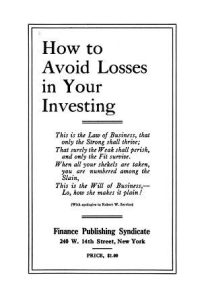
The book, published in 1920, shows how little human nature changes in markets, especially around speculation, gambling, and greed. It also offers historical context on how markets operated pre-SEC and warns about the dangers of widespread leverage that led to the 1919 to 1921 crash and the 1929 bubble and bust a decade later.
The Notes
- “It can safely be said that under ordinary conditions all stocks listed on these exchanges have behind them real intrinsic values somewhat in proportion to the prices at which they are quoted. It is frequently the case that, due to manipulation or a public de- mand that does not take into consideration their just values, many of these stocks sell at times for prices much in excess of what they are worth, but, on the other hand, it is no uncommon thing to find stocks whose prices are considerably below what their assets and earning powers should call for. “
- “In the past many and flagrant were the abuses to which the investing public was subjected by the manipulations possible under the rules governing trading. Stocks were skyrocketed to abnormal prices or, on the other hand, were depressed to figures so low as to be ridiculous. These manipulations generally resulted in the public buying at the inflated values or selling for less than their holdings were really worth.”
- “It is somewhat surprising that such a large institution, having such intimate relations with the public through its members who handle the public’s property, should not be in some way under the jurisdiction of special national laws.”
- 1919 Market
- A year after the end of WWI
- 1919 – margin loans hit a record high between $1.5 and $1.7 billion.
- The crash began in November 1919, fell almost 50%, and bottomed in August 1921 — coinciding with the 1920-1921 depression.
- “In this downward plunge of stock values thousands upon thousands of small traders on margin throughout the land lost heavily. The stock market had for some time been advancing by leaps and bounds and the public, blind as an avalanche coming down the side of a mountain, was rushing forward in its market speculation at a rate that was both dangerous and foolish.”
- “As long as the stock exchange call loans retain their prominence as secondary reserves of too many banks and as long as stock exchange demands fix the call loan rate in the largest money centre of the world, we shall not enjoy a complete and perfect banking system.” — Paul Warburg, December 1919
- “Our bill market should be protected from the daily unsettlement caused by the increasing and decreasing demands of the Stock Exchange. The call money market ought to be based primarily on prime bills that can quickly be turned into cash balances, while the bulk of undigested stocks and bonds ought to be carried by time loans rather than call loans. As a matter of fact, many of these call loans are callable only in name, and inasmuch as they are carried by loans that are actually subject to call, they are a source of unrest and danger.” — Paul Warburg, December 1919
- “In the face of rising prices for money a decline in all stocks may be said to be inevitable.”
- “The high rates for call money which have prevailed continuously for the last two weeks, and intermittently for several months past, were in themselves very clear indication of the strained position into which the unabridged speculation had thrown the stock market and rendered a readjustment inevitable.” — William P.G. Harding, Governor of the Federal Reserve Board
- Margin loans (call loans) were a big part of the lending business for banking, especially rural banks between harvest and planting seasons. Rural banks sent money to big city banks, which lent to brokerages for margin loans. When banks called in loans, forced selling occurred and stock prices dropped. Margin loans, used to speculate in markets, were the flaw in the system. The tightening of margin requirements led to instability and crashes.
- Market manipulation was legal at the time i.e. trading pools, naked short selling, etc.
- Bucketshops
- Bucketshops, before being banned, acted more like a gambling parlor than a brokerage. It allowed people to bet on the direction of stock prices. No shares were traded.
- “Do you know what bucketing orders is? Do you know that it is taking your orders and money for the purchase of stocks, not filling, i.e., not buying them, and trusting, if you are one of the rare, lucky ones who is later in a position to demand their delivery, that they can be bought for less than you paid for them? Do you know this is illegal?”
- “In bucketing no one benefited except the broker.”
- New York Curb Market
- The Curb Market was a loosely organized market — relegated to new and speculative issues not traded on the NYSE — where shares traded outside on the street (the curb). It later was taken indoors and became the AMEX.
- “So scandalous during the past two years were many of the oil-promotions, whose stocks were traded in on the New York Curb, that pressure was brought to bear on the brokers, urging them to investigate carefully any issues traded in. The harvest was so great that the number of traders or brokers in the open market on Broad Street, New York, where the New York Curb Association does business, increased by hundreds and all kinds of wildcat stocks were sold and bought and are now held by the public at great loss to the investors.”
- Margin Loans
- Stocks could be bought for 10% down, borrowing 90% at the time. Margin loans amplified gains and losses.
- “Is the volume of business in the actual purchase of stocks for permanent investment, or the sale of securities to secure funds for other enterprises, so great? Whilst, undoubtedly, transactions for these purposes are large, there is another factor that must be taken into consideration, and that is the enormous buying and selling on margin.”
- “Buying and selling on margin is well recognized in most cases as nothing more nor less than speculating.”
- The author insinuates that brokers/banks out to enrich themselves push customers to buy stocks on margin knowing that any significant decline leads to forced selling, where the broker/banks can buy shares at reduced prices.
- “The financial leaders who have the power can, if they be so inclined, avail themselves of their forehanded knowledge of the coming high price of money to make large profits by selling short in the market (i.e., speculating on a decline in prices of stocks), and, when securities have declined sufficiently, buy them in at the lowered prices and hold them for the next rise in prices when they can be resold to the public.”
- “Much of the money deposited in the banks all over the United States finds its way at certain seasons to New York, or, as they say in the west and in the farming districts, to ” Wall Street.” New York is the great financial centre and clearing house of the country. Your banker may be paying you 2, 3 or even 4 percent on your deposits. When he lends the money in his bank to New York it is, of course, for a higher rate of interest. The New York banker must, of course, secure a still higher rate. Millions of this money from your banks is used to finance loans made to brokers on stocks, cotton, etc., bought by the public on margin. The same thing applies to Chicago where the great trading in food products is carried on.”
- “Marginal speculation in food commodities by those whose only desire is to make a profit on the increase or decrease in the market quotations is apt to create false price conditions not at all beneficial to the users of these foods.”
- The Right Kind of Brokers
- “Webster defines a broker as “One who buys and sells for others, especially, stocks and securities.” The broker who honestly fulfills the functions of his calling, keeping in mind always the best interests of his customers, is a requisite and valuable member of the business community.”
- “The broker whose pride it is to attend to your business, protecting you always in so far as he can, and never suggesting that you do that which he would not do himself. He is the conservative, safe, upright type… He is not swamping you with letters making all kinds of suggestions which he would have you believe would be to your advantage if acted on through him.”
- “If you buy securities, or if you must speculate, choose the broker who wants to help you make good, who would sooner not earn his commissions on your transactions than see you lose money. This kind of broker wants your investment business, but he does not want it for a few months or a year, he wants it permanently because of your satisfaction with his services.”
- The Wrong Kind of Broker
- “There are many others, and the woods (I mean the cities) are full of them, who, availing themselves of a profound insight into human nature, exploit the weaknesses of their customers, the public, to their, the brokers ‘ own advantage. These men are in business exclusively to make money for themselves, no matter who loses. The lists of their customers are constantly changing because the basic principle of serving the customers’ best interests is not adhered to. The constant loss of clients does not worry them. They know how to get more. They know the speculative blood is rampant in mankind, and that there is an unending flow of people ever ready, hopeful of making easy and quick money. Long experience has taught them that the average stock speculator in the long run almost always loses.”
- “Occasionally the broker is right, more often he is wrong. In either event it is immaterial to him provided the customer buys on margin. Why? The broker knows the great mass of the public that dabbles in stocks always buys on the assumption that the market will advance, and he knows, furthermore, that no matter how great the advance there is always a decline coming.”
- “The broker knows that very, very few have the qualifications necessary to be a successful stock speculator. Many brokers have proven this to their loss and sorrow.”
- “The speculators who, staying in the game, have made money in stock speculation, due to the profound knowledge and experience and advice from the better class of brokers, are small in number, but the losers, their number is legion.”
- “The wrong kind of broker wants you to attend to his business. He is a very clever individual… His advertising is as varied in kind as he is. Some of it is rank get-rich stuff, and some of it is, on the surface, essentially conservative in character. The latter is the really clever advertising.”
- “The object of his organization is business and new business to replace the lost and dead, and he gets it. You will receive pamphlets and booklets showing you how to trade in stocks and the profits you should make, but you seldom or ever make them in the long run. He knows the trend of your mind, and he has you on his list to attend to his business, to exploit you to the limit you will stand for his particular profit.”
- “His main object is to convince the customer of the possibilities of great profit in margin trading, and behind the mass of literature and correspondence he sends is that one undeviating purpose.”
- “The broker rather likes in the beginning to see the account of a new customer show a profit on his books. It appears so easy to the customer that orders for more stocks are generally forthcoming. He is encouraged to send all the cash he can…”
- “The financial world has many “Fishers of men” of the wrong kind — “Fishers of men” who make it their business to get as many as possible in their carefully placed nets, not with the object of doing good but to relieve them of their money, and, when they have cleaned – out and skinned their catch, throw them back into the sea of despair.”
- The Speculator
- “The speculator, on the contrary, is not interested in buying and holding his purchases; he is only interested in the variations in prices. In other words, he gambles on the rise (generally the rise) or fall on the public market in the value of stocks.”
- “What does the ordinary speculator know about the stocks he is buying on margin or outright? In reality, practically nothing, except what the broker tells him. What does the average broker or the customer know about the future trend of the market? Nothing, but the customer believes the broker does, and he swallows the broker’s suggestions…”
- “The thinking processes of the speculating customer are peculiar. He is almost invariably on the long side of the market. His idea seems fixed that the market price of stock is bound to increase. For him, there is no top to the market. He is more likely to buy or increase his holdings after a big advance, and when the crest is being reached he is then buying in greater volume than ever. When the break comes he is surprised, and if he is carrying his stocks on margin puts up as long as he can, but when the decline is severe or continues long enough he inevitably comes out on the debit side of the ledger.”
- “On a big recession in the market, the majority of the margin traders is caught short. He rarely learns after repeated losses that he cannot beat this angle of the game, being upheld by the same foolish optimism of the player who frequents a Monte Carlo.”
- “When the crest of the market is passed and the decline takes place he finds himself long an amount of stock he never would have thought of taking on at one time. If he has followed his broker’s suggestions he also finds that he has little or no excess margin when the inevitable break in prices comes and, with it, the call for more money to properly margin his account. Sometimes, if the break in prices is great enough, he is wiped out entirely. Generally speaking, if he only knew it, that might be the best thing that could happen to him. His losses would stop right there. Unfortunately for the customer he may not be wiped out, and encouraged by the broker’s statement that the market is only suffering from a temporary setback, he sends the funds needed.”
- “The market is like the tides of the sea. When it has reached the full it goes to the ebb with recurrences of seeming strength apparently indicating another upturn. During the ebb in prices the customer is almost certain to forward money to the broker as long as he can, hoping each remittance is the last. His ready cash gone he gives instructions to sell part of his stocks and keeps this up to the last, or nearly the last, in which event he may find himself in possession of a few shares of stock that have cost him very dear indeed.”
- “In every rise in the market an occasional speculator sells out at a profit before it is too late, but, having made money once that way, he is sure to go back again and in time he is caught with losses he can ill afford.”
- “Scant reference is made about those who have lost their all or more than they could afford in that most seductive form of gambling, ” speculation on margin in stocks, securities, cotton, wheat, corn, etc.,” and in this exists an evil as great as, or greater than, those which have been declared illegal. Millions of dollars are risked daily on the vagaries of the markets. At every great drop in prices thousands are seriously crippled financially or ruined because of the gambler’s inability to be satisfied with a fair profit.”
- “For the many of the margin speculators it is not a two-sided affair, it is one-sided — a losing affair.”
- “It is inherent in man to speculate and to gamble.”
- “When people wish to speculate with the hope of unusual gain they should do so in some such direction as the purchase of stocks in development ventures having for their object the manufacture of a new product or the exploitation and utilization of natural resources which the reports of experts indicate have favorable chances of becoming profitable. Although such speculation is slower, it is surer in its results and is justifiable because, when successful development brings gain, there is the secondary satisfaction of having helped to create new wealth from which the country benefits .”
- “It is well recognized among financiers and brokers that the public always carries the bag. Many of these shrewd, far-seeing financiers, with their great means, always avail themselves of the margin method of speculation to reap great profits from the downward and upward swings of the markets. Having a real knowledge of the intrinsic values of securities, they buy when market values decline. Having ample means at their disposal, and not being so subject to the suggestions of brokers to margin up to the limit, they are prepared to carry their holdings over long periods. The result is that when the market reaches the top and the public is buying like mad ( on margin ) they unload on the unsophisticated and smile grimly. The man with a few hundreds or thousands has no chance in this game.”
- “The advice of leaders of finance to the people never to take risks would, carried to its logical conclusion, keep wage-earners always wage-earners, because no new business would ever be opened up, no new enterprises started, except by those who have more than they need, and wealth would corral all the opportunities from which it would reap the greater profits, and then let the less fortunate buy the securities when they have been boiled down to a 5 or a 6 percent basis.”
- “Despite all that may be said to the contrary, the acquisition of wealth is, more often than not, accompanied by the element of risk. If the wealthy men of the country ( except those who inherited it ) were to tell the exact truth in connection with the accumulation of their wealth it would probably be found that there were times when they took the risks, and big ones they could not afford, which they now advise others against.”
- Conclusions
- “Speculation in stocks on margin is risky.”
- “Experience has proven that the percentage is greatly against the speculator.”
- “The percentage increases rapidly against the speculator when he listens to the broker and applies his excess margins to the purchase of additional stocks.”
- “No one, not even the wisest, ever knows the future trend of the market. In speculating on margin the speculator is staking his money, more often than not, against an absolute uncertainty.”
- “The community does not benefit by such stock speculation on margin. It is in no way productive.”
- “If you can afford it, the investment, by outright purchase and ample margining of stocks in legitimate development enterprises, will, if development is successful, benefit you and the community because of its production. “
Buy the Book: eBook