
Buy the Book: eBook
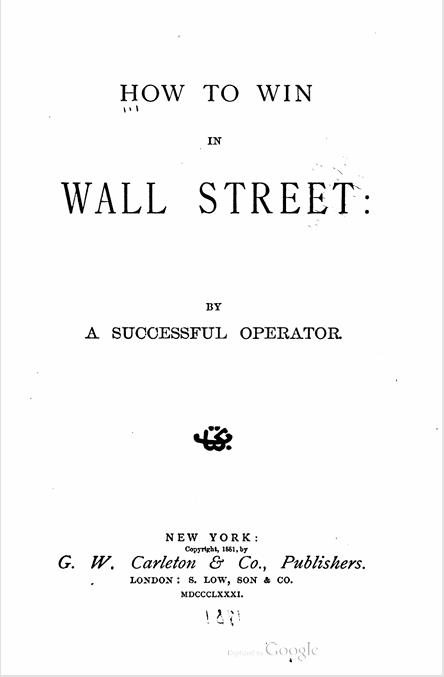
Published in 1881, How to Win in Wall Street offers some historical context around U.S. financial markets, and the enduring role human nature plays within it, alongside timeless investing wisdom.
The Notes
- “Long observation has shown me how utterly uncertain is all speculation in the great money centers of the earth, and I hesitate to say that this or that is the infallible rule, or road to fortune.”
- “Sometimes a very ignorant man will gain great wealth in speculation in defiance of all rules. And again, a man of vast experience, deliberate judgment and close observance of the accepted rules of the ‘street’ will steadily lose, until a fortune will slip away.”
- “While it is to be admitted that a man may for a time make money by chance there, I assert that the tenure of all men who depend solely on ‘luck’ in Wall Street is only for a season. And yet there are many, thousands, who enter into speculations there dependent solely on the chapter of accidents to pull them through. Those are ‘Lambs,’ and it is on these that the Lions thrive and fatten.”
- “‘Fortune favors the brave,’ is an old and a true adage. But fortune abhors a fool, no matter how brave he may be.”
- “Man is a born gambler. Man loves adventure — peril.”
- Short Selling
- “A worthless thing ought to be sold. There is much more money in that than anything else, if you hit it right. But it is much more risky. For if its friends have been able to lift it up in the face of the shrewd men there, thus high, may they not be able to take it away up out of your reach?”
- “It seems to me it is not a magnificent nature that takes the ‘bear’ side and bets on the fall of a property, or the misfortunes of the country.”
- “It is well to consider how many things favor the ‘short’ side.”
- “The ‘bear’ must necessarily be a sore-headed, sour-natured creature, who doubts and disbelieves everything, and waits for and even desires disaster, that he may profit by the fall of others.”
- “What to buy? Or more properly, I should have asked, what to not buy?”
- “Under the loose and unregarded law of this country a stock company can, and often does, no doubt, sell bonds and pay a dividend that never has been and never will be earned. The purpose is, of course, apparent. But the poor, heedless little lamb, for whom the snare was laid, counts it ‘a dividend-paying stock,’ and, to the extent of his hard-earned and limited means, buys it, simply because it seems cheap. For my part, I had rather a great deal buy the stock of a company that never pays a dividend than that which pays out money it has not earned. Beware of such traps.”
- “I would warn my readers to beware of ‘strange gods.’ It is in the nature of man to prefer new ventures. Only consider the ‘South Sea Bubble,’ where hundreds of thousands were invested without the remotest possibility of any profit or return! The same disposition to speculate in property located remote regions attracts us all to this day, as of old. ‘The eyes of the fool,’ said Solomon, ‘are in the ends of the earth.’”
- “Make no haste about buying. These stocks are going to stay there. They will not leave town. They will remain, my friend, and be bought and sold, cursed, blessed, wept and wailed over, when you and I and all of today are in the dust. So take your time and wait till you are perfectly certain that they are low, and are about as low as they are likely to go for the next half year.”
- “Lay this to your heart as one of your chief rules of action, that if you do not buy your stocks cheap you better not buy them at all.”
- “The annihilation of that unfortunate being who clings on to the string, and must either buy or sell every day, is only a question of time. His only safety lies in shutting up at once and leaving Wall Street forever, or at least till he can learn to wait his opportunities.”
- “For my part, I always despise money made in Wall Street by accident or by ignorance. I like to lay my plans of battle, fight it out according to discipline and tactics, take my time and win my victory as a general wins a campaign.”
- “It is not the thing to do to remain in Wall Street if you wish to trade successfully and like a gentleman on a small fortune. To see and comprehend the market and the movements of Wall Street you must always stand off at a distance.”
- “The eternal jabber of that idiot at your elbow, the death-rattle of the ‘tape man,’ the impecunious gentleman with ‘points’ — all these bother and confuse you or drive you into a state of semi-insanity, where you in all probability will either buy or sell or do something for which you will despise yourself the very next moment.”
- “A man who hopes to make money in stocks cannot afford to be either a fool or an ignoramus.”
- “There may yet be another terrible battle between the bulls and the bears, and the bulls may be beaten again. You may have gone in too soon after all your waiting. But now that you are in you are in to stay. It may look to you as if stocks never again will rally. All your friends are demoralized. They are quietly throwing their stocks overboard… Hold on to every share. Do not lose one dollar. The darkest hour is just before dawn.”
- “For me it is more difficult to decide when to sell than when to buy. In a growing land like this, when the country takes two steps forward and then one back, and then perhaps three forward, it is not so hard to say when stocks are low as it is to determine when they are high.”
- The author uses a simple valuation model, as an example, by asking what a stock’s dividend yield should be relative to similar companies and interest rates. Then solves for price.
- “I repeat, it takes as much thought, coolness and care to know when to sell as to know when to buy, in almost every case, and often a great deal more.”
- “There is a general belief among young dealers, that if a man can only get the ear and advice of one of the few great speculators in Wall Street, his fortune is as good as made. This is a great mistake. Not that the great man would deceive you, but his advice or opinion is almost always unsuited to either your nerves or your fortune.”
- “I would not advise a speculator to seek or even accept the advice of any great — not even the greatest — operator in the street. In the first place, he doesn’t know half the time what is going to happen.”
- “You must have opinions of your own, and act on them too. If you are not prepared to do this do not enter Wall Street.”
- “When you propose to sell, as when you propose to buy, study. Read, and understand your business, and do not imagine your time wasted either.”
- General Rules:
- “Go into Wall Street only about twice a year; once to buy and once to sell. For the man who goes there and holds on to and gets tangled up in the tape is like a fly in a spider’s web.”
- “Buy only after a great decline when the last little lamb has fled, and when the press and every friend you have are generously volunteering the opinion that the market is going all to pieces. In fact, before buying, you ought to begin to feel yourself that the bottom has dropped out.”
- “Beware of advisers who are forever seeing disaster ahead. Never, for this year at least, let anyone persuade you to trade on the short side. It is a bad plan at best to sell another man’s property. He probably knows better what it is worth than you do.”
- “Never be in haste to buy. Take your time. Stocks are not going to leave town. And never buy without ample margin. But, being once in, ‘stay!’”
- “Buy nothing without first making yourself acquainted with what you propose to purchase. Property that is not open to the ready inspection of all is the best property in the world to let alone.”
- “Beware of impecunious gentlemen who are full of ‘points.’ Your mental answer to such should always be, ‘Physician, heal thyself.’”
- “Never, under any circumstances, permit yourself to be set astraddle of the market. It is said to be a pretty safe position, but to my mind it is the position of a coward or a fool. It is hardly possible for you to make, and you will surely lose your commissions and your interest.”
- “Never talk about stocks. Mr. Jay Gould is accredited with saying, ‘I cannot afford to talk stocks much, for I sometimes have to think.’ As a rule, the world over, no man who talks much ever thinks much. And then there are nobler things for a gentleman to talk about than stocks, if talk he must. So keep your stock opinions to yourself and pool the opinions of others.”
- “And, finally, believe largely in your own convictions. Have your own opinions and follow them. Have your rules and obey them, as a general obeys the tactics of war. And then if you make money you make it yourself and can do it again; and if you lose it, why, you at least lose it scientifically.”
- “The fluctuations in Wall Street are frequently violent, and a broker who buys on narrow margins for you is doing the same for many others, and he is not the safest man by a great deal.”
- “If you are too poor to put up a liberal margin, you are too poor to afford the luxury of risking money for amusement, and you have little business in the street.”
- “Even in the strongest market, on a solid recovery, there are some reverses, and you will think that the whole thing is going to pieces.”
- “The lamb, in short, has this one quality of the sheep, that proves his relationship – he must go with the flock. If stocks are going high, he jumps on to the highest point, like a billy goat, and is left there, exposed to the public gaze. If stocks are going down fearfully low, he must here, also, go with the masses, and throws his holdings over at about the lowest figures.”
- “There is no more mystery about buying or selling, making money or losing it, in Wall Street, than there is in making or losing money in the thousand and one mercantile ways throughout the world. And in truth there is a deal less of it. The vast difference is in the rapidity with which it is lost or won.”
- “The Wall Street man bears his bad luck quietly. He is not at all anxious to tell you that he has made a fool of himself. And so it is, that while you do now and then hear of a man who went into Wall Street solely on his ‘luck,’ and came out a big man, you hear nothing of the many who went in on the same principle, and came out with nothing but experience.”
- “Don’t believe in luck in Wall Street. But do believe in sense, solid, pure sense, knowledge, coolness and courage, and you will win the money which the lamb who believes in luck must lose.”
- “It is the man who gets frightened in Wall Street who loses his money; you are not that man.”
- “It is these fluctuations that make the New York market the most desirable in the world for the speculator. The certainty that they will come, the certainty that the pendulum will swing far to the right, and then just as far to the left, perhaps, and so on perpetually, year after year. You see the vast possibilities it gives any man with a little money, courage and common sense.”
- “This vigorous and all expressive word ‘boom’ is the only one that could fully express the floodtide of a sudden rise of stocks in Wall Street.”
- “Such sudden and violent advances, unless they come upon the heels of some sudden collapse that had no reason in it, are always unlasting, and must be followed by reactions that possibly may drag the market down to the verge of a panic.”
- “As a ‘bear’ market is subject to a succession of ‘raids,’ each of which leaves the market, at its last reaction, a little lower than before, so is a ‘bull’ market liable to have many little ‘booms’ before it reaches its best figures. It is noticeable, however, that the strongest and the biggest ‘boom’ occurs last.”
- “Sit still and take your punishment. This is what you have to do oftentimes, if you hope to be one of the very few successful speculators in Wall Street. It is much easier to run, to sell, buy, hedge — do anything in the world, rather than sit still and make no sign.”
- “There is no denying the thrill of delight that runs through you, as you take hold of the tape and see your shares climbing right up an eighth, a quarter, and a half, at every click of the indicator. It is not the money which is in it altogether that so delights you. Of course, the money is not to be despised; nor should you affect to despise it; but it is the compliment to your judgment which pleases you really more than the money.”
- “And one gets very brave by degrees when the market goes in his favor, too! He begins to feel perfectly confident he can make all the money he wants at this speculating in Wall Street.”
Buy the Book: eBook