
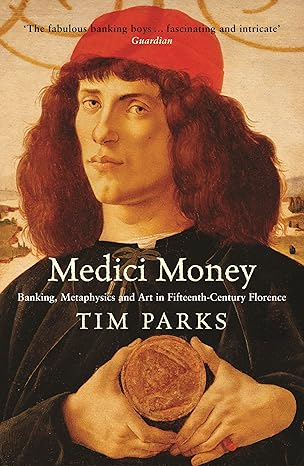
Medici Money chronicles the the history of the Medici Bank, from its founding to its complex structure, the wealth and power that came with it, and its ultimate demise, in a world where usury was sinful.
The Notes
- The Medici bank timeline lasts five generations but less than 100 years: 1397 to 1494.
- The bank came after the invention of double-entry bookkeeping, the bill of exchange, letter of credit, and the deposit account.
- It followed larger bank collapses – the Bardi and Peruzzi banks in the 13th and 14th centuries. Both banks failed due to concentrated loans to kings that couldn’t pay it back.
- The bank followed the great plague of 1348 that killed 1/3 of the European population. Florence had 95,000 people in 1338 and only 40,000 in 1427 (about the same as London).
- “They fell ill daily in their thousands. Many dropped dead in the open streets… Such was the multitude of corpses that there was not sufficient consecrated ground for them to be buried in.” — Boccaccio
- Slavery was made legal in the late 1300s because the plague wiped out the working population.
- Usury
- Usury was considered a sin by the Catholic Church at the time.
- The Lateran Church Council of 1179 denied a Christian burial to usurers.
- The General Council of Rome in 1274 confirmed the ruling.
- Wealthy men would often set aside money, at their death, to pay full restitution to atone for sinful gains.
- Dante placed usurers in the 7th circle of hell with sodomites and blasphemers.
- Usury was seen as unnatural. It allowed money to grow with no effort, without “toil.”
- Bankers, of the time, were also merchants and traders.
- Instead of charging interest on a loan, the bank increased the price of goods sold to the borrower at a rate equal to the interest it would have charged.
- Instead of paying interest on deposited money, it offers a “gift.” The deposit is discretionary: 1) discreet (secret), 2) interest (gift) is at the discretion of the banker), and 3) it’s not contractual.
- Some theologians of the time view the fact that since there is no certain gain, it’s not usury. Not everyone agrees.
- Dry exchanges were banned in Florence as usury in 1429 (the law was revoked in 1435). A dry exchange was an attempt to exchange one currency for another but instead of repaying in the foreign currency, took out a second exchange, a reverse of the first, doubling the payment period and avoiding the currency exchange altogether. It was a loan to theologians.
- Italy
- Italy was made up of city states.
- The five major areas: Naples, Rome and Papal States, Florence, Milan, and Venice.
- In major cities, like Florence, powerful families built towers to defend themselves against each other. Florence had about 100 towers in 1200.
- “Until the mid-1450s…the reader can take it that Florence is always at war, and that these wars have fewer consequences for most people than almost any other war we are used to thinking of.”
- “One cannot affirm it to be peace where principalities frequently attack one another with arms; yet they cannot be called wars in which men are not killed, cities are not sacked, principalities are not destroyed, for these wars came to such weakness that they were begun without fear, carried on without danger, and ended without loss.” — Machiavelli
- The wars required funds, which is where the Medici and other big banks came in. Most wars were fought with condottieri (hired mercenaries). The condottieri were incentivized to not finish the job. They were paid win or lose.
- “Enemies were despoiled, but then neither detained nor killed so that the conquered only put off attacking the conqueror again until such time as whoever was leading them could refurbish them with arms and horses.” –Machiavelli
- “Florence worked like this: To prevent anyone from ever becoming a tyrant, a new government of eight priors plus one gonfaloniere della giustizia was elected every two months. To prevent divisive election campaigns on party lines, the names of possible priors—men who met certain restrictive financial and family criteria—were written on tags and placed in a series of leather bags representing different quarters of the town and different guilds. Then nine names were selected at random, two priors for each of the four quarters of town, six from the seven richer guilds, two from the fourteen artisans’ guilds, and one man, always from the richer guilds, to be gonfaloniere della giustizia, the head of government. That is, in order that no single man might rule, everyone must rule, or at least everyone in the wealthiest classes, but briefly. It was an idealistic solution but hardly practical when it came to deciding policies for the long term.”
- “The key to unity in Italy is always the presence of a common enemy.”
- May 1453 – the Ottomans capture Constantinople. Italy was united in a “Most Holy League” against the Ottomans.
- Catholic Church
- The Church demanded tributes from all over Christendom. It pulled in money from all of Europe. Excommunication was punishment for late payment.
- Newly appointed Cardinals, Bishops, or Abbots would pay their first year’s income to Rome.
- Travelers to Rome could stop at a bank in London, Cologne, or Bruges, buy a letter of credit, travel to Rome, and cash it in at a Rome bank. An exchange rate and service fee is applied, but robbery becomes less likely.
- Rome was an economic anomaly. The Church was the largest international economic entity. It created a trade imbalance. It takes in far more money than pays out for goods.
- Bankers, essentially, “balance the books.” Bankers act as merchants, and mostly solve the problem with triangular movements.
- The Florentine bank in London takes in papal tributes.
- Florence buys raw wool from English sheep farmers.
- The Florentine bank pays the sheep farmers with funds from papal tributes.
- The raw wool is cleaned and weaved in finished cloth in Florence and sent to Rome to be sold.
- The Florentine bank in Rome collects funds from the sale of wool cloth and recovers money paid out by the London Branch.
- When a bank loaned money to the Church, instead of charging interest on the loan, it increased the price of goods it sold to the Church in the amount equal to the interest it would have charged.
- Exchangers’ Guild
- “Italian banco (later banca): a bench, table, or board, something to write on, to count over, to divide two people engaged in a transaction.”
- The guild held strict rules. Everything must be written down, in front of the client, in Roman numerals and in columns.
- Any member that destroys or alters an account is expelled.
- Pawnbrokers can not be part of the guild but are fined collectively 2,000 florins per year. It covers tax and atonement for the “sin” of charging interest on a loan.
- Pawnbrokers were banned in Florence after 1437.
- Banche a minuto – were small local banks that sold jewels via installment payments, held deposits that paid an annual “gift” of 9% or 10%, and exchanged silver piccioli for gold florins.
- The Guild lists the maximum time for travel from one financial center to another, which is used to determine payment schedule for bills of exchange.
- Any guild member caught “trimming” coins is expelled immediately.
- Currency
- Silver piccioli and gold florins were two separate currencies.
- Piccioli could only be change into florins by a bank at the going exchange rate, plus a small commission.
- “The picciolo was the currency of the poor, the salary of the worker, the price of a piece of bread. Luxury goods, wholesaling, international trade, these were the exclusive realm of the golden florin. By law.”
- The piccioli was devalued over time.
- 1 lira de piccioli was 20 piccioli.
- In 1252: 1 florin = 1 lira de piccioli or 20 piccioli.
- In 1500: 1 florin = 7 lira de piccioli or 140 piccioli.
- The Merchants’ Guild and Clothmakers’ Guild earned in florins but paid salaries in piccioli. When profits were down, they encouraged the government (made up of businessmen) to lower the silver content in the piccioli, so it would take less florins to pay salaries in piccioli.
- Florins value:
- 50 florins bought a slave girl or mule.
- 10 florins paid a maid’s wages for a year.
- 35 florins paid rent for a small townhouse for a year.
- 1,000 florins built a palazzo.
- 1 lira de piccioli bought a barrel of wine.
- “The city’s many wool- and silkworkers were on piece rates and demand was not steady. In hard times, you might be better off as a slave at a rich man’s table.”
- Bankers invented an accounting currency so that prices and gifts could be calculated in fractions of florins.
- 1 lira a fiorino = 20/29ths of a florin.
- 1 soldi a fiorino = 1/20th of a lira a fiorino.
- 1 lira a fiorino = 1/12th of a denari a fiorino.
- 1 florin = 248 denari or 20 soldi.
- Sumptuary Laws
- Limited what people could spend money on, wear, show of their wealth, etc.
- “No meal with more than two courses for the common classes. No more than a certain number of guests at any given meal. No clothes with more than one color, unless you are a knight or his lady. Or a magistrate, perhaps. Or a doctor. No fine materials for children. No soft leather soles on your white linen socks. No fur collars. No buttons on women’s clothes except between wrist and elbow, and for maids, none at all. For maids, in fact, no fancy headdress and no high heels, just kerchief and clogs.”
- “If such and such a material was banned, then a new one was invented. As in the area of finance, repression proved a great stimulus for creativity, to the detriment of plain speech.”
- Officers of the Night – were fashion police appointed to walk the streets to check peoples — mainly women’s — clothes.
- “Envy was a weed best left unwatered.”
- The Medici Bank
- “The Medici were merchants as well as bankers. They would procure goods abroad for rich clients: tapestries, wall hangings, painted panels, chandeliers, manuscript books, silverware, jewels, slaves. They would speculate, buying shiploads of alum (for the textile business) or wool or spices or almonds or silks, moving them from southern to northern Europe, or vice versa, and selling at a higher price. There was a risk involved.”
- Trade only accounted for a small percentage of the Medici Bank’s profits.
- Most of the bank’s profits came from currency exchange.
- Ex: Merchant offers to take florins in Florence and repay in pounds sterling in London. A bill of exchange is produced. The merchant, or merchant’s agent, repays in sterling on the appropriate day. Around the same time, the London bank branch seeks out a merchant to do the same but in reverse — take pounds in London to be repaid in florins in Florence — but at a different exchange rate.
- “Basically, the trick is that the currency quoted as a unit is always worth a small percentage more in the country of issue. As far as Florence and northern Europe are concerned, the difference in the two exchange rates, which determines the banker’s profit, tends to be greatest in early spring, just before the Florentine galleys set out from Pisa for their long trip to Bruges. Because this is when demand for credit to finance trade is highest. It then narrows in the summertime. Manuals are written to help merchants and bankers get their minds around the system.”
- “Out of sixty-seven exchanges for which we have records among London, Bruges, and Venice, only one resulted in a loss for the banker, while the remaining sixty-six saw him making gains that range between 7.7 and 28.8 percent. How? The exchange rates are fixed daily, Sundays and holidays excluded, by paid bill brokers meeting together with merchants and bankers in the open street.”
- The view toward usury made long-term “loans” almost impossible. Bills of exchange were limited by international travel times.
- “Throughout Giovanni di Bicci’s life, and much of Cosimo’s, more than 50 percent of the Medici bank’s profits came from Rome.”
- Giovanni structured each bank branch as a separate company. Shareholders of each branch included the branch director (got 10% to 40%) and the Medici Bank (a separate holding company located in Florence owned the rest). The holding company hired, fired, and paid salaries for each branch. Each branch treated other branches like any other company. They were in competition.
- All branch employees (total of 4 to 6) lived and worked in the same building.
- Bank employees were prohibited from gambling and keeping a woman in the house.
- The biggest issue: Most funds from trade and papal dues was flowing in one direction.
- “The Italian bank had to recover not only the payment for products sent north but also the papal dues that it was responsible for collecting. This in a world where to move money in coin was extremely dangerous. Much of the territorial expansion of the Medici bank was undertaken to deal with this chronic imbalance. The upheavals that led to the bank’s eventual collapse stemmed in large part from the growing desperation of the measures used.”
- The Rome branch began operating without capital in 1429. Deposits from clergy and incoming funds, was enough to run the bank. That freed up 20k to 30k florins.
- Debt obligations owed the Rome branch grew over time from other Medici branches and other banks.
- The growing debt forced the bank to expand new branches throughout Europe: London, Bruges, Geneva, Basle, Ancona, Pisa, Milan, Avignon…
- Cosimo, early on, registered new branches in the name of the branch manager rather than the Medici name, to avoid unlimited liability.
- “From the 1460s onward, the Medici bank was lending out more to the Curia than it was taking in with the commission on papal tributes. All too soon, the classic situation would be reached where the indebted client has the upper hand, the bank is too deeply involved to pull out.”
- The holding company structure was dropped in 1455, after the death of the director Giovanni Benci. The Medici share of each branch was held directly by Medici family members, instead of the holding company, in partnership with the local bank director. The Medici bank director (of the holding company) no longer had a personal financial interest in every branch through his share of the holding company. He was no longer incentivized to ensure all branches operate at a profit. So they didn’t.
- The banks decline began under Piero di Cosimo de’ Medici and continued under his son, Lorenzo di Piero de’ Medici.
- Nepotism, greed, bad loans, bad trade deals, fraud (hiding losses), and concentrated loans to kings and popes slowly bled the bank dry.
- The London branch closed in 1472 after excessive bad loans to King Edward IV.
- The Bruges, Avignon, and Milan branches are closed in 1478. Losses in Bruges exceeded 100,000 florins.
- The Venice branch closed in 1481.
- “In 1482, a proposal for restructuring the whole bank was drawn up. There would be two holdings, one under Tornabuoni, running Rome and Naples, the other under Sassetti, running Florence, Lyon, and Pisa. Two barons, two entirely separate entities to satisfy two considerable egos. Total capital would be only about 52,000 florins, of which Lorenzo’s part was under 20,000, the merest trifle compared with the vast sums he had inherited. Nothing became of the plan.”
- Pisa branch closed in 1489, leaving just the Florence, Rome, Naples, and Lyon branches.
- “The bank was paying the price for its fatal attraction to political power. To lend to people whose reputation and position do not depend on honoring their debts will always be dangerous, but to give huge sums to people who actually feel it is undignified to repay is madness. These were not the kind of people you could take to court. They were the court. Often a condition of lending to one of them was that you must not lend to another.”
- Giovanni Di Bicci de’ Medici
- Born in 1360.
- Worked for Viero di Cambio de’ Medici at his bank.
- Married in 1385, which brought a dowry of 1500 florins.
- Invested the dowry into a branch of the Vieri bank in Rome and became the executive partner. He learned everything he needed to know about banking with the Church.
- Returns to Florence in 1397 and founds the Medici Bank. He invests 5,500 florins in the new bank. He partners with Benedetto di Lippaccio (added 2,000 florins) and Gentile di Baldassarre Boni (added 2,500 florins). Boni pulled out after a few months, forcing Giovanni to add 1,000 more florins.
- The Bank made 1,200 florins in the first 18 months.
- From 1397 to 1492, total profit for the bank was 152,820 florins. Giovanni took 75%.
- In 1410, the Medici banks Rome branch became Depositary for the Papal Chamber, for Pope Giovanni XXIII. It collected his income, paid expenses, and lent money for his war on Naples.
- Profits from the Rome branch were used to open new branches in Naples and Venice.
- 1414 – a Church Council in Constance deemed Pope Giovanni XXIII illegitimate (there were 3 popes at the time, one in Rome, Avignon, and Naples). Pope Martin V was named the true pope. Pope Giovanni was imprisoned. The Rome branch attached itself to the new pope. (Cosimo commissioned the tomb of Pope Giovanni XXIII in the Florence Baptistery.)
- Giovanni retires in 1490. He was 60 years old.
- Dies in 1492. He was buried in San Lorenzo.
- Cosimo Di Giovanni de’ Medici
- Born in 1389. His twin brother died at birth.
- Known as Pater Patriae or Father of His Country.
- Took over the Medici bank from his father in 1420 at age 31. Spent the first 3 years in Rome.
- Had a child, Carlo, with a 21-year-old slave. Carlo was later named bishop of Prato. “It was considered appropriate for the fruits of carnal sin to take vows of celibacy.”
- Had two legitimate sons Piero and Giovanni.
- 1427 – Declares ownership of 2 factories that turn wool into cloth.
- 1433 – Declares ownership of a silk factory, a villa at Careggi, and a villa at Trebbio.
- Exiled
- The Albizzi family controls most of the government. They previously set up a taxation scheme — catasto or register — the required every family in Florence to declare all their property, investments, and income so it could be taxed at 0.5% of its value, multiple times a year.
- War comes to Florence in 1929 and lasts until 1433.
- Cosimo resigns from the war committee early on to avoid blame…and slander the war commissioner Rinaldo degli Albizzi.
- Cosimo uses his bank resources to fund the war and gain political influence.
- May 13, 1433 – he moves funds out of Florence to protect it in case the Albizzi try to confiscate his wealth.
- September 7, 1433 – Albizzi controls Florence and has Cosimo arrested for treason — a vague charge “to elevate himself above others.”
- September 9, 1433 – a balia is called to decide Cosimo’s fate. Albizzi calls for his death. The balia is divided. Representatives from Medici bank client’s — the Pope, Venice, marquis of Ferrera — argue in Cosimo’s favor.
- Family and friends gather an army and march on Florence.
- September 28, 1433 – Albizzi backs down, suggests exile, the balia agrees, and Cosimo is exiled to Padua for 10 years. His brother Lorenzo was exiled to Venice and his cousin Averardo was exiled to Naples.
- He leaves the city in secret at night to avoid any attempted assination.
- November 1433 – A new signoria is appointed that allows Cosimo to move to Venice. He uses the Venice bank branch resources to make friends in the city.
- Summer 1434 – Renaldo degli Albizzi allows a pro-Medici group of priors to appear in the electoral bags. He loses control. Cosimo is invited back. Albizzi is exiled for 10 years a few days later, along with 70 of his supporters.
- 1444 – Albizzi exiled is extended another 10 years.
- Cosimo’s return from exile and expulsion of enemies allowed to run Florence in the background for the most part. He sat at the head of government in 1439 and 1445. He fixed elections when needed.
- “Cosimo has long since understood—and this is his modernity—that since power can no longer stem from a truly legitimate source, but is always at the end of the day “seized,” it will always be at best ad hoc, pro tem. Any drastic and definitive solution would thus be a fort waiting to be stormed by someone else equally drastic and determined. It is better to appear to be in constant negotiation, constantly ready to compromise. In the end, the key thing is to keep people, if not actually happy, then happy enough.”
- 1436 – Open a bank branch in Ancona. The port city is important for exporting cloth to the East, importing grain, and to back Francesco Sforza. Sforza was a soldier who wanted to control Milan. The money also ensured he never attack Florence. He would eventually owe the bank the unpayable sum of 190,000 florins.
- 1439 – Opens a bank branch in Bruges with 6,000 florins with secondary office in London.
- 1442 – Cosimo forms “The Good Men of San Martino” a charity group that gave money anonymously to the poor to avoid the shame of asking for it. 50% of donations came from the Medici bank.
- 1442 – Opens a branch in Pisa, a port city a monopoly on Florentine galleys. Right to rent galleys were auctioned off.
- 1446 – London office becomes a bank branch with 2,500 florins.
- 1446 – The bank has 8 branches with agents in 11 more banking centers.
- He spent lavishly on commissions for religious buildings and art.
- “I know the Florentines. Before fifty years are up we’ll be expelled, but my buildings will remain.” — Cosimo
- 1447 – Failure of the Italian trading company Giovanni Venturi and Riccardo Davanzati in Barcelona, forced the bank to loan money to Henry VI of England in return for more wool, to be repaid with export duty exemption. It bypassed and angered the English wool trade organization.
- A 1457 tax return showed possession of four slaves.
- Cosimo appoints his youngest son Giovanni to run the head office. It failed to work out. He preferred to party.
- He suffered from gout late in life that left him bedridden (his sons suffered the same).
- The bank reached its peak size and profitability under Cosimo’s rule.
- From 1420 to 1435, profits for the bank totaled 186,382 florins. Medici took 66%.
- From 1435 to 1450, profits for the bank totaled 290,791 florins. Medici took 70%.
- His son Giovanni died in 1463.
- Dies in 1464.
- Piero Di Cosimo de’ Medici
- Born in 1416.
- Known as Piero il Gottoso or Piero the Gouty.
- Before taking over the bank, he oversaw most of his father’s commissions on buildings and art. He preferred collecting art, coins, manuscripts, furnishings, etc. over government and bank duties.
- He married Lucrezia Tornabuoni. She brought a dowry of only 1,000 florins but brought the prestige of a noble family name.
- He had two daughters, Bianca and Lucrezia, and two sons, Lorenzo and Giuliano and an illegitimate daughter, Maria.
- Ran the bank from 1464 to 1469.
- He owned 50% of the Medici bank. His cousin Pierfrancesco de’ Medici held the other 50% but wanted no part in running it.
- When Piero took over the bank, it was undercapitalized and overstretched. He called it debts.
- 1465 – Piero promotes his brother-in-law Giovanni Tornabuoni to run the Rome branch. “Giovanni Tornabuoni had no special talents.”
- Piero dealt with a power struggle in Florence in 1466.
- Four men lead the call to remove Medici influence on elections.
- He claims an attempted assassination on himself by the marquis of Ferrara. He calls for Milanese troops as a response.
- One of the four men turns sides in exchange for a seat for himself and brother in government and the marriage of his daughter to “someone close to Peiro.” She married Piero’s brother-in-law, Giovanni Tornabuoni.
- All this took place 1 day before the election. The results are pro-Medici and seal Piero’s control of Florence.
- Under Piero’s watch the bank declined.
- Branch directors enriched themselves at the bank’s expense thanks to less oversight in their operations.
- Extended family and friends were given branch control and ran it to their personal benefit. Huge (bad) loans were given to ensure influence in courts. Bad trade deals were made to help the courts, not the bank. They spent lavishly. Piero refused to fire and replace bank directors (family members).
- “What these men were mostly doing was lending far too much of the bank’s money to the people they wished to spend time with and resemble: kings, princes, dukes, lords, and cardinals.”
- “With the court of Burgundy or other lords or princes you must deal as little as possible … because the dangers are greater than the profits and many merchants have ended up badly in this way…. From this and other great enterprises you must steer clear, because our intention is to do business to conserve what we have of material goods, of credit and of honor, not to seek to get richer at great danger.” — Piero on his deathbed.
- Nobody listened.
- Money was lent extensively to the duke of Burgundy, Edward IV, and other kings, princes, popes, etc. It led to risky concentrated loans.
- “One would have thought that the crises of the previous years would have demonstrated once and for all the folly of tying up a bank’s capital in loans to a monarch who not only was barely solvent but liable at any moment to be overwhelmed by civil war.”
- He died December 2, 1469.
- Lorenzo di Piero de’ Medici
- Known as Il Magnifico.
- Born in 1449.
- Took over the bank and Florence at age 20.
- “Though I, Lorenzo, was very young, being twenty years of age, the principal men of the city and of the regime came to us in our house to mourn our loss and to encourage me to take charge of the city and the regime as my grandfather and my father had done. The which being contrary to my age and involving great responsibilities and perils, I accepted with reluctance, and only to preserve our friends and possessions, for in Florence things can go badly for the rich if they don’t run the state.” — Lorenzo
- Alum trade:
- Alum was used to clean raw wool, fix dyes, cure leather. Its importance ranked behind only salt and iron.
- Alum was discovered north Rome, in Tolfa, in 1460. Pope Pius declared the land Church property.
- In 1466, Lorenzo signed a trade deal for alum with the Church and Pope Paul II. It gave the Medici a monopoly on alum sales in Europe.
- Monopolies were illegal under Church law. This deal was “okay” since the profits would fund the crusade against the Turks.
- Pope Paul II threatens excommunication to anyone buying foreign alum (Turks were the only other suppliers).
- Estimates put annual European alum sales around 300,000 florins.
- Excommunication threats failed to work. Merchants bought the cheaper alum from the Turks, excess Medici alum forced prices lower, and foreign buyers formed associations to negotiate prices lower.
- The alum sales also adds to growing imbalance of trade moving away from Italy that bank must deal with.
- In addition, the deal Lorenzo signed, agreed to pay the Pope for alum before it was shipped and sold.
- Another alum deposit is discovered southwest of Florence in Volterra. Lorenzo sends an army to convince the Volterrans to sign a deal with Medici bank and add the alum to the monopoly. The alum turns out to be poor quality.
- The alum prices eventually collapse. By March 1475, the bank is losing money on alum.
- Married Clarice Orsini in 1469 but he loved Lucrezia Donati. The Orsini were a great Roman noble family.
- “Lorenzo’s greatest failing was suspicion.” – Guicciardini, 1509
- “A pattern of behavior emerged: imagining himself threatened, or offended (it was the same thing), he would overreact and bring about the clash he feared.”
- Pazzi Assassination Plot
- Lorenzo denies Pope Sixtus 40,000 florins to buy the lordship of Imola.
- He nominates his brother-in-law Rinaldo Orsini as archbishop of Florence against the Popes wishes.
- Pope Sixtus declines to renew the alum monopoly with the Medici and gives it to the Pazzi.
- Lorenzo intervenes in an inheritance dispute with Beatrice Borromei (wife of Giovanni Pazzi) and her cousin Carlo. He passes a law allowing nephews inheritance preference over daughters.
- The Pazzi family plan to kill Lorenzo and his brother, Giuliano. The Pazzi family run their own bank. With Lorenzo gone, they would take over a large part of the Medici business.
- Only two important members of the Pazzi family were not involved. They brought in Archbishop Salviati in Pisa and Girolamo Riario, the Pope’s nephew. It brings military support from the Papal States and Naples.
- The initial plan called for the brothers to killed during a lunch invitation with Cardinal Raffaele Riario (nephew to Girolamo Riario). Armed guards would escort the Cardinal and kill the brothers. Giuliano didn’t show.
- The second attempt was at another meeting, one week later, with the Cardinal to show off Lorenzo’s collection of cameos. Again, Giuliano didn’t show.
- The third plan was to kill them both at mass disguised as priests.
- Giuliano was assassinated at mass in April 1478. The Florence bank manager blocks the assassins and is stabbed so Lorenzo can escape.
- The papal army failed to arrive on time. Florence rallies around Lorenzo.
- “Revenge is rapid and brutal. Archbishop Salviati, Francesco Pazzi, and scores of others, many innocent, are strung from the windows of the Palazzo della Signoria, or in some cases simply tossed to their deaths from the higher floors. Bodies are dragged about the streets, derided and defiled. Only Baroncelli escapes. The young Cardinal Riario is held prisoner; a hostage is essential to discourage the pope from taking revenge on Florentines in Rome. All adult Pazzi males, with the exception of Lorenzo’s brother-in-law Guglielmo, are killed or imprisoned. Their children are ordered to change their last name. Their widows and daughters are forbidden to marry. All over Europe, Pazzi assets will be tracked down and confiscated for years to come. The family’s name and emblems must be destroyed wherever they are found.”
- Pope Sixtus responds to Lorenzo’s revenge by excommunicating him and declares war on Florence.
- Lorenzo’s response is to encourage King Louis XI of France to renew his claim on Naples, urge Milan and Venice to send troops, and takes advantage of the printing press by publishing his version of the assassination plot. The bankers influence extends just as far as the Pope’s.
- He stashes away over 120,000 florins.
- December 6, 1479 – Lorenzo sails to Naples to negotiate with King Ferrante and writes a letter to the signoria of Florence that he would sacrifice himself for the good of the city.
- Over 3 months, Lorenzo talked Naples into backing down. The treaty concedes Florentine territories.
- August 1480 – Turks invade Otranto. In exchange for Lorenzo’s support, the territories are returned, and he’s absolved by Pope Sixtus.
- December 1481 – Medici bank is back in Rome negotiating on papal debt owed the bank.
- “He introduced a new coin, the quattrino bianco, in which all customs duties must be paid. The silver picciolo had long been losing value. The new money effectively increased those taxes paid by the poor by 25 percent. It did not alter their incomes.”
- “An atmosphere of farce hangs over these last years of the Medici bank. A second generation of untouchables and prima donnas was now being trained up beneath the first.”
- Lorenzo, like his father, paid little attention to bank.
- He was forced to sell the country villas to pay back florins owed to his cousins in 1485.
- Lorenzo presided over the final years of the Medici bank, but he ensured his family’s fortune through nobility and church appointments.
- His second son, Giovanni, was ordained a priest at 8 years old, named abbot of Fontdouce in France, and later the priory of Sainte Gemme.
- “One by one the Church benefices fell into his son’s lap: the Abbey of Passignano on the road to Siena, churches in Prato, the Arno Valley, the Mugello; the Abbey of Monte Cassino near Naples, Morimondo, near Milan. By the time the bank collapsed, the Church incomes would be there to give the family a new economic base.”
- The Pope named Giovanni a Cardinal at age 13, in 1489.
- Giovanni became Pope Leo X.
- Died 1492. He died one of the main debtors to the Medici bank.
- Piero di Lorenzo de’ Medici
- Known as Piero the Fatuous.
- He took control of what remained of the Medici bank and Florence after his father’s death.
- “‘I have three sons,’ Lorenzo is reputed to have said, ‘one dumb, one smart, one sweet.’ Piero was the dumb one, Giovanni the smart.”
- King Charles VIII of France marched an army to take Naples, an ally of Florence.
- Peiro road out to negotiate, agreed to hand over Sarazana, Sarzanello, Pietrasanta, and the ports of Pisa and Leghorn. The Florence signoria refused to recognize the agreement.
- Fled Florence in 1494 as French troops approached the city.
- Family assets were confiscated and the bank collapsed in 1494, as French troops sacked the city.
- Died 10 years later by drowning while crossing the Garigliano River north of Naples.
- The Medici family returned to Florence in 1512 and were recognized as dukes in 1529.
- “The Medici of the fifteenth century were obliged to be great propagandists, to present themselves as special, gifted, worthy. Perhaps this is one reason why there is such an extraordinary amount of literature about them. There are those historians who buy into the Medici’s flattering vision of themselves, those who react and reject, and those who try to sort out the wood from the trees. Nothing breeds interest like an ongoing argument.”
- “Dealing in money is so exciting because its liquid nature makes the losses as great and as swift as the profits. The medieval wheel of fortune has speeded up. Everything is levered and intensified.”
- “Nothing is more inimical to the diktat of revealed truth than the complexity of human history.”
- “Unlimited power for a day can cast its shadow years hence.”
- “The real scandal of money, as we have already said, is that it does not respect traditional hierarchies. The merest artisan can make a fortune and start strutting around in expensive crimson. The feudal order breaks down. But once made, money notoriously seeks that which cannot—supposedly—be bought.”
- “It is in the nature of every artist to combine seduction and coercion.”
- “People have a stubborn bias toward freedom.”
- “Propaganda can invent a great deal, but it does prefer to work with a kernel of truth.”