
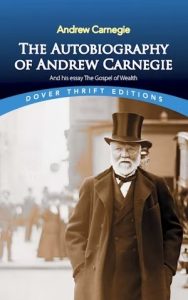
 Buy the Book:
 Andrew Carnegie was a steel magnate, financier, and philanthropist. His story tells how a kid from Scotland, who started as a bobbin boy in a cotton factory, built the biggest steel company in America and became one of the richest men in the world. Then he gave it all away for the betterment of society.
The Notes
- “Perhaps the most inspiring part of Mr. Carnegie’s life, to those who were privileged to know it intimately, was the way he bore his ‘burden of old age.’ Always patient, considerate, cheerful, grateful for any little pleasure or service, never thinking of himself, but always of the dawning of the better day, his spirit ever shone brighter and brighter until ‘he was not, for God took him.’” — Louise Whitfield Carnegie
- “Nothing stranger ever came out of the Arabian Nights than the story of this poor Scotch boy who came to America and step by step, through many trials and triumphs, became the great steel master, built up a colossal industry, amassed an enormous fortune, and then deliberately and systematically gave away the whole of it for the enlightenment and betterment of mankind.” — John C. Van Dyke, Editor
- Life
- Born in Dunfermline, Scotland on Nov. 24, 1835.
- Father, William Carnegie, was a damask weaver. He had 4 or 5 looms.
- “Fortunate in my ancestors I was supremely so in my birthplace. Where one is born is very important, for different surroundings and traditions appeal to and stimulate different latent tendencies in the child.”
- He was influenced by his family’s radicalism, denounced aristocracy, and admired what the U.S. was founded on.
- “The denunciations of monarchical and aristocratic government, of privilege in all its forms, the grandeur of the republican system, the superiority of America, a land peopled by our own race, a home for freemen in which every citizen’s privilege was every man’s right—these were the exciting themes upon which I was nurtured. As a child I could have slain king, duke, or lord, and considered their deaths a service to the state and hence an heroic act. Such is the influence of childhood’s earliest associations that it was long before I could trust myself to speak respectfully of any privileged class or person who had not distinguished himself in some good way and therefore earned the right to public respect.”
- Invention of the steam loom hurt the family business. Carnegie’s father and other small manufacturers couldn’t compete against more efficient looms and the family suffered financially. His mother opened a shop to make up for the lost income.
- “It was from my uncle I learned all that I know of the early history of Scotland—of Wallace and Bruce and Burns, of Blind Harry’s history, of Scott, Ramsey, Tannahill, Hogg, and Fergusson. I can truly say in the words of Burns that there was then and there created in me a vein of Scottish prejudice (or patriotism) which will cease to exist only with life. Wallace, of course, was our hero. Everything heroic centered in him.”
- Started shool at 8 years old. His first teacher, Mr. Robert Martin, made a big enough impression that Carnegie enjoyed attending — “that excellent teacher, my only schoolmaster, to whom I owe a debt of gratitude which I regret I never had opportunity to do more than acknowledge before he died.”
- Carnegie’s only schooling was the 5 years in Dunfermline, from age 8 to 13, and one winter of night-school in America. He could read, write, and do basic math.
- “I cannot name a more important means of benefiting young people than encouraging them to commit favorite pieces to memory and recite them often.”
- First Business Venture
- Carnegie’s first business was allowing his friends to name his pet rabbits in exchange for rabbit food. His friends had to gather food for a season for the reward of naming the rabbits.
- “My conscience reproves me to-day, looking back, when I think of the hard bargain I drove with my young playmates, many of whom were content to gather dandelions and clover for a whole season with me, conditioned upon this unique reward—the poorest return ever made to labor. Alas! what else had I to offer them! Not a penny.”
- “I treasure the remembrance of this plan as the earliest evidence of organizing power upon the development of which my material success in life has hung—a success not to be attributed to what I have known or done myself, but to the faculty of knowing and choosing others who did know better than myself. Precious knowledge this for any man to possess. I did not understand steam machinery, but I tried to understand that much more complicated piece of mechanism—man.”
- On May 17, 1848, the family sold the looms and furniture and emigrated to the U.S. The destination was Pittsburg, where his mother’s sisters lived, having emigrated a few years earlier. Carnegie was 13, his brother Tom was 8, father was 43, and mother was 33. The voyage took 7 weeks by ship. They stayed with a family friend in New York. Then took the Erie Canal to Cleveland, then took the canal to Beaver, Pennsylvania, just outside Pittsburg. The trip from New York to Pittsburg took 3 weeks.
- The lived in Alleghany City. His father made and sold tablecloths — “The returns were meager in the extreme.” His mother took a job with a shoemaker, binding shoes.
- “This is where the children of honest poverty have the most precious of all advantages over those of wealth. The mother, nurse, cook, governess, teacher, saint, all in one; the father, exemplar, guide, counselor, and friend! Thus were my brother and I brought up. What has the child of millionaire or nobleman that counts compared to such a heritage?”
- Carnegie, at 13, figured that the family needed $300/year ($25/month) to not be dependent on others.
- First Job
- Carnegie’s father gave up weaving and got a job at a cotton factory. He also got Carnegie a job as a bobbin boy for $1.20/week.
- “It was a hard life. In the winter father and I had to rise and breakfast in the darkness, reach the factory before it was daylight, and, with a short interval for lunch, work till after dark. The hours hung heavily upon me and in the work itself I took no pleasure; but the cloud had a silver lining, as it gave me the feeling that I was doing something for my world—our family. I have made millions since, but none of those millions gave me such happiness as my first week’s earnings.”
- Second Job
- Carnegie’s second job earned him $2/week at another bobbin factory. He ran a steam engine and fired the boiler in the cellar.
- That led to helping write the bills and do the books for the owner, Mr. John Hays.
- Carnegie took a night course to learn double-entry accounting with 3 friends.
- Third Job — Telegraph Messenger
- His uncle was asked if he knew a boy to act as a messenger for the telegraph office in 1850.
- Carnegie jumped at the chance.
- “Upon such trifles do the most momentous consequences hang. A word, a look, an accent, may affect the destiny not only of individuals, but of nations. He is a bold man who calls anything a trifle. Who was it who, being advised to disregard trifles, said he always would if any one could tell him what a trifle was? The young should remember that upon trifles the best gifts of the gods often hang.”
- “I took care to explain that I did not know Pittsburgh, that perhaps I would not do, would not be strong enough; but all I wanted was a trial. He asked me how soon I could come, and I said that I could stay now if wanted. And, looking back over the circumstance, I think that answer might well be pondered by young men. It is a great mistake not to seize the opportunity.”
- “From the dark cellar running a steam-engine at two dollars a week, begrimed with coal dirt, without a trace of the elevating influences of life, I was lifted into paradise, yes, heaven, as it seemed to me, with newspapers, pens, pencils, and sunshine about me. There was scarcely a minute in which I could not learn something or find out how much there was to learn and how little I knew. I felt that my foot was upon the ladder and that I was bound to climb.”
- His biggest worry was not learning addresses fast enough. He memorized streets, names of businesses, and the people who owned the businesses.
- Pittsburg had a population of 40,000 in 1850 and was still recovering from a fire that partially destroyed the business section on April 10, 1845.
- Dime Messages
- Messages were charged an extra 10 cents after a certain limit. The 10 cents went to the messenger boys, who fought to deliver them.
- Carnegie proposed to pool the dime messages and divide the money equally at the end of each week. He was named the treasurer.
- The boys decided to spend some of their cut at a neighboring candy shop before they got paid, ran up a tab, and forced the treasurer to notify the candy shop that he was not responsible for the boys debts.
- “I did not spend my extra dimes, but they knew not the reason. Every penny that I could save I knew was needed at home. My parents were wise and nothing was withheld from me. I knew every week the receipts of each of the three who were working—my father, my mother, and myself. I also knew all the expenditures. We consulted upon the additions that could be made to our scanty stock of furniture and clothing and every new small article obtained was a source of joy.”
- Messengers’ work hours alternated between ending the day at 6 pm or staying until the office closed, which got the boys home by 11 pm.
- Colonel John P. Glass ran the downstairs office of the telegraph service and brought Carnegie on to watch over it when he wasn’t around. Glass gave Carnegie a raise to $13.50/month for the new responsibilities.
- Messenger boys had an opportunity to practice on the telegraph machines in the mornings before the day started and talk to messenger boys in other stations. Carnegie used it as a chance to learn how it worked. Not long after he watched the telegraph machine when the operator needed a break.
- Colonel James Anderson
- Opened his personal library — 400 volumes — each Saturday to boys who wanted to learn. They could take a book and exchange it for another the next Saturday.
- It was limited to “working boys” who worked with their hands. Carnegie argued, via letter to Pittsburg Dispatch, that messenger boys should qualify. He signed it “Working Boy.” Anderson eventually allowed it.
- “The windows were opened in the walls of my dungeon through which the light of knowledge streamed in. Every day’s toil and even the long hours of night service were lightened by the book which I carried about with me and read in the intervals that could be snatched from duty. And the future was made bright by the thought that when Saturday came a new volume could be obtained.”
- “Books which it would have been impossible for me to obtain elsewhere were, by his wise generosity, placed within my reach; and to him I owe a taste for literature which I would not exchange for all the millions that were ever amassed by man. Life would be quite intolerable without it.”
- Carnegie funded a monument to Anderson placed in front of the libary in Alleghany.
- Anderson’s generosity sparked the idea to fund libraries in Carnegie’s philanthropic years.
- “The fundamental advantage of a library is that it gives nothing for nothing. Youths must acquire knowledge themselves. There is no escape from this.”
- Webster Literary Society
- Carnegie and five friends joined a small group organized to debate the topics of the day.
- “I know of no better mode of benefiting a youth than joining such a club as this. Much of my reading became such as had a bearing on forthcoming debates and that gave clearness and fixity to my ideas.”
- Telegraph Operator
- Promoted to telegraph operator in 1852 after successfully filling in for an operator in Greenburg, PA who needed two weeks off.
- He was 17 years old, making $25/month.
- Transmitting foreign news was a big part of the telegraph business and one of Carnegie’s main duties.
- “The lines in those days worked poorly, and during a storm much had to be guessed at. My guessing powers were said to be phenomenal, and it was my favorite diversion to fill up gaps instead of interrupting the sender and spending minutes over a lost word or two.”
- He was paid an extra $1/week to make multiple copies of press dispatches for the local newspapers.
- Carnegie’s job and raise at the Pennsylvania Railroad allowed his family to buy the house and lot that they lived in. They paid $700 ($100 down) with semi-annual payments. The debt was paid off just before his father died.
- Carnegie’s Father died on October 2, 1855.
- Written in 1868 — “Man must have an idol—the amassing of wealth is one of the worst species of idolatry—no idol more debasing than the worship of money. Whatever I engage in I must push inordinately; therefore should I be careful to choose that life which will be the most elevating in its character. To continue much longer overwhelmed by business cares and with most of my thoughts wholly upon the way to make more money in the shortest time, must degrade me beyond hope of permanent recovery. I will resign business at thirty-five, but during the ensuing two years I wish to spend the afternoons in receiving instruction and in reading systematically.”
- He took a trip around the world in 1878 that opened his mind to Darwin, Spencer, Confucius, Buddha, Zoroaster, and more. He wrote a book about the experience: Round the World — “I had a philosophy at last. The words of Christ ‘The Kingdom of Heaven is within you,’ had a new meaning for me. Not in the past or in the future, but now and here is Heaven within us. All our duties lie in this world and in the present, and trying impatiently to peer into that which lies beyond is as vain as fruitless.” and “I found that no nation had all the truth in the revelation it regards as divine, and no tribe is so low as to be left without some truth; that every people has had its great teacher; Buddha for one; Confucius for another; Zoroaster for a third; Christ for a fourth. The teachings of all these I found ethically akin.”
- His mother and brother died in 1886 of typhoid fever. Carnegie was stricken first with it but survived.
- He married Louise Whitfield on April 22, 1887.
- A daughter, Margaret, was born March 30, 1897.
- His only political appointment was as a US delegate to the Pan-American Congress.
- Pennsylvania Railroad Company
- Success as a telegraph operator caught the notice of Thomas A. Scott. Scott hired Carnegie on February 1, 1853 as his clerk and operator for $35/month.
- Carnegie hired his friend Davy McCargo as superintendent of the telegraph department on March 11, 1859. Carnegie made a habit of hiring close friends into the railroad.
- Davy and Carnegie were credited with hiring the first women as telegraph operators for the railroad. “At all events, we placed girls in various offices as pupils, taught and then put them in charge of offices as occasion required… Our experience was that young women operators were more to be relied upon than young men. Among all the new occupations invaded by women I do not know of any better suited for them than that of telegraph operator.”
- After a few years as Scott’s clerk, Carnegie was allowed to fill in for Scott’s absence and run the division, including scheduling and tracking the trains along their section of the line.
- A raise to $40/month came with the added job of paying the men every month.
- Scott’s promotion to railroad superintendent in 1856 moved Carnegie and the family to Altoona for two years.
- Carnegie got the job to run the Pittsburgh Division at age 24 on December 1, 1859. He hired his brother Tom as his secretary. The new job moved the family back to Pittsburgh.
- “The superintendent of a division in those days was expected to run trains by telegraph at night, to go out and remove all wrecks, and indeed to do everything. At one time for eight days I was constantly upon the line, day and night, at one wreck or obstruction after another. I was probably the most inconsiderate superintendent that ever was entrusted with the management of a great property, for, never knowing fatigue myself, being kept up by a sense of responsibility probably, I overworked the men and was not careful enough in considering the limits of human endurance.”
- “Any accurate description of Pittsburgh at that time would be set down as a piece of the grossest exaggeration. The smoke permeated and penetrated everything. If you placed your hand on the balustrade of the stair it came away black; if you washed face and hands they were as dirty as ever in an hour. The soot gathered in the hair and irritated the skin, and for a time after our return from the mountain atmosphere of Altoona, life was more or less miserable.”
- Carnegie was offered the job of assistant general superintendent. He declined because his investments required more of his time.
- He resigned on March 28, 1865. It was the last time he worked for a salary.
- Civil War
- “At an early age I became a strong anti-slavery partisan and hailed with enthusiasm the first national meeting of the Republican Party in Pittsburgh, February 22, 1856, although too young to vote.”
- “I was an ardent Free-Soiler in days when to be an abolitionist was somewhat akin to being a republican in Britain.”
- “Looking back today one cannot help regretting so high a price as the Civil War had to be paid to free our land from the curse, but it was not slavery alone that needed abolition. The loose Federal system with State rights so prominent would inevitably have prevented, or at least long delayed, the formation of one solid, all-powerful, central government. The tendency under the Southern idea was centrifugal. Today it is centripetal, all drawn toward the center under the sway of the Supreme Court, the decisions of which are, very properly, half the dicta of lawyers and half the work of statesmen.”
- “Men at first argued and theorized about Constitutional rights. It made all the difference in the world when the flag was fired upon. In a moment everything was ablaze—paper constitutions included. The Union and Old Glory! That was all the people cared for, but that was enough. The Constitution was intended to insure one flag, and as Colonel Ingersoll proclaimed: ‘There was not air enough on the American continent to float two.’”
- “I occasionally meet men whom I had forgotten, who recall some trifling attention I have been able to pay them, especially when in charge at Washington of government railways and telegraphs during the Civil War, when I could pass people within the lines—a father helped to reach a wounded or sick son at the front, or enabled to bring home his remains, or some similar service. I am indebted to these trifles for some of the happiest attentions and the most pleasing incidents of my life. And there is this about such actions: they are disinterested, and the reward is sweet in proportion to the humbleness of the individual whom you have obliged.”
- War broke out in 1861. Thomas Scott was named the Assistant Secretary to War in charge of the Transportation Department. Scott brought Carnegie in as his assistant in charge of the military railroads and telegraph for the Government.
- Carnegie’s first job was to create a railroad crew to rebuild the railway line and telegraph cut between Baltimore and Annapolis Junction. They had to rebuild a bridge across the Potomac. They rebuilt the bridge in 7 days.
- He was stationed in Alexandria, Virginia during the battle of Bull Run — “I went out there and loaded up train after train of the poor wounded volunteers. The rebels were reported to be close upon us and we were finally compelled to close Burke Station, the operator and myself leaving on the last train for Alexandria where the effect of panic was evident upon every side.”
- In Washington DC, Carnegie was headquartered in the War Building. The post put him in contact with President Abraham Lincoln, Seward, Cameron, and others.
- Carnegie believed the North’s early faults were a lack of decisive action — “Days would elapse before a decision could be obtained upon matters which required prompt action. There was scarcely a young active officer at the head of any important department—at least I cannot recall one. Long years of peace had fossilized the service… The wonder to me is that order was so soon evolved from the chaos which prevailed in every branch of the service.”
- The Transportation Department’s advantage was Scott’s ability, authorized by Secretary Cameron, to do what he deemed necessary despite the slow-moving orders.
- The original belief was that the war would be over quickly. Once people realized the war would take years, permanent people were put in charge. Scott and Carnegie returned to their positions in the Pennsylvania Railroad in 1862.
- Abraham Lincoln
- “Mr. Lincoln would occasionally come to the office and sit at the desk awaiting replies to telegrams, or perhaps merely anxious for information.”
- “All the pictures of this extraordinary man are like him. He was so marked of feature that it was impossible for any one to paint him and not produce a likeness. He was certainly one of the most homely men I ever saw when his features were in repose; but when excited or telling a story, intellect shone through his eyes and illuminated his face to a degree which I have seldom or never seen in any other. His manners were perfect because natural; and he had a kind word for everybody, even the youngest boy in the office. His attentions were not graduated. They were the same to all, as deferential in talking to the messenger boy as to Secretary Seward. His charm lay in the total absence of manner. It was not so much, perhaps, what he said as the way in which he said it that never failed to win one.”
- “I never met a great man who so thoroughly made himself one with all men as Mr. Lincoln. As Secretary Hay so well says, “It is impossible to imagine any one a valet to Mr. Lincoln; he would have been his companion.” He was the most perfect democrat, revealing in every word and act the equality of men.”
- General Grant
- “If ever a man was without the slightest trace of affectation, Grant was that man. Even Lincoln did not surpass him in that: but Grant was a quiet, slow man while Lincoln was always alive and in motion. I never heard Grant use a long or grand word, or make any attempt at “manner,” but the general impression that he was always reticent is a mistake. He was a surprisingly good talker sometimes and upon occasion liked to talk. His sentences were always short and to the point, and his observations upon things remarkably shrewd. When he had nothing to say he said nothing. I noticed that he was never tired of praising his subordinates in the war. He spoke of them as a fond father speaks of his children.”
- Investments
- First Investment
- An opportunity to buy 10 shares of Adams Express Company for $500. It paid a monthly dividend of $10.
- The opportunity came for his boss Thomas Scott. The family mortgaged the house to buy the shares.
- “It gave me the first penny of revenue from capital—something that I had not worked for with the sweat of my brow. ‘Eureka!’ I cried. ‘Here’s the goose that lays the golden eggs.’”
- Central Transportation Company
- An inventor approached Carnegie when he worked at the Pennsylvania Railroad. He had designed the first train car for night traveling. It was T.T. Woodruff.
- Carnegie recognized its importance immediately. He approached Thomas Scott with the idea who ordered two cars built.
- Woodruff asked Carnegie to join him in the venture for 1/8th of the new business. Carnegie accepted — “I promptly accepted his offer, trusting to be able to make payments somehow or other.”
- The cars were paid for in monthly installments after delivery.
- Carnegie borrowed the money from a local bank to cover his share of the cost of the two cars.
- “The sleeping-cars were a great success and their monthly receipts paid the monthly installments. The first considerable sum I made was from this source.”
- The company owned the cars. Revenue was made from ticket sales for the sleepers.
- The sleeping car company eventually merged with Pullman Company because of a mutually agreed upon deal between George Pullman and Carnegie to build sleeping cars for the Union Pacific Railway. Carnegie knew they couldn’t compete with Pullman so he worked out a deal to work with him rather than compete against him.
- The merger gave Pullman a monopoly, basically, on the biggest railroad companies from East to West.
- Carnegie was the largest shareholder of the Pullman Company until he sold his shares in the Panic of 1873, to raise money to protect his iron and steel mills.
- George Pullman
- Got his start as a carpenter which led to contracts to raise and move buildings in Chicago.
- “He was one of those rare characters who can see the drift of things, and was always to be found, so to speak, swimming in the main current where movement was the fastest. He soon saw, as I did, that the sleeping-car was a positive necessity upon the American continent. He began to construct a few cars at Chicago and to obtain contracts upon the lines centering there.”
- Superior Rail Mill and Blast Furnace
- Iron prices soared to $130/ton during the Civil War. Supply was not a problem — it was a lack of rails to deliver the commodity.
- Carnegie organized a rail-making company in Pittsburgh in 1864.
- Pittsburgh Locomotive Works
- High demand for locomotives led Carnegie to create a locomotive manufacturer with Thomas N. Miller in 1866.
- The original $100/share to start the company sold for $3,000 in 1906, not including “large annual dividends paid regularly.”
- Keystone Bridge Works
- Carnegie’s experience rebuilding wooden railroad bridges led him to propose an iron bridge-building company with bridge designers John L. Piper and Schiffler in 1862. Iron was the future for bridges (until steel came around).
- It was originally called Piper and Schiffler before merging with the Keystone Bridge Company in 1863.
- He brought 5 people total in on the deal. Each person got 20% of the business — started with $1,250 each. Carnegie borrowed his share from the bank. ” Looking back at it now the sum seemed very small, but ‘tall oaks from little acorns grow.’”
- They built a railroad bridge across the Ohio River at Steubenville — a span of 300 feet. People, including the President of the railway company, were unsure it could be done. They broke even on the deal only because the President of the Pennsylvania Railroad paid extra after finding out they took a loss.
- They built a 515-foot span railroad bridge across the Mississippi River at St. Louis, MO. Funding for the bridge was done through $4 million in bonds. Carnegie sold half the offering, with an option to buy the other half, to Junius S. Morgan in London in 1869. Bonds were paid through revenue generated from “tolls” paid by railroad companies for its use.
- They built a railroad bridge across the Mississippi River at Dubuque, IA. It was one of their most profitable contracts.
- Storey Farm Oil Wells
- Oil found in Pennsylvania drew attention in 1862.
- “What surprised me was the good humor which prevailed everywhere. It was a vast picnic, full of amusing incidents. Everybody was in high glee; fortunes were supposedly within reach; everything was booming. On the tops of the derricks floated flags on which strange mottoes were displayed.”
- Carnegie and his partners took an option on the Storey farm wells to buy for $40,000 — (they bought them).
- The idea was to store the oil until supply dried up and sell it at a higher price. It never happened. And they lost oil waiting for it to happen.
- “We did not think then of Nature’s storehouse below which still keeps on yielding many thousands of barrels per day without apparent exhaustion.”
- What they didn’t expect was the amount of oil they got from those wells and the rise in the value of the land they bought.
- “The wells on the Storey farm paid in one year a million dollars in cash and dividends, and the farm itself eventually became worth, on a stock basis, five million dollars.”
- Revenue from the wells, and credit from the value of the land, were used to build new mills in Pittsburgh.
- Union Works
- “The Keystone Works have always been my pet as being the parent of all the other works. But they had not been long in existence before the advantage of wrought-over cast-iron became manifest. Accordingly, to insure uniform quality, and also to make certain shapes which were not then to be obtained, we determined to embark in the manufacture of iron. My brother and I became interested with Thomas N. Miller, Henry Phipps, and Andrew Kloman in a small iron mill.”
- The company was set up in November 1861 as a private partnership.
- “In those early days it was a question with axles generally whether they would run any specified time or break. There was no analysis of material, no scientific treatment of it.”
- Kloman’s expertise was as a mechanic, an axle maker, and an inventor of machines that cut and rolled iron to exact length.
- Kloman and Phipps forced Miller out. Carnegie partnered with Miller creating the Cyclops Mills in 1864. The Cyclops Mills merged back with the Iron Works in 1867. The result was the Union Works. Carnegie, his brother, and Miller controlled the Union Works. Miller sold his share to Carnegie.
- “We began at the new mill by making all shapes which were required, and especially such as no other concern would undertake, depending upon an increasing demand in our growing country for things that were only rarely needed at first. What others could not or would not do we would attempt, and this was a rule of our business which was strictly adhered to. Also we would make nothing except of excellent quality. We always accommodated our customers, even although at some expense to ourselves, and in cases of dispute we gave the other party the benefit of the doubt and settled.”
- Carnegie introduced a system of tracking costs not used by iron manufacturers at the time. Nobody knew the cost of the different processes at the iron mills until year end, after the books were balanced. His system led cost controls, knowing where in each process the largest waste was created.
- “I insisted upon such a system of weighing and accounting being introduced throughout our works as would enable us to know what our cost was for each process and especially what each man was doing, who saved material, who wasted it, and who produced the best results.”
- “One of the chief sources of success in manufacturing is the introduction and strict maintenance of a perfect system of accounting so that responsibility for money or materials can be brought home to every man. Owners who, in the office, would not trust a clerk with five dollars without having a check upon him, were supplying tons of material daily to men in the mills without exacting an account of their stewardship by weighing what each returned in the finished form.”
- They introduced the Siemens Gas Furnace, used in Great Britain. It was deemed too expensive by U.S. iron and steel manufacturers but it was more efficient by almost half — half the waste was saved compared to old furnaces.
- They borrowed a process from the British that washed and coked the dross from coal mines — it took an expense for coal companies and turned it into a profit for the mills. The coal-washing machinery in the U.S. was set up in 1871. 10-year contracts with the leading coal companies. They eventually built 500 ovens that washed 1,500 tons of coal per day.
- “I confess I never pass these coal ovens at Larimer’s Station without feeling that if he who makes two blades of grass grow where one grew before is a public benefactor and lays the race under obligation, those who produce superior coke from material that has been for all previous years thrown over the bank as worthless, have great cause for self-congratulation. It is fine to make something out of nothing; it is also something to be the first firm to do this upon our continent.”
- The company’s success led to moving its headquarters from Pittsburgh to New York in 1867. Carnegie moved to New York, leaving his brother and Phipps running the Works.
- Carnegie put all his earnings in other areas toward expanding the Union mills, and eventually went all-in on iron and steel making. — ” I had become interested, with my friends of the Pennsylvania Railroad Company, in building some railways in the Western States, but gradually withdrew from all such enterprises and made up my mind to go entirely contrary to the adage not to put all one’s eggs in one basket. I determined that the proper policy was ‘to put all good eggs in one basket and then watch that basket.’”
- Lucy Furnace and Pig Iron
- In 1870, they started making pig iron. They built a massive furnace — the Lucy Furnace — that produced 100 tons per day (a record output). The estimated cost of the furnace was half the total cost to build. It was a risky experiment.
- “Among many wrecks our firm stood with credit unimpaired. But the manufacture of pig iron gave us more anxiety than any other department of our business so far.”
- The biggest trouble with the furnace was figuring out the correct combination and quality of ore, limestone, and coke. They hired a chemist — a first in the industry — to solve the problem. They tested everything to find the mines that produced the best quality ore, etc. The best quality ore did not always come from the mines with that reputation.
- “The mines which had no reputation and the products of which many firms would not permit to be used in their blast furnaces found a purchaser in us. Those mines which were able to obtain an enormous price for their products, owing to a reputation for quality, we quietly ignored.”
- “Nine tenths of all the uncertainties of pig-iron making were dispelled under the burning sun of chemical knowledge.”
- “What fools we had been! But then there was this consolation: we were not as great fools as our competitors. It was years after we had taken chemistry to guide us that it was said by the proprietors of some other furnaces that they could not afford to employ a chemist. Had they known the truth then, they would have known that they could not afford to be without one. Looking back it seems pardonable to record that we were the first to employ a chemist at blast furnaces—something our competitors pronounced extravagant.”
- “The Lucy Furnace became the most profitable branch of our business, because we had almost the entire monopoly of scientific management.”
- The success of Lucy led to a second furnace in 1872.
- Kloman made a bet on another iron company, unbeknownst to Carnegie and partners. The other company failed. Kloman filed for bankruptcy. The partners bought him out at book value, at a time when manufacturers were selling at one-third cost. This occurred after the Panic of 1873. Still, Carnegie offered Kloman a 10% interest in the company, paid from future profits but Kloman declined. So Carnegie gave him $40,000 to “make a new start.” Kloman invested in a rival and lost it all.
- Edgar Thomson Steel Works
- A steel-rail company was created in 1873 with Carnegie, William Coleman, David McCandless, John Scott, David Stewart, Edgar Thomson, and Thomas Scott.
- Carnegie followed the innovation in England around the Bessemer process — created steel from pig iron. He recognized its importance but held off because it was still in the experimental phase. He let other iron mills — Freedom Iron Works, Pennsylvania Steel Works, Cambria Iron Company — figure things out first before building a Bessemer plant himself.
- It was named after Edgar Thomson.
- The Panic of 1873, forced some partners to sell their interest due to losses elsewhere. Carnegie bought them out and became the controlling partner. He also brought in his brother and Phipps as partners.
- Steel rails sold for $70/ton when the company began.
- The mill was completed and producing rails in 1874. They made a profit of $11,000 in the first month (his accounting system worked).
- They expanded the plant with 3 blast furnaces to make a consistent supply of pig iron. They were buying pig iron previously. They also bought another furnace that turned out to be inferior. It was a mistake but it was later used to make spiegel and ferro-manganese. It became the sole supplier for the US and cut the cost of ferro-manganese from $80 to $50/ton. (Ferro-manganese was bought from foreign markets before then).
- ” There is nothing so unsatisfactory as purchases of inferior plants.”
- “The one vital lesson in iron and steel that I learned in Britain was the necessity for owning raw materials and finishing the completed article ready for its purpose.”
- They bought up mines to control their supply of ore, coke, and other materials. His chemist came in handy in finding the best mines.
- The advantage of a partnership over a corporation, according to Carnegie, is that a board of directors takes too long to decide on something. A partnership can move quickly to ensure success.
- In 1886, they bought out the 5 or 6 competitors in Pittsburgh. The competition could not compete as rail prices fell. Carnegie gave the owners of the companies the option to join his partnership dollar for dollar or take a cash buyout. All but one took the cash.
- The new company became Carnegie, Phipps, & Co. in 1886.
- 1888: they had $20 million invested in the firm, made 600,000 tons of pig iron per year, 2,000 tons of iron and steel per day, and 5,000 ovens with a capacity of 6,000 tons.
- 1897: they had $45 million invested in the firm, made 1.8 million tons of pig iron per year, 6,000 tons of iron and steel per day, and 15,000 ovens with a capacity of 18,000 tons.
- ” It may be accepted as an axiom that a manufacturing concern in a growing country like ours begins to decay when it stops extending.”
- “To make a ton of steel one and a half tons of iron stone has to be mined, transported by rail a hundred miles to the Lakes, carried by boat hundreds of miles, transferred to cars, transported by rail one hundred and fifty miles to Pittsburgh; one and a half tons of coal must be mined and manufactured into coke and carried fifty-odd miles by rail; and one ton of limestone mined and carried one hundred and fifty miles to Pittsburgh. How then could steel be manufactured and sold without loss at three pounds for two cents? This, I confess, seemed to me incredible, and little less than miraculous, but it was so.”
- The mill produced steel at such a low cost, that they were exporting it.
- Homestead Strike
- Occurred on July 1, 1892.
- Carnegie usually dealt with any issues the workers had, but he was in Scotland at the time.
- The Homestead mills (bought from a competitor) were expanded and improved to produce 60% more steel.
- Workers under contract (paid by the ton of steel produced) were offered a 30% wage raise — half of the 60% production improvement to the workers and half to the firm for the cost of improvements. The workers wanted the full 60%. The firm disagreed.
- It concerned 218 that had formed a union out of over 3,000 workers.
- The other partners decided to keep the plant running. The 218 workers went on strike. State officials advised that sheriffs be brought in to “protect” the other workers. The strikers got violent. Sheriffs were shot. Pennsylvania’s Governor sent in 8,000 troops and it escalated. Workers died.
- “My idea is that the Company should be known as determined to let the men at any works stop work; that it will confer freely with them and wait patiently until they decide to return to work, never thinking of trying new men—never. The best men as men, and the best workmen, are not walking the streets looking for work… The kind of men we desired are rarely allowed to lose their jobs, even in dull times. It is impossible to get new men to run successfully the complicated machinery of a modern steel plant.”
- Carnegie sailed back, offered a sliding scale wage based on the prices of the product (with a minimum built-in) to the strikers, and closed that plant until 2/3 voted in favor of it.
- The company set up a cooperative store for workers, sold coal to workers (to heat homes) at cost, and workers’ savings plan — up to $2,000 at 6% interest — kept in a trust and lent out to workers to build homes.
- The steelworks was sold in 1901. J.P. Morgan organized the sale with then-CEO Charles Schwab and became U.S. Steel.
- Carnegie could have gotten $100 million more. He was paid in 5% bonds.
- “I considered what was fair: and that is the option Morgan got. Schwab went down and arranged it. I never saw Morgan on the subject or any man connected with him. Never a word passed between him and me. I gave my memorandum and Morgan saw it was eminently fair. I have been told many times since by insiders that I should have asked $100,000,000 more and could have got it easily. Once for all, I want to put a stop to all this talk about Mr. Carnegie ‘forcing high prices for anything.’” — Carnegie’s testimony to House of Representatives in 1912.
- Profits hit $40 million a year before the sale.
- British Newspapers
- He partnered with Samuel Storey, MP in 1881 to buy 18 newspapers.
- “We purchased several British newspapers and began a campaign of political progress upon radical lines. Passmore Edwards and some others joined us, but the result was not encouraging.”
- He sold the out of the newspapers without a loss.
- “I have never bought or sold a share of stock speculatively in my life, except one small lot of Pennsylvania Railroad shares that I bought early in life for investment and for which I did not pay at the time because bankers offered to carry it for me at a low rate. I have adhered to the rule never to purchase what I did not pay for, and never to sell what I did not own. In those early days, however, I had several interests that were taken over in the course of business. They included some stocks and securities that were quoted on the New York Stock Exchange, and I found that when I opened my paper in the morning I was tempted to look first at the quotations of the stock market. As I had determined to sell all my interests in every outside concern and concentrate my attention upon our manufacturing concerns in Pittsburgh, I further resolved not even to own any stock that was bought and sold upon any stock exchange. With the exception of trifling amounts which came to me in various ways I have adhered strictly to this rule. Such a course should commend itself to every man in the manufacturing business and to all professional men. For the manufacturing man especially the rule would seem all-important. His mind must be kept calm and free if he is to decide wisely the problems which are continually coming before him.”
- “Nothing tells in the long run like good judgment, and no sound judgment can remain with the man whose mind is disturbed by the mercurial changes of the Stock Exchange. It places him under an influence akin to intoxication. What is not, he sees, and what he sees, is not. He cannot judge of relative values or get the true perspective of things. The molehill seems to him a mountain and the mountain a molehill, and he jumps at conclusions which he should arrive at by reason. His mind is upon the stock quotations and not upon the points that require calm thought. Speculation is a parasite feeding upon values, creating none.”
- “I determined that the proper policy was ‘to put all good eggs in one basket and then watch that basket.’”
- First Investment
- Panic of 1873
- “The financial panic of September 1873, came upon us. I then entered upon the most anxious period of my business life. All was going well when one morning in our summer cottage, in the Allegheny Mountains at Cresson, a telegram came announcing the failure of Jay Cooke & Co. Almost every hour after brought news of some fresh disaster. House after house failed. The question every morning was which would go next. Every failure depleted the resources of other concerns. Loss after loss ensued, until a total paralysis of business set in. Every weak spot was discovered and houses that otherwise would have been strong were borne down largely because our country lacked a proper banking system.”
- “It was not our bills payable but our bills receivable which required attention, for we soon had to begin meeting both. Even our own banks had to beg us not to draw upon our balances.”
- Carnegie’s companies did not have enough debt to worry about. A bigger concern was getting money from banks to pay workers. Banks wouldn’t lend. Carnegie sold his personal securities to help cover payroll.
- “The banks were forced to renew maturing paper. They behaved splendidly to us, as they always have done, and we steered safely through. But in a critical period like this there was one thought uppermost with me, to gather more capital and keep it in our business so that come what would we should never again be called upon to endure such nights and days of racking anxiety.”
- “Speaking for myself in this great crisis; I was at first the most excited and anxious of the partners. I could scarcely control myself. But when I finally saw the strength of our financial position I became philosophically cool and found myself quite prepared, if necessary, to enter the directors’ rooms of the various banks with which we dealt, and lay our entire position before their boards.”
- “Up to this time I had the reputation in business of being a bold, fearless, and perhaps a somewhat reckless young man. Our operations had been extensive, our growth rapid and, although still young, I had been handling millions. My own career was thought by the elderly ones of Pittsburgh to have been rather more brilliant than substantial… I am sure that any competent judge would be surprised to find how little I ever risked for myself or my partners. When I did big things, some large corporation like the Pennsylvania Railroad Company was behind me and the responsible party. My supply of Scotch caution never has been small; but I was apparently something of a dare-devil now and then to the manufacturing fathers of Pittsburgh. They were old and I was young, which made all the difference.”
- Business
- “I have never known a concern to make a decided success that did not do good, honest work, and even in these days of the fiercest competition, when everything would seem to be matter of price, there lies still at the root of great business success the very much more important factor of quality. The effect of attention to quality, upon every man in the service, from the president of the concern down to the humblest laborer, cannot be overestimated.”
- “The surest foundation of a manufacturing concern is quality. After that, and a long way after, comes cost.”
- “Working-men always do reciprocate kindly feeling. If we truly care for others we need not be anxious about their feelings for us. Like draws to like.”
- “When one party to a bargain becomes excited, the other should keep cool and patient.”
- “In all subsequent negotiations I made it a rule to give the first offer to Junius S. Morgan, who seldom permitted me to leave his banking house without taking what I had to offer. If he could not buy for his own house, he placed me in communication with a friendly house that did, he taking an interest in the issue. It is a great satisfaction to reflect that I never negotiated a security which did not to the end command a premium.”
- “A great business is seldom if ever built up, except on lines of the strictest integrity. A reputation for “cuteness” and sharp dealing is fatal in great affairs. Not the letter of the law, but the spirit, must be the rule. The standard of commercial morality is now very high. A mistake made by any one in favor of the firm is corrected as promptly as if the error were in favor of the other party. It is essential to permanent success that a house should obtain a reputation for being governed by what is fair rather than what is merely legal. A rule which we adopted and adhered to has given greater returns than one would believe possible, namely: always give the other party the benefit of the doubt. This, of course, does not apply to the speculative class. An entirely different atmosphere pervades that world. Men are only gamblers there. Stock gambling and honorable business are incompatible.”
- Carnegie tells several stories where he negotiated deals for other railroad companies. He used his contacts at the Pennsylvania Railroad to ensure deals. For example, he did this on deals for Alleghany Valley Railway (Penn guaranteed bonds issued by Alleghany Valley) and Union Pacific (got money from Penn to get UP through a crisis). He also used contacts in London — Junius Morgan and others — to raise money for those companies through bond offerings. He raised over $30 million from bond issues.
- “The business man has no rock more dangerous to encounter in his career than this very one of endorsing commercial paper. It can easily be avoided if he asks himself two questions: Have I surplus means for all possible requirements which will enable me to pay without inconvenience the utmost sum for which I am liable under this endorsement? Secondly: Am I willing to lose this sum for the friend for whom I endorse? If these two questions can be answered in the affirmative he may be permitted to oblige his friend, but not otherwise, if he be a wise man. And if he can answer the first question in the affirmative it will be well for him to consider whether it would not be better then and there to pay the entire sum for which his name is asked. I am sure it would be. A man’s means are a trust to be sacredly held for his own creditors as long as he has debts and obligations.”
- Carnegie was asked a few times to endorse deals for his friends — putting his name and money on the line to help raise money for his friend’s company.
- “Strict adherence to what I believed to be my duty never to put my name to anything which I knew I could not pay at maturity; or, to recall the familiar saying of a Western friend, never to go in where you couldn’t wade. This water was altogether too deep for me.
Regard for this rule has kept not only myself but my partners out of trouble. Indeed, we had gone so far in our partnership agreement as to prevent ourselves from endorsing or committing ourselves in any way beyond trifling sums, except for the firm. This I also gave as a reason why I could not endorse.” - “Many men can be trusted, but a few need watching.”
- “There was danger lest I should drift away from the manufacturing to the financial and banking business. My successes abroad brought me tempting opportunities, but my preference was always for manufacturing. I wished to make something tangible and sell it and I continued to invest my profits in extending the works at Pittsburgh.”
- “I believe the true road to preëminent success in any line is to make yourself master in that line. I have no faith in the policy of scattering one’s resources, and in my experience I have rarely if ever met a man who achieved preëminence in money-making—certainly never one in manufacturing—who was interested in many concerns. The men who have succeeded are men who have chosen one line and stuck to it.”
- “It is surprising how few men appreciate the enormous dividends derivable from investment in their own business. There is scarcely a manufacturer in the world who has not in his works some machinery that should be thrown out and replaced by improved appliances; or who does not for the want of additional machinery or new methods lose more than sufficient to pay the largest dividend obtainable by investment beyond his own domain. And yet most business men whom I have known invest in bank shares and in far-away enterprises, while the true gold mine lies right in their own factories.”
- “It has been with me a cardinal doctrine that I could manage my own capital better than any other person, much better than any board of directors. The losses men encounter during a business life which seriously embarrass them are rarely in their own business, but in enterprises of which the investor is not master. My advice to young men would be not only to concentrate their whole time and attention on the one business in life in which they engage, but to put every dollar of their capital into it. If there be any business that will not bear extension, the true policy is to invest the surplus in first-class securities which will yield a moderate but certain revenue if some other growing business cannot be found. As for myself my decision was taken early. I would concentrate upon the manufacture of iron and steel and be master in that.”
- “There is one imperative rule for men in business—no secrets from partners.”
- “My experience has been that no partnership of new men gathered promiscuously from various fields can prove a good working organization as at first constituted. Changes are required. Our Edgar Thomson Steel Company was no exception to this rule.”
- ” The sound rule in business is that you may give money freely when you have a surplus, but your name never—neither as endorser nor as member of a corporation with individual liability. A trifling investment of a few thousand dollars, a mere trifle—yes, but a trifle possessed of deadly explosive power.”
- Law of the Surplus: “One great advantage which America will have in competing in the markets of the world is that her manufacturers will have the best home market. Upon this they can depend for a return upon capital, and the surplus product can be exported with advantage, even when the prices received for it do not more than cover actual cost, provided the exports be charged with their proportion of all expenses. The nation that has the best home market, especially if products are standardized, as ours are, can soon outsell the foreign producer. The phrase I used in Britain in this connection was: ‘The Law of the Surplus.’”
- “Taking no account of the reward that comes from feeling that you and your employees are friends and judging only from economical results, I believe that higher wages to men who respect their employers and are happy and contented are a good investment, yielding, indeed, big dividends.”
- “Capital, labor, and employer were a three-legged stool, none before or after the others, all equally indispensable.”
- On Tariffs: “My part has always been to favor reduction of duties, opposing extremes—the unreasonable protectionists who consider the higher the duties the better and declaim against any reduction, and the other extremists who denounce all duties and would adopt unrestrained free trade.”
- The estimated value of manufactures in Great Britain in 1900 was $5 billion compared to $13 billion for the United States. In 1914 the United States sat at over $24 billion.
- New York and Wall Street
- “I was surprised to find how very different was the state of affairs in New York. There were few even of the business men who had not their ventures in Wall Street to a greater or less extent.”
- Carnegie was bombarded with investment offers because of his “inside” information on the railroad companies.
- “The supposition being that from the inside view which I was enabled to obtain I could invest for them successfully. Invitations were extended to me to join parties who intended quietly to buy up the control of certain properties. In fact the whole speculative field was laid out before me in its most seductive guise. All these allurements I declined.”
- Jay Gould wanted to buy control of the Pennsylvania Railroad and offered Carnegie half the profits to run it. He declined.
- Philanthropy
- The first library he donated was in 1881 for Dunfermline, Scotland. The town named it Carnegie Library. The motto: “Let there be light.” with a rising sun was carved above the door.
- He set up a $4 million Relief Fund as a small disability/pension fund for steel workers (1901).
- He gave $1 million to maintain the library and halls for the workers (1901).
- He gave $5.25 million for 68 libraries in New York City.
- In total, he donated over $60 million for over 2,800 libraries in various towns.
- He set up the Carnegie Institute in Pittsburgh for $28 million — library, museum, gallery, technical school, and School for women (1895).
- He gave $10 million for the Carnegie Institute in Washington DC — to push cooperation through science, literature, or art (1902).
- Set up a Hero Fund with $5 million for families of people who died selflessly serving others (1904). It was expanded to countries outside the U.S.
- He donated the funds for a building at Lehigh University on the condition that it be named after Charlie Taylor who ran the Hero Fund for free.
- He set up a $15 million pension fund for university professors (1905).
- He gave $10 million for the Carnegie Trust for the Universities of Scotland — half of the revenue to improve universities in Scotland, half as a scholarship for students who couldn’t afford university (1902).
- He donated $27 million to 500 smaller colleges in the US for buildings or endowment funds, believing they needed the money more than the larger colleges (referred to Harvard and Columbia as examples) at the time.
- He set up an organization to give organs to churches — the organization paid half the cost if the church covered the other half. 7,689 organs had been donated by 1919, at a cost of over $6 million.
- “This is my favorite and best answer to the question which will never down in my thoughts: ‘What good am I doing in the world to deserve all my mercies?’ Well, the dear friends of the pension list give me a satisfactory reply, and this always comes to me in need.”
- He donated the money to build the “Temple of Peace” at The Hague.
- He bought the Pittencrieff Estate and gave it to the city of Dunfermline, along with 1 million sterling (half to the city, half to maintain/update the estate).
- He set up the Carnegie Endowment for International Peace with $10 million (1910).
- He set up the Carnegie Corporation of New York, a foundation with $125 million (1911) to ” promote the advancement and diffusion of knowledge and understanding among the people of the United States by aiding technical schools, institutions of higher learning, libraries, scientific research, hero funds, useful publications and by such other agencies and means as shall from time to time be found appropriate therefor.”
- He donated over $350 million in life, with his will stating the remaining amount to go to the Carnegie Corporation of New York at his death.
- Gospel of Wealth
- “The ‘good old times’ were not good old times. Neither master nor servant was as well situated then as to-day. A relapse to old conditions would be disastrous to both—not the least so to him who serves—and would sweep away civilization with it.”
- 3 Ways to dispose of wealth:
- Leave it to families – brings the likely chance that the family becomes “spoiled” by wealth.
- Bequeathed for public purposes – “In many cases the bequests are so used as to become only monuments of his folly. It is well to remember that it requires the exercise of not less ability than that which acquires it, to use wealth so as to be really beneficial to the community.”
- Administered while alive – Carnegie sees this option as the best. You know where the money goes, how it’s spent, and you’re still alive to enjoy the benefits it offers society.
- He supported an estate tax — “By taxing estates heavily at death the State marks its condemnation of the selfish millionaire’s unworthy life.”
- “It is well to remember that it requires the exercise of not less ability than that which acquires it, to use wealth so as to be really beneficial to the community.”
- “Poor and restricted are our opportunities in this life, narrow our horizon, our best work most imperfect; but rich men should be thankful for one inestimable boon. They have it in their power during their lives to busy themselves in organizing benefactions from which the masses of their fellows will derive lasting advantage, and thus dignify their own lives.”
- “The best means of benefiting the community is to place within its reach the ladders upon which the aspiring can rise—free libraries, parks, and means of recreation, by which men are helped in body and mind; works of art, certain to give pleasure and improve the public taste; and public institutions of various kinds, which will improve the general condition of the people; in this manner returning their surplus wealth to the mass of their fellows in the forms best calculated to do them lasting good.”
- On Public Speaking
- “My two rules for speaking then (and now) were: Make yourself perfectly at home before your audience, and simply talk to them, not at them. Do not try to be somebody else; be your own self and talk, never “orate” until you can’t help it.”
- “There is one rule I might suggest for youthful orators. When you stand up before an audience reflect that there are before you only men and women. You should speak to them as you speak to other men and women in daily intercourse. If you are not trying to be something different from yourself, there is no more occasion for embarrassment than if you were talking in your office to a party of your own people—none whatever.”
- ” I once asked Colonel Ingersoll, the most effective public speaker I ever heard, to what he attributed his power. ‘Avoid elocutionists like snakes,’ he said, ‘and be yourself.’”
- “A sunny disposition is worth more than fortune. Young people should know that it can be cultivated; that the mind like the body can be moved from the shade into sunshine. Let us move it then. Laugh trouble away if possible, and one usually can if he be anything of a philosopher, provided that self-reproach comes not from his own wrong-doing. That always remains. There is no washing out of these “damned spots.” The judge within sits in the supreme court and can never be cheated. Hence the grand rule of life which Burns gives: ‘Thine own reproach alone do fear.’ This motto adopted early in life has been more to me than all the sermons I ever heard…”
- “War breeds war, that every battle sows the seeds of future battles, and that thus nations become traditional enemies.”
- “It remains for maturer years and wider knowledge to tell us that every nation has its heroes, its romance, its traditions, and its achievements; and while the true Scotsman will not find reason in after years to lower the estimate he has formed of his own country and of its position even among the larger nations of the earth, he will find ample reason to raise his opinion of other nations because they all have much to be proud of—quite enough to stimulate their sons so to act their parts as not to disgrace the land that gave them birth.”
- “It is not the rich man’s son that the young struggler for advancement has to fear in the race of life, nor his nephew, nor his cousin. Let him look out for the ‘dark horse’ in the boy who begins by sweeping out the office.”
- ” Whenever one learns to do anything he has never to wait long for an opportunity of putting his knowledge to use.”
- “The experience with coarse men was probably beneficial because it gave me a ‘scunner’ (disgust), to use a Scotism, at chewing or smoking tobacco, also at swearing or the use of improper language, which fortunately remained with me through life.”
- “The battle of life is already half won by the young man who is brought personally in contact with high officials; and the great aim of every boy should be to do something beyond the sphere of his duties—something which attracts the attention of those over him.”
- “A new judge is very apt to stand so straight as really to lean a little backward. Only experience teaches the supreme force of gentleness. Light but certain punishment, when necessary, is most effective. Severe punishments are not needed and a judicious pardon, for the first offense at least, is often best of all.”
- “I forget who first started us with a second axiom. It was one we often dwelt upon: ‘A forgiving God would be the noblest work of man.’ We accepted as proven that each stage of civilization creates its own God, and that as man ascends and becomes better his conception of the Unknown likewise improves. Thereafter we all became less theological, but I am sure more truly religious.”
- “It also passed into an axiom with us that he who proclaims there is no hereafter is as foolish as he who proclaims there is, since neither can know, though all may and should hope. Meanwhile ‘Home our heaven’ instead of ‘Heaven our home’ was our motto.”
- “Slight attentions or a kind word to the humble often bring back reward as great as it is unlooked for. No kind action is ever lost… It counts many times more to do a kindness to a poor working-man than to a millionaire, who may be able some day to repay the favor.”
- “It would be safe to wager that a thousand Americans in a new land would organize themselves, establish schools, churches, newspapers, and brass bands—in short, provide themselves with all the appliances of civilization—and go ahead developing their country before an equal number of British would have discovered who among them was the highest in hereditary rank and had the best claims to leadership owing to his grandfather. There is but one rule among Americans—the tools to those who can use them.”
- “A man must necessarily occupy a narrow field who is at the beck and call of others. Even if he becomes president of a great corporation he is hardly his own master, unless he holds control of the stock.”
- “Most of the troubles of humanity are imaginary and should be laughed out of court. It is folly to cross a bridge until you come to it, or to bid the Devil good-morning until you meet him—perfect folly. All is well until the stroke falls, and even then nine times out of ten it is not so bad as anticipated. A wise man is the confirmed optimist.”
- “The writer of a book designed for his friends has no reason to anticipate an unkind reception, but there is always some danger of its being damned with faint praise… Every author is prone to believe sweet words.”
- “Of all professions, that of teaching is probably the most unfairly, yes, most meanly paid, though it should rank with the highest. Educated men, devoting their lives to teaching the young, receive mere pittances.”
- “I have never known of a body of men capable of legislating for the generation ahead, and in some cases those who attempt to legislate even for their own generation are not thought to be eminently successful.”
- “Moral: If you wish to play peace-maker, seat adversaries next each other where they must begin by being civil.”
- “Most quarrels become acute from the parties not seeing and communicating with each other and hearing too much of their disagreement from others. They do not fully understand the other’s point of view and all that can be said for it. Wise is he who offers the hand of reconciliation should a difference with a friend arise.”
- “He is the happy man who feels there is not a human being to whom he does not wish happiness, long life, and deserved success, not one in whose path he would cast an obstacle nor to whom he would not do a service if in his power.”
- “There are times in most men’s lives that test whether they be dross or pure gold. It is the decision made in the crisis which proves the man.”
- “Democracy worships a precedent-breaker or a precedent-maker.”
- “No man can dishonor me except myself. Honor wounds must be self-inflicted.”
- “Nothing is impossible to genius!”