
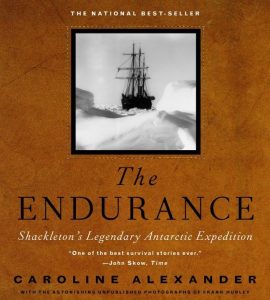
 Buy the Book: Print
Sir Earnest Shackleton’s expedition to be the first to cross Antarctica in 1914 turned into a 20-month ordeal trapped in an ice pack, their ship crushed, and the desperate attempt to save themselves as the pack broke up. It’s a story of endurance and survival.
The Notes
- Sir Ernest Shackelton was a national hero with two polar expeditions. He laid claim to travel further south than anyone before — within 100 miles of the South Pole. Yet, the South Pole was the prize.
- Shackelton’s third polar expedition was to be the first to cross Antarctica. The first to the South Pole had been claimed by others.
- “Antarctic exploration of the early twentieth century was unlike exploration of anywhere else on earth. No dangerous beasts or savage natives barred the pioneering explorer’s way. Here, with wind speeds up to nearly 200 miles an hour and temperatures as extreme as –100° Fahrenheit, the essential competitions were pure and uncomplicated, being between man and the unfettered force of raw Nature, and man and the limits of his own endurance.”
- “Shackleton’s greatness as a leader on the Endurance owes much to the sometimes insane suffering of his earlier Antarctic experiences.”
- Shackleton’s Early Life
- He was born in County Kildare, Ireland, the son of a physician. The family moved to England.
- He was one of 3 sons and 8 sisters.
- He attended Dulwich College and joined the British Merchant Navy at 16.
- He married Emily Dorman in 1904.
- Shackleton’s First South Pole Expedition
- August 1901, Captain Robert Falcon Scott led the expedition. He brought Dr. Edward Wilson and Lieutenant Earnest Shackleton (28 years old) with him on a ship named Discovery. It was the first-ever attempt at the South Pole.
- They had 19 sled dogs and 5 sleds.
- They set off across Antarctica on November 2, 1902, on a 1,600-mile round-trip journey and came within 463 miles of the pole.
- Starvation, scurvy, and poor preparation were their undoing. They reached their ship on February 3, 1903.
- Nobody in the expedition knew how to ski or drive sled dogs. Dogs were blamed, written off as a hindrance, rather than the operators (they learned the wrong lesson).
- They also failed to ration enough food for the trip.
- Antarctica was the first continent to be discovered by camera, during Scott’s expedition.
- Shackleton’s Second South Pole Expedition
- Shackleton got seed money for his own South Pole expedition and set sail in August 1907 on the Nimrod.
- They had 10 ponies and 9 dogs despite prior expeditions to the Arctic proving sled dogs were the only viable transportation in the polar region.
- 3 men with 4 ponies began the Antarctica expedition on October 29, 1908. The ponies were useless — 3 of the 4 were shot and eaten.
- The men made it to 88°23′ South — within 100 miles of the South Pole before turning around due to frostbite, snow blindness, and hunger. It was the closest anyone had gotten to the South Pole.
- They dumped their gear, made a mad dash to the base camp, and traveled 36 hours without rest, only to find the camp deserted. A search party from the Nimrod found them afterward.
- Shackleton was knighted upon returning home.
- Shackleton spent the next few years paying off the Nimrod’s debts with a speaking circuit, a book deal — The Heart of the Antarctic, and admission fees to see the Nimrod.
- “Shackleton’s decision to turn back was more than a singular act of courage; it bespoke the dogged optimism that was the cornerstone of his character. Life would always offer more chances.”
- First to the South Pole
- Roald Amundsen, a Norwegian Explorer, turned his sights from the Arctic to Antarctica in October 1910, after hearing Robert Scott was making another attempt at the South Pole.
- Both expeditions set out in October 1911. Amundsen from the Bay of Whales. Scott from Cape Evans.
- Amundsen, with four companions and a team of 52 trained sled dogs, averaged 15 to 20 miles a day.
- Scott’s team, with ponies and dogs nobody knew how to drive, struggled to make 10 to 13 miles a day. Scott also added a 5th man to his team at the last minute. The extra man became a burden on food supplies and sled load.
- “Cannot understand what the English mean when they say that dogs cannot be used here.” — Amundsen
- Amundsen reached the pole first. Scott was second on January 16, 1912.
- Scott’s team was trapped by a blizzard on their return and died — about 11 miles south of a supply depot.
- Scott’s diary, edited by Sir James Barrie (author of Peter Pan), left out his fatal blunders.
- Shackleton’s Antarctic Crossing
- Prospectus: “From the sentimental point of view, it is the last great Polar journey that can be made. It will be a greater journey than the journey to the Pole and back, and I feel it is up to the British nation to accomplish this, for we have been beaten at the conquest of the North Pole and beaten at the conquest of the South Pole. There now remains the largest and most striking of all journeys—the crossing of the Continent.”
- Funds were raised mainly from the British Government and Sir James Key Caird.
- News and pictorial rights were also sold in advance to fund the expedition. The Imperial Trans Antarctic Film Syndicate was formed for the film rights. Story rights were sold to the Daily Chronicle.
- Endurance — a Norwegian vessel originally named Polaris was 144 feet long, 1.5 feet thick, and sheathed in greenhart.
- Aurora — a second relief ship was to deposit supply caches for Shackleton’s team on the other side of the continent.
- He arranged for 69 Canadian sled dogs. The plan required an average of 15 miles per day. None of the men had experience driving dogs and only one knew how to ski.
- 3 lifeboats, named Stancomb Wills, James Caird, and Dudley Docker, were integral to their survival.
- Timeline
- August 1, 1914 — Endurance departed from London.
- August 4, 1914 — British government orders a general mobilization after war breaks out between Germany and Russia. Precursor to WWI.
- August 8, 1914 — Endurance leaves Plymouth after orders from the Admiralty to “Proceed.” Shackleton placed the Endurance and crew at the government’s disposal.
- The first leg south traveled by way of Madeira, Montevideo, and Buenos Aires, Argentina.
- Mid-October – Shackleton joins the expedition in Buenos Aires.
- October 26 – Endurance, loaded with new supplies and 69 sled dogs, sails to South Georgia, east of the Falklands.
- November 5 – Endurance arrives on South Georgia island. South Georgia was a whaling outpost — the Grytviken Whaling Station — with a small population of Norwegian whalers. Shackleton was advised to wait until later in the summer to start his trek to Antarctica due to the pack ice extending further north than usual. They spent a month on South Georgia island.
- December 5, 1914 – Endurance leaves Grytviken with 28 men including Shackleton, 69 sled dogs, 2 pigs, and a cat named Mrs. Chippy.
- December 7 – They see the edge of the pack ice. — “The Weddell Sea is uniquely configured for maximum hazard to ships… A prevailing current drives the roughly circular sea in a slow clockwise motion. Sea ice, which can form here during any season, is thus never dispersed into the warmer northern waters, but churned in an interminable semicircle, eventually packed by the westward drift against the Palmer Peninsula.”
- December 25 – Christmas is celebrated aboard with mince pies and Christmas pudding as the boat works its way through the ice float.
- January 6, 1915 – Dogs were taken off the boat to a large ice floe for exercise. It was the first exercise they had in a month.
- January 10 – The ship came within sight of Coats Land at 72° south. They were a week from Vahsel Bay.
- January 11 – Breakfast consisted of Quaker Oats, seal’s liver, and bacon as the ship drifted with a large floe due to bad weather.
- January 14 – The ship was held fast in the ice floe. “The ice was more like seracs than pack ice, for it was so tossed, broken & crushed. Great pressure ridges thrown up 15 to 20 feet in height bear evidence of the terrific force & pressure of the ice in these latitudes.” — James Francis Hurley, Australian photographer
- January 15 – An opening in the floe appeared in the early morning allowing the ship to steam ahead for 124 miles over 24 hours until they hit dense pack ice again.
- January 23 – “An assessment of the ship’s supply of fuel determined that only 75 tons of coal remained of the 160 the Endurance had carried from South Georgia.”
- January 27 – “It appears as though we have stuck fast for this season. A noticeable drop in the temperature at midnight, +9 being recorded. This has had the effect of freezing up many of the small pools & cementing together the floes, an ominous happening.” — James Hurley
- Being locked into the ice pack, the men’s routine changed to one of diversions with football (soccer) on ice, attending to the dogs, dog sled races, reading books aloud, a traditional Saturday night toast, and Sunday sing-alongs.
- Early February – “The idea of spending the winter in an ice bound ship is extremely unpleasant, more so, owing to the necessarily cramping of the work and the forced association with the ships party—who, although being an amiable crowd are not altogether partial to the scientific staff.” — James Hurley
- February 22 – The ice drift carried the Endurance to the 77th parallel — the farthest south the expedition would reach.
- February 24 – Shackleton orders the Endurance to become a winter station. Any chance of a successful expedition would have to wait for the ice pack to break up in the Spring (October), but that grew less likely by the day. “The summer had gone… Indeed the summer had scarcely been with us at all… [T]he seals were disappearing and the birds were leaving us. The land showed still in fair weather on the distant horizon, but it was beyond our reach now.” — Shackleton
- “Shackleton at this time showed one of his sparks of real greatness. He did not rage at all, or show outwardly the slightest sign of disappointment; he told us simply and calmly that we must winter in the Pack, explained its dangers and possibilities; never lost his optimism, and prepared for Winter.” — Alexander Macklin, ship surgeon
- Shackleton set up a strict winter routine to maintain morale and guard against the psychological strain of an Antarctic winter. He issued winter clothing, set aside for the shore party, to all the men — 2 wool shirts, long underwear, wool mitts. He set up warmer winter quarters in the storage area of the ship, called “the Ritz” by the crew, made up of 6 x 5 foot cubicles for 2 men each. In the middle of “the Ritz” sat a table for meals and a stove at one end. Shackleton took the Captain’s cabin, the coldest part of the ship. Dogs were set up in igloos on the ice outside the ship.
- March 1 – Blizzard hit with temperatures reaching -8° F.
- March – March temperatures fluctuated from 11° F to -24° F. There were equal hours of daylight and night by the end of March.
- April – Shackleton divided the dogs into six teams to keep the men busy, exercise the dogs, scout for seals, and explore the ice.
- Late April – “That is Sir Ernest all over. He is always able to keep his troubles under and show a bold front. His unfailing cheeriness means a lot to a band of disappointed explorers like ourselves. In spite of his own great disappointment and we all know that is disasterous enough, he never appears to be anything but the acme of good humour and hopefulness. He is one of the greatest optimists living… [H]e enters the lists every time with the spirit that every prize fighter enters the ring with.” — Thomas Ord-Lees
- May – The sun disappeared — the polar night — for the next four months. Diversions continued — chess, checkers, cards, and guessing games. By late May, cabin fever set in and the men shaved their heads and had a good laugh. Frank Hurley, the expedition photographer, spent his days and nights photographing the changing landscape.
- “Shackleton’s presence informed every event that occurred on his ship. On the one hand, he was always ready to be one of the boys: He shaved his head along with everyone else, and he joined, enthusiastically and tunelessly, in the singsongs. He was anxious, with much to ponder and plan, but he did not require a brooding solitude in which to do this. He was always among his men, perceived to be in good spirits, and this fact alone was in great part responsible for the atmosphere of security that pervaded their stricken circumstances.”
- June – “In June began the darkest part of the year. Save for the moon and a couple of hours of dim twilight at noon, there was no light. The temperature had dropped to the minus twenties and leads of water that had been clear only the day before became encrusted with six inches of ice overnight.”
- June 3 – “During the night of the 3rd we heard the ice grinding to the eastward, and in the morning we saw that young ice was rafted 8 to 10 ft. high in places. This was the first murmur of the danger that was to reach menacing proportions in later months.” — Shackleton
- June 22 – Midwinter’s Day was celebrated with a feast and entertainment. A morale booster.
- Late June – The ship and ice pack had drifted 670 miles since it was trapped in February. Daylight hours began to increase.
- July 13 – A blizzard hits. Shackleton admits to Captain Frank Worsley and Frank Wild, that the ice would likely take the ship. “The ship can’t live in this, Skipper. You had better make up your mind that it is only a matter of time. It may be a few months, and it may be only a question of weeks, or even days…but what the ice gets, the ice keeps.” – Worsley, relaying Shackleton’s remarks
- July 21 – Shackleton orders the ship decks cleared in case the dogs need to be evacuated off the ice. By that point, pressure piled massive ice blocks high into the air.
- August 1 – A gale raged for three days. Dogs were brought on board after ice blocks crushed the kennels, emergency rations were stored with the sleds, the rudder was damaged, and the ship’s beams buckled.
- August 1 – “Our position became extremely perilous, as huge blocks were rafting and tumbling over themselves in their apparent eagerness to hurl their force against our walls.” — Hurley
- August 26 – Pressure in the ice pack returned.
- September 2 – “On the night of 2nd September, I had one of the most startling moments of my life. I was lying in my bunk, when…the ship literally jumped into the air and settled on its beam.” – William Bakewell, ship’s crew
- September 2 – Pressure from the ice pack buckled the iron plate in the engine room and distorted door frames.
- October 10 – Temperatures hit 29° F and the surface ice turned to mush.
- October 14 – The ice split and the Endurance floated in open water for the first time in 9 months. The crew learned the ice surrounding Endurance reached as much as 40 feet below water. The ship drove ahead 100 yards before it was stuck in the ice pack again.
- October 16 – The ship, squeezed between two massive floes, pushed the ship above the ice, listing 30 degrees. By the evening the ship was back to an even keel.
- October 24 – After dinner, a crash was heard that pushed the ship over 8 degrees. The ship was twisted and leaking water at the sternpost.
- October 24 – “Shackleton gave the order to raise steam for the engine room pumps. With water rising rapidly, the engineers, Rickinson and Kerr, desperately piled on fuel—coal, blubber, wood—racing to raise steam before the rising water could put the fires out. Within two hours they had the pump working, but they soon saw that it could not cope with the inrush of water. Hudson, Greenstreet, and Worsley disappeared into the bunkers, where the coal was stored, to clear the bilge pump, which had been jammed with ice all winter.”
- October 24 – The rest of the crew gathered supplies, clothes, gear, and dog food in case they had to disembark onto the ice. By the next morning, the leak had been checked.
- October 26 – The ship began leaking badly again. The crew split time working the pumps 15 minutes at a time, Shackleton ordered lifeboats and sleds lowered onto the ice.
- October 27 – Temperatures hit -8.5° F. The crew worked the pumps all day. At 4 pm the ship was knocked stern up, a floe ripped the rudder and sternpost, the deck broke up, and water poured in. Shackleton ordered to abandon ship at 5 pm.
- “It is hard to write what I feel. To a sailor his ship is more than a floating home… Now, straining and groaning, her timbers cracking and her wounds gaping, she is slowly giving up her sentient life at the very outset of her career.” — Shackleton
- “Awful calamity that has overtaken the ship that has been our home for over 12 months…We are homeless & adrift on the sea ice.” — Hurley
- October 27 – They set up camp on the ice 100 yards from the ship. The temperature dropped to -15° F. They were 350 miles from the nearest land. Each man was assigned to 1 of 5 tents and a sleeping bag. They drew for sleeping bags. Shackleton rigged it so the main crew got warmer fur sleeping bags while he and the officers got the less desirable wool bags. Three times that night the ice crapped underneath them, each time they picked up camp and moved.
- October 28 – “Like a lamp in a cottage window, it braved the night until in the early morning the Endurance received a particularly violent squeeze. There was a sound of rending beams and the light disappeared.” — Shackleton
- October 28 – Shackleton informed the men that they would hike towards Snow Hill or Robertson Island, 200 miles northwest. The hike meant hauling the supplies, 2 lifeboats, and 2 pounds each of personal possessions. A few exceptions were allowed like a banjo.
- October 30 – The march to Robertson Island began. It was snowing. Dog teams hauled supplies back and forth throughout the day. They made it one mile in 5 hours.
- November 1 – They were hip-deep in snow and only covered a quarter mile. “The condition of the surface is atrocious. There appears scarcely a square yard of smooth surface which is covered by a labyrinth of hummocks & ridges.” — Hurley
- November 1 – Shackleton halts the march and orders to set up camp until the ice breaks up. They made it 1.5 miles from the Endurance. “His hope was that the drift of the pack would carry them northwest to within striking distance of Paulet Island, nearly 400 miles distant. Nordenskjöld’s Swedish expedition had built a hut there in 1902, and Shackleton knew it to be stocked with emergency supplies; he himself had helped provision the relief operation for the expedition twelve years earlier. From here, a small overland party would continue west to Graham Land, and make its way to Wilhelmina Bay, where they could expect to meet up with whaling vessels.”
- November – Days after making camp, much of their possessions and abandoned supplies were salvaged near the ship. The ship, the wheelhouse still above water, was broken into to retrieve any additional food supplies. 3 tons were salvaged.
- November – Hurley, the ship’s photographer, retrieved his negatives. He kept 120 of 400 and an album of developed prints: “During the day. I hacked through the thick walls of the refrigerator to retrieve the negatives stored therein. They were located beneath four feet of mushy ice & by stripping to the waist & diving under I hauled them out. Fortunately they are soldered up in double tin linings, so I am hopeful they may not have suffered by their submersion.” — Hurley
- November – Shackleton set up a new routine for camp: “At 8:30 a.m., breakfast was served consisting of fried seal, lumps of baked dough called “bannocks,” and tea. Each tent appointed a mess-man, whose job was to bring meals from the galley to the tent. After breakfast, parties went out scouting for seals or did chores around the camp until lunch, at 1 p.m. Afternoons were spent as one chose, generally reading, darning, or walking. At 5:30, penguin stew (“hoosh”) was served with cocoa, and immediately afterward the crew settled into their sleeping bags. Hour watches were set throughout the night, to guard against dogs “coming adrift” or to warn the camp of a sudden breakup of the floe.”
- November – Shackleton allotted one pound of food per man per day. Estimates put their food supply at about 100 days.
- “It is beyond conception, even to us, that we are dwelling on a colossal ice raft, with but five feet of ice separating us from 2,000 fathoms of ocean, & drifting along under the caprices of wind & tides, to heaven knows where.” — Hurley
- November – “The days were very long, with the sun rising at 3 a.m. and setting at 9 p.m. The crew passed the time by hunting seals amid the slush, playing cards, and arguing over articles in the Encyclopaedia Britannica. In tent No. 5, Clark read aloud from Science from an Easy Chair. Singsongs were still held in the evenings. Marston resoled everyone’s boots, and Hurley was absorbed with improvising crampons for the march to the west from Snow Hill Island.”
- November 16 – “I have been busy since Saturday finishing the sledge for the boat & now I am building the boat up 1 foot higher & decking her in half way making her fit to carry the whole party in case we have to make a longer journey than we intisipate at present.” — Henry McNish, ship’s carpenter
- November 21 – Endurance finally sinks. “At 5 p.m. she went down by the head: the stern the cause of all the trouble was the last to go under water. I cannot write about it.” — Shackleton
- December – Shackleton came down with sciatica and couldn’t leave his sleeping bag without assistance. He took two weeks to recover.
- December 20 – The ice drift they were on pushed them away from land. Another march was discussed to get them closer to open water. A scouting party went out to check on the conditions. Shackleton orders another march in three days. He planned to march west for 60 miles.
- December 23 – The march was done at night: “Eighteen men straining in harness relayed two of the boats ahead over the now precarious ice; then all hands returned to pack up the remaining supplies. Tents, galley, stores, sledges were dragged as far as the boats, where a new camp was pitched; the third boat was left behind at Ocean Camp. At the end of the first day of eight hours’ marching, they had covered approximately one and a quarter miles.”
- December 29 – Shackleton halts the march and makes camp. Resentment, low morale, and impassable conditions were the reasons behind his decision. They traveled a total of 8 miles.
- December 29 – “Turned in but could not sleep. Thought the whole matter over & decided to retreat to more secure ice: it is the only safe thing to do… Am anxious… Everyone working well except the carpenter: I shall never forget him in this time of strain & stress.” — Shackleton
- January 1916 – The ice pack showed no signs of breaking and kept them below the 66th parallel. Food became a worry. The blubber for fuel was running low. Seals and penguins were scarce.
- January 14 – The dog teams were killed. The dogs consumed too much food and there was no use for them. The dog food became food for the crew. Shackleton allowed Hurley and Macklin to run back 8 miles to the previous camp to salvage any supplies. They returned with 900 pounds the next day.
- January 21 – A blizzard hits that blows their ice pack east across the Antarctic Circle and within 150 miles of Snow Hill Island.
- February 2 – Shackleton orders the retrieval of the 3rd lifeboat left behind at the original camp where Endurance sank. Spirits lifted with the extra boat. “It has taken a long time to persuade the Boss to this move. and I doubt if he would have done it, had it not been for the general feeling in camp.” — James Wordie
- February – Shackleton’s optimism got the best of him at times. Food scarcity was a major concern, yet he limited seal excursions claiming incorrectly they had enough food for a month. “Shackleton’s prime objective was to keep his men unified—and this may have necessitated some apparently illogical decisions.”
- Late February – A flock of Adélie penguins came across the camp. 300 were killed for food and fuel.
- March 7 – A blizzard hit. It was the heaviest snowfall since they were icebound.
- March 9 – The swell of the ocean was felt for the first time. Shackleton orders practice drills for loading the boats.
- March 21 – The first day of winter.
- March 23 – Shackleton sights land — Joinville Island. The first sight of land by the crew in 16 months. A day’s journey by boat but the ice pack refused to break up.
- April 7 – The ice pack brought them within sight of Clarence Island.
- April 8 – Elephant Island could be seen. That evening the ice cracked under the lifeboat named the James Caird. The ice they were camped on was 90 x 100 x 120 yards.
- April 9 – Shackleton served breakfast, ordered the boats prepared, and launched the boats at 1 pm. They were trapped in the ice for 15 months.
- April 9 – “Our first day in the water was one of the coldest and most dangerous of the expedition. The ice was running riot. It was a hard race to keep our boats in the open leads… [W]e had many narrow escapes from being crushed when the larger masses of the pack would come together.” — Bakewell
- April 9 – They camped on an ice floe 200 x 100 feet. At about 11 pm that night, the floe cracked. Two men fell into the water and were pulled out. “Some intangible feeling of uneasiness made me leave my tent about 11 p.m. that night and glance around the quiet camp. I started to walk across the floes in order to warn the watchman to look carefully for cracks, and as I was passing the men’s tent the floe lifted on the crest of a swell and cracked right under my feet.” — Shackleton
- April 10 – “Last night, a night of tension & anxiety—on a par with the night of the ship’s destruction.… Sea & wind increase & have to draw up onto an old isolated floe and pray to God it will remain entire throughout the night. No sleep for 48 Hours, all wet Cold & miserable with a N.E. Blizzard raging … no sight of land & Pray for cessation of these wild conditions.” — Hurley
- April 10 – Boats were launched at 8 am. The men rowed, surrounded by ice and high winds, about 60 miles from Elephant Island. They camped on a small ice floe that night.
- April 11 – “One of the anxieties in my mind was the possibility that we would be driven by the current through the eighty-mile gap between Clarence Island and Prince George Island [as it was then called] into the open Atlantic.” — Shackleton
- April 12 – With no ice floe large enough to camp, they spent the night in the boats. “Constant rain and snow squalls blotted out the stars and soaked us through. Occasionally the ghostly shadows of silver, snow, and fulmar petrels flashed close to us, and all around we could hear the killers blowing, their short, sharp hisses sounding like sudden escapes of steam.” — Shackleton
- April 13 – An observation was taken around noon to see how far they had traveled. The wind and current had pushed them 30 miles east, opposite of their destination. Shackleton decided to change course and head for Hope Bay, 130 miles southwest.
- April 14 – Shackleton changed course again, this time to Elephant Island. “Most of the men were now looking seriously worn and strained. Their lips were cracked and their eyes and eyelids showed red in their salt-encrusted faces… Obviously, we must make land quickly, and I decided to run for Elephant Island.” — Shackleton
- April 14 – “By four in the afternoon, the wind had increased to a gale that blew surging waves into the boats, compounding the men’s misery. The Stancomb Wills alone had not had her gunwales raised, and water poured in over stores and men. From the James Caird, Shackleton, sensing a need to lift morale if only in some small way, distributed extra food to all hands. A number, overcome with seasickness, could not take advantage of this bonus; many were suffering from dysentery from uncooked dog pemmican, and were forced to relieve themselves over the side of the surging boats, balancing on the gunwales.”
- April 15 – Elephant Island was sighted for the first time. The men who weren’t exhausted spent the next few days constantly bailing, rowing, and going without sleep.
- “Continual immersion in salt water had caused the eruption of painful boils on many men; their bodies were badly chafed, and their mouths throbbed with thirst. As the wind died they took to the oars, a task made painful by the blisters on their hands.”
- April 15 – They hit a tidal current about 10 miles from Elephant Island that held them at bay. “We were in the midst of confused lumpy seas which running…from two directions were far more dangerous for small boats than the straight running waves of a heavy gale in open seas. The boats could never settle down, and to steer became a work of art.” — Worsley
- “Practically ever since we had first started Sir Ernest had been standing erect day and night on the stern-counter of the Caird. How he stood the incessant vigil and exposure is marvelous.” — Lees
- April 16 – They spotted a narrow beach on the northwest end of the island and decided to make landfall. The boats were unloaded, beached, and the men stepped on land for the first time since December 2014. “I decided we must face the hazards of this unattractive landing-place. Two days and nights without drink or hot food had played havoc with most of the men.” — Shackleton
- April 16 – “Some of the men were reeling about the beach as if they had found an unlimited supply of alcoholic liquor on the desolate island.” — Shackleton
- April 16 – “In the Wills, only two men were fit to do anything. Some fellows moreover were half crazy: one got an axe and did not stop till he had killed about ten seals.… None of us suffered like this in the Caird.” — Wordie
- April 16 – “They had spent seven fearful days in open boats in the South Atlantic, at the beginning of an Antarctic winter; 170 days drifting on a floe of ice with inadequate food and shelter; and not since December 5, 1914—497 days before—had they set foot on land.”
- April 16 – “I did not sleep much, just lay in my damp sleeping bag and relaxed. It was hard for me to realize that I was on good old solid earth once more. I got up several times during the night and joined the others, who were like me, just too happy to sleep. We would gather around the fire, eat and drink a little, have a smoke and talk over some of the past adventures.” — Bakewell
- April 17 – A more suitable place to make camp was found about 7 miles down the coast. The new camp was larger with more wildlife — seals, penguins, and limpets.
- “Many of the men were still incapacitated. The most critical were Blackborow with severe frostbite, Hudson with frostbite and a mysterious pain in his lower back, and Rickinson, who was believed to have suffered a heart attack.”
- April 18 & 19 – Blizzard hit the camp. Shackleton woke the men with a hot breakfast of blubber and seal steak. The reality of their situation was starting to sink in with some of the men and low morale was a potential problem.
- April 19 – “Now that the party are established at an immovable base I review their general behaviour during the memorable escape from the ice. … It is regrettable to state that many conducted themselves in a manner unworthy of gentlemen & British sailors.… Of a fair proportion of the [company] I am convinced they would starve or freeze if left to their own resources on this island, for there is such an improvident disregard for their equipment, as to allow it to be buried in snow, or be carried off by the winds. Those who shirk duties, or lack a fair sense of practicability should not be in these parts. These are harsh places where it takes all one’s time & energies to attend to the individual, & so make himself as effective & useful a unit as possible.” — Hurley
- April 20 – Shackleton announces that he’ll lead 5 men in the James Caird to the whaling station on South Georgia island. It offered hope but it was a long shot. If it failed, Frank Wild was ordered to take the remaining men to Deception Island in the Spring.
- “The island of South Georgia was 800 miles away—more than ten times the distance they had just traveled. To reach it, a twenty-two-and-a-half-foot long open boat would have to cross the most formidable ocean on the planet, in the winter. They could expect winds up to 80 miles an hour, and heaving waves—the notorious Cape Horn Rollers—measuring from trough to crest as much as sixty feet in height; if unlucky, they would encounter worse. They would be navigating towards a small island, with no points of land in between, using a sextant and chronometer—under brooding skies that might not permit a single navigational sighting. The task was not merely formidable; it was, as every sailing man of the company knew, impossible.”
- April 21 – “All hands are busy skining & storing penguins. Some repairing the Cairds gear 2 sewing canvas for the deck. Myself Marsten & McLeod are busy getting the Caird ready.… There are 5 on the sick list some heart trouble some frost bites & 1 dilly.” — NcNish
- April 23 – “In the event of my not surviving the boat journey to South Georgia you will do your best for the rescue of the party. You are in full command from the time the boat leaves this island, and all hands are under your orders. On your return to England you are to communicate with the Committee. I wish you, Lees & Hurley to write the book. You watch for my interests. In another letter you will find the terms as agreed for lecturing you to do England Great Britain & Continent. Hurley the U.S.A. I have every confidence in you and always have had, May God prosper your work and your life. You can convey my love to my people and say I tried my best.” — Shackleton, from a letter to Frank Wild
- Shackleton’s Run to South Georgia
- April 24 – Weather cleared long enough for Shackleton and a group to launch the James Caird. The boat was ballasted with 2,000 pounds of stones and boulders. It was also loaded with food and supplies for 4 weeks. “For if we did not make South Georgia in that time we were sure to go under.” — Shackleton
- “The tale of the next sixteen days is one of supreme strife amid heaving waters.” — Shackleton
- April 24 – Shackleton’s small crew hit the ice pack an hour into their journey. They made their way through the ice to open water by nightfall.
- “The routine was, three men in bags deluding themselves that they were sleeping, and three men ‘on deck’; that is one man steering for an hour, while the other two when not pumping, baling or handling sails were sitting in our ‘saloon’ (the biggest part of the boat, where we generally had grub).” — Worsley
- They made about 45 miles in the first 24 hours. They estimated 128 miles traveled by day 3.
- “Real rest we had none.” — Shackleton
- “We were getting soaked on an average every three or four minutes. This went on day and night. The cold was intense.” — Worsley
- April 28 – The wind died down but the swells were so high that the sails slackened between the crest of the waves.
- April 29 – They had traveled about 238 miles since leaving the island.
- April 30 – The boat was sitting lower in the water. Everything was frozen solid, covered in 15 inches of ice. They had to chip away the ice to keep the boat from sinking.
- “We held the boat up to the gale during that day, enduring as best we could discomforts that amounted to pain.” — Shackleton
- “We sat as still as possible. [I]f we moved a quarter of an inch one way or the other we felt cold, wet garments on our flanks and sides. Sitting very still for a while, life was worth living.” — Worsley
- “Two of the party at least were very close to death. Indeed, it might be said that [Shackleton] kept a finger on each man’s pulse. Whenever he noticed that a man seemed extra cold and shivered, he would immediately order another hot drink of milk to be prepared and served to all. He never let the man know that it was on his account, lest he became nervous about himself.” — Worsley
- May 2 – An enormous wave hits the boat. Shackleton confused it with clear skies. “Then a moment later I realized that what I had seen was not a rift in the clouds but the white crest of an enormous wave. During twenty-six years’ experience of the ocean in all its moods I had not encountered a wave so gigantic. It was a mighty upheaval of the ocean, a thing quite apart from the big white capped seas that had been our tireless enemies for so many days. I shouted, ‘For God’s sake, hold on! It’s got us!’” — Shackleton
- May 3 – The gale subsided after 48 hours and the sun appeared. They had covered 444 miles since leaving Elephant Island.
- May 5 – They covered 96 miles that day.
- May 6 – A gale and heavy seas hit again. Getting proper observations of their location was a problem. A lack of sun or moon and tossing seas made it difficult to impossible.
- May 7 – A piece of kelp floated by. Birds were sighted. The crew got excited. They were close to land.
- May 8 – Land was spotted 10 miles away. “There, right ahead through a rift in the flying scud our glad but salt-rimmed eyes saw a towering black crag with a lacework of snow around its flank. One glimpse, and it was hidden again. We looked at each other with cheerful foolish grins. The thoughts uppermost were ‘We’ve done it.’” — Worsley
- “Our need of water and rest was wellnigh desperate but to have attempted a landing at that time would have been suicidal. There was nothing for it but to haul off till the following morning.” — Shackleton
- May 9 – A gale hit in the early hours and turned into a hurricane that drove the boat toward the coast. The crew did everything to prevent it. The pounding swell cracked the planks. Water poured in. The men bailed throughout the day and night.
- “I think most of us had a feeling that the end was very near… We stood offshore again, tired almost to the point of apathy. The night wore on. We were very tired. We longed for day.” — Shackleton
- May 10 – The weather cleared. The boat sailed to King Haakon Bay, where they hit the beach at dusk.
- “We have not been as comfortable for the last 5 weeks. We had 3 young & 1 old albatross for lunch with 1 pint of gravy which beets all the chicken soup I ever tasted. I have just been thinking what our companions would say if they had food like this.” — McNish
- May 11 – Shackleton announces the next stage of his rescue plan: he and 2 men would hike 22 miles across land to Stromness Bay. He gave the men four days to rest before embarking again.
- “Although the highest mountains on the island were just under 10,000 feet, the interior was a confusion of jagged rocky upthrusts and treacherous crevasses, overlain with deep snow and thick ice. To further complicate matters, no one had ever made this crossing before. No maps existed to guide the way.”
- “We had very scanty knowledge of the conditions of the interior. No man had ever penetrated a mile from the coast of South Georgia at any point, and the whalers I knew regarded the country as inaccessible.” — Shackleton
- May 19 – Shackleton’s trek began at 3 am. The extra few day’s wait was due to a snowstorm.
- “After consultation we decided to leave the sleeping-bags behind and make the journey in very light marching order. We would take three days’ provisions for each man in the form of sledging ration and biscuit. The food was to be packed in three socks, so that each member of the party could carry his own supply.” — Shackleton
- The men were not fit for a trek. They had spent almost a month in the boats, no exercise, salt-encrusted clothes, frostbitten feet, still exhausted, and with a diet consisting mainly of protein. Each rocky crag forced them to climb to the peak and backtrack if any were impassible.
- “We stood between two gigantic black crags that seemed to have forced their way upwards through their icy covering. Before us was the Allardyce range, peak beyond peak, snow-clad and majestic, glittering in the sunshine. Sweeping down from their flanks were magnificent glaciers, noble to look upon, but, as we realized, threatening to our advance.” — Worsley
- “Each of these successive climbs was steeper and this third one, which brought us to about five thousand feet above sea level, was very exhausting.” — Worsley
- On the fourth ridge, Shackleton took a chance, climbed down 300 feet, and slid. “We seemed to shoot into space. For a moment my hair fairly stood on end. Then quite suddenly I felt a glow, and knew that I was grinning! I was actually enjoying it.… I yelled with excitement, and found that Shackleton and Crean were yelling too.” — Worsley
- May 20 – They hiked downhill for about 2 hours and noticed the familiar landscape of Stromness Bay. They were about 12 miles away. At 6:30 am they heard a steam whistle. Then another 7 am. The station was still manned. “To our minds the journey was over though as a matter of fact twelve miles of difficult country had still to be traversed.” — Shackleton
- Their descent took 3 hours to reach Fortuna Bay. By 12:30 pm they had crossed the bay and climbed a plateau that led to Stromness. They followed a stream down, that led to a 25-foot waterfall and repelled down. They reached the outskirts of Stromness Station at 3 pm.
- “They had done it all; and now long-held dreams came true. Hot baths, the first in two years; a shave, clean new clothes, and all the cakes and starch they could eat. The hospitality of the whalers was boundless. After an enormous meal, Worsley was despatched with a relief ship, the Samson, to collect the rest of the party at King Haakon Bay, while Shackleton and Sørlle urgently talked over plans to rescue the men on Elephant Island.”
- News of Shackleton’s survival in Britain was met with congratulations.
- May 21 – Shackleton sailed to Husvik Station to arrange a rescue ship for the crew on Elephant Island.
- May 23 – Shackleton, Worsley, and Crean sailed for Elephant Island on the Southern Sky. They hit an ice pack 100 miles from the island and were forced to go back. “To attempt to force the unprotected steel whaler through the masses of pack-ice that now confronted us would have been suicidal.” — Worsley
- June 10 – Uraguay volunteered a survey ship to rescue the crew on Elephant Island. It returned 6 days later, unable to get through the ice.
- July 12 – A ship named Emma, from Punta Arenas, attempted a rescue and also had to turn back, reaching the harbor on August 6. Shackleton begged the British government for another ship to no avail. He then begged the Chilean government.
- August 25 – The Chilean ship, the Yelcho, headed for Elephant Island.
- Elephant Island Crew
- April 30 – “We pray that the Caird may reach South Georgia safely and bring relief without delay. Life here without a hut & equipment is almost beyond endurance.” — Hurley
- A shelter was built using the two remaining lifeboats. Two four-foot walls were built, with boats lifted on top. It was big enough for everyone.
- “May is the southern hemisphere’s equivalent of November, and by midmonth the gravel beach was hidden beneath a layer of ice, and an ice foot extended on both sides of the spit. Everything was covered with snow. The temperatures on Elephant Island, situated above the Antarctic Circle, were not so severe as those the men had encountered on the floes—11° Fahrenheit was considered low— but because they were constantly wet and exposed to gales approaching 80 miles an hour, they often felt colder.”
- Wild set a daily routine. Maintaining morale was paramount. Sickness, boils, abscesses, and frostbite were dealt with.
- June 15 – Blackborrow’s frostbite was so bad, they eventually amputated the toes on his left foot.
- June 22 – Midwinter’s Day was celebrated to boost morale.
- “Had we had plenty to eat and to smoke, our minds would have been on our real peril which would have been very dangerous to the morale of the camp.” — Bakewell
- August 19 – signs of anxiety and concern start to set in. “All are becoming anxious for the safety of the Caird as allowing a fair margin of time for contingencies, [a ship] should have made her appearance by now. The weather is wretched. A stagnant calm of air & ocean alike, the latter obscured by heavy pack & a dense wet mist hangs like a pall over land & sea. The silence is extremely oppressive.” — Hurley
- August 29 – Wild revealed plans to take one of the boats to Deception Island, leaving on October 5th.
- August 30 – A ship is spotted around noon. Within an hour the entire crew was aboard the Yelcho.
- “I am not very susceptible to emotions… Yet as those noble peaks faded away in the mist, I could scarce repress feelings of sadness to leave forever the land that has rained on us its bounty and been salvation. Our hut, a lone relic of our habitation, will become a centre around which coveys of penguins will assemble to gaze with curiosity & deliberate its origin. Good old Elephant Isle.” — Hurley
- “I have done it. Damn the Admiralty… Not a life lost and we have been through Hell.” — Shackleton, letter to his wife upon landing back in Punta Arenas
- October 8, 1916 – The Endurance expedition ends in Buenos Aires. Shackleton left his crew to pick up the pieces of the Aurora.
- “Optimism is true moral courage.” — Shackleton
- “Shackleton’s tactics always involved a dangerous gamble of morale against practical necessity.”
- “The reader may not realize quite how difficult it was for us to envisage nearly two years of the most stupendous war of history. The locking of the armies in the trenches, the sinking of the Lusitania, the murder of Nurse Cavell, the use of poison-gas and liquid fire, the submarine warfare, the Gallipoli campaign, the hundred other incidents of the war, almost stunned us at first.… I suppose our experience was unique. No other civilized men could have been as blankly ignorant of world-shaking happenings as we were when we reached Stromness Whaling Station.” — Shackleton, from his book South
- Hurley, the photographer, reached Liverpool on November 11, 1916. Handed the film to the Daily Chronicle and spent 3 months developing photos, film, and slides for lectures.
- Shackleton returned to England in May 1917, after rescuing the Aurora and lecturing across the US. He sought a position in the war effort. He was sent to South America on a tour to raise morale. He was back in London in April 1918. His book South was published in 1919, to critical acclaim. The royalties from the book went to Sir Robert Lucas-Tooth, the executor of one of the expedition’s benefactors. Shackleton was broke.
- In 1920, Shackleton set up another polar expedition. His last.
- The ship, the Quest, set sail on September 17, 1921. It reached South Georgia on January 4, 1922. He had made no plans beyond Grytviken. He died of a heart attack at 47 years old. Shackleton’s wife requested that he be buried in South Georgia. He was laid to rest on March 5.
- “Shackleton’s popularity among those he led was due to the fact that he was not the sort of man who could do only big and spectacular things. When occasion demanded he would attend personally to the smallest details.… Sometimes it would appear to the thoughtless that his care amounted almost to fussiness, and it was only afterwards that we understood the supreme importance of his ceaseless watchfulness.” — Worsley
- “Behind every calculated word and gesture lay the single-minded determination to do what was best for his men. At the core of Shackleton’s gift for leadership in crisis was an adamantine conviction that quite ordinary individuals were capable of heroic feats if the circumstances required; the weak and the strong could and must survive together. The mystique that Shackleton acquired as a leader may partly be attributed to the fact that he elicited from his men strength and endurance they had never imagined they possessed; he ennobled them.”
- “Shackleton’s entrepreneurial method of financing his expedition was itself indicative of a new order, one in which energetic, ambitious men would seek to force their own opportunity… Likewise, in this increasingly sophisticated age, photo and story rights for whatever adventure might transpire had been sold well in advance; that a book would be the outcome of their experience was never completely out of the crew’s mind, and at critical junctures Shackleton had made sure that the diarists and Hurley preserved their work.”
Buy the Book: Print