
Buy the Book: Print
The book is a collection of essays, written for S.C. Johnson & Son, Inc.’s 100th anniversary celebration in 1986, reflecting on the philosophy and principles that built the company.
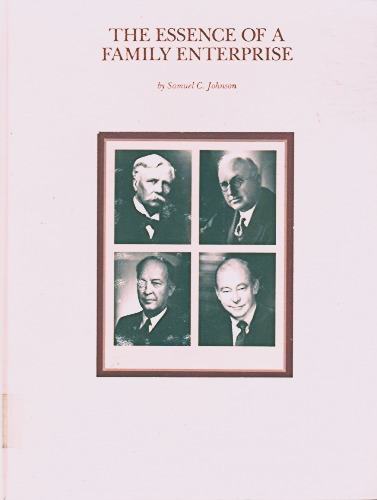
The Notes
- Published in 1988.
- The author is the great-great grandson of the company’s founder, Samuel Curtis Johnson.
- S.C. Johnson & Son is a private family-owned business.
- “We have said on many occasions that we do not run our business for tomorrow, or the next quarter, or the next year, but for future generations.”
- “I believe in doing what we call the ‘right things.’ In order to see the right things, we must have a broad perspective, which means the ability to see beyond the immediate.”
- Benefits of Being Private Family-Owned
- The biggest edge for private companies is secrecy from competition — no financial disclosures.
- Being “free from the vagaries of the stock market, ups and downs that sometimes, through no fault of the management, can send shudders through a corporation.”
- Management stability.
- Allows for long-term, generational, focus.
- Able to support charitable, social, or local causes without shareholder pushback.
- “A public company does its utmost to enhance short-term earnings, numbers that appear in quarterly and annual reports: columns of black ink that keep shareholders happy, content, and quiet. But a family-controlled company manages its earnings from another perspective, with success measured in terms of years and decades, and not merely quarter-by-quarter.”
- The author mentions a USC study that showed private companies had higher profit margins and ROA, on average, than public companies.
- “Sometimes you have to play catch-up, and it’s important to do that as well as being an innovator.”
- The skillset needed to do a job differs more from the initial skillset upon hiring as your promotions pile up.
- Leadership Qualities:
- “What is this thing called leadership? Well, in the most basic sense it is the ability to bring a group of people together into a common and cooperative course of action.”
- Honest communication is the required skill of a good leader. Listening is second on the list. Communication works both ways.
- Good listening requires understanding what people are really saying while separating out what people think you want to here.
- “If there is not cross communication among people of different backgrounds and disciplines, if new ideas and approaches are not proposed and tried, even at the risk of failure, then an organization will grow stagnant.”
- “If there is good news concerning the company, by all means say it loudly. If there is bad news, well, speaking softly and seriously is fine. But be sure you are totally honest, comprehensive, and are heard.”
- “My personal decision-making process involves soaking up the best advice I can get from the people I think know the most about a given subject. When I’m confident, I’ve gotten the best advice possible, then I’ll make up my mind.”
- “The ability to accept the best advice and yet have the courage to ignore it is also a quality of leadership. Leadership sometimes puts one in a position of being alone, out front, as it were, leading.”
- Leaders rally those that disagree with their decisions.
- “I have been wrong in my career plenty of times. I’ve been right more times but I believe I’ve learned to accept making a mistake in a dignified way. If you’re not willing to be wrong or to make a mistake, then you can’t lead.”
- “Mediocrity breeds mediocrity, while excellence breeds success… Excellence should be reflected in every element of your business, right down to the way products are packaged.”
- Great leaders praise often and give credit when its due.
- Communication
- The company, at the time, gave employees three lines of communication: to their supervisor, to the personnel department, and to the CEO, with no fear of reprisals. Employees not satisfied with an answer at one line, can go up the line for an answer.
- Just Ask – A system that allows employees to submit questions confidentially, questions get directed to the person who knows the answer, and the answer is returned.
- Opinion Surveys – All employees get surveys and plans are created to address any issues raised in the surveys.
- Profit Sharing Requirements:
- The company instituted a profit-sharing plan in 1917.
- Company goals, from the top down, must be clear to everyone.
- The money needs to be meaningful to employees. The company sets aside 25% of profits before taxes to employees — potential for two-months’ pay.
- It has to be universal. Every employee is included not just executives.
- It cannot used to offset fair wages. It’s in addition to good pay.
- It must be consistent from year to year. Employees need to share in the success and failure of the company for it to work. If profits go up, the amount shared goes up. When profits are down, profit sharing is down.
- “More family enterprises have gone astray through a lack of good advice than for any other single reason.”
- “A board composed mostly of outside individuals, strong and reputable professionals, can act in the best interest of the company. And that is what you need in a family business: decisions that ensure the future of the enterprise, which are not clouded by the short-term considerations, or perhaps selfish interests, of family members or managers who may think more in terms of themselves than the company.”
- Diversification, Innovation, and Creativity
- “Without new products a business almost invariably stagnates.”
- Innovation includes improving existing products, develop products for new markets, and recognizing when an improvement leads to a new product that creates more consumer choices and strengthens market share.
- Diversification includes M&A into new product markets.
- “The primary objective for a corporate leader is to ensure institutional survival. Developing a survival strategy is what every company and every CEO is doing. To survive you have to grow. To grow you have to diversify. Therefore, diversification is essential to a survival.”
- “When a company is diversified into various fields, it is rarely seriously vulnerable to the ups and downs that ravage individual businesses. And, if you are geographically diversified — that is, spread throughout the nation and the world — then you have some insulation between yourself and localized political and economic trouble.”
- “Seeing the significance of vital relationships is very much a part of the creative process and should be part of disciplined scientific training. Men and women with technical backgrounds can all of sudden ‘see the light’ and connect disparate thoughts.”
- Fostering creativity involves challenging people, open mindedness, willingness to fail, curiosity and learning, patience, exchanging ideas, a long enough leash to try things, and luck.
- “To be successful, companies must develop a coordinated strategy for both technological development and marketing. To grow, companies must find new markets and new customers for existing products, as well as develop new products for both current and new markets and customers.”
- R&D extends down to the cap on a bottle.
- “Most existing products can be expected, over the course of time, to be preempted by other new and improved products. Or, as similar products enter the market, to degenerate into a price-competitive situation, which yields narrow profit margins. Only by continually bringing forth new products, or improving upon old ones, can a company sustain long-term growth and profitability.”
- Product Plus – the company’s philosophy that any new product should have an advantage over existing products on the market, clear superior performance, or has no competition and be obvious to customers.
- “While positioning and market segmentation are very important, the products themselves must establish that position, with a unique attribute that fits the position.”
- “The ability to anticipate the needs of the consumer is an essential ingredient found in the successful, innovative company.”
- “Ultimately this is what business is all about: building the better mousetrap again and again.”
- Diversification includes expanding to markets in other countries.
- Intrapreneurs – Gifford Pinchot came up with the term to describe existing employees who come up with solutions to problems even when its outside their job.
- The company added a reward system for potential intrapreneurs in the company to stimulate innovations.
- Marketing
- Ask, “What sets [the product] apart?”
- “No matter what form of management you ultimately follow, it is important to move into a country or potential market as early as you can. by doing this you avoid having to fight entrenched competition.”
- Public Relations
- Public perceptions shape customers decisions. A favorable impression is key.
- “My favorite definition of public relations is that is the management function designed to increase profits directly or indirectly by earning public goodwill, through the communication of corporate accomplishments and policies in the public interest. A company defines itself by what it does and how it communicates with others. Lack of identity can be just as fatal to an organization’s success as it is to the success of an individual.”
- “Good news in whatever form has to be fairly spectacular to draw widespread and long-term media and public attention. If the achievement is unique, creative, and distinctive, then it can’t help but get exposure through the media. But few companies seem to understand that point, including some that are otherwise fine firms.”
- “Excellent companies attract excellent people, which in turn perpetuates the cycle.”
- Media Guide:
- Don’t refuse an interview with a legitimate professional member of the press but check their credentials, affiliation, and authenticity first.
- Avoid “no comment.” It can be interpreted as agreement or guilt. The media will eventually dig up info from less informed or reputable sources.
- If you don’t have an answer, don’t make one up. Say, I’ll get back to you with that info.” Then follow up on it before any deadline.
- Give media relevant good and bad news, but do not offer strategies anything that might help competition like potential deals, acquisitions, etc.
- Avoid negative or controversial comments on other people or companies. Be aware of questions designed as traps.
- No “off the record” comments. Don’t say anything you don’t want to see quoted or broadcast in the news.
- Get legal advice in advance (in writing) before commenting on any litigation.
- Candor and honesty can defuse publicized bad news.
- Prep for interviews with PR staff in advance to anticipate questions and prepare answers.
- Challenge major errors, not minor errors. Rebutting minor errors can keep the topic alive longer it should.
- Keep a record of all interviews to defend against misquotes.
- Be available for events in the public interest, with no profit motive, and inform the media.
- Keep a positive attitude toward media. Know the reporters and editors, accommodate them and inform them.
- “The bigger a company gets, the greater the tendency is to develop a bureaucratic middle layer.”
- The “bureaucratic middle layer” acts as a buffer that stalls creative ideas and stagnates the company. One possible solution is to push decision-making to the lowest level.
- Philanthropy, Volunteer Program
- The company sets aside a 5 percent of pretax profits for charitable giving each year and has a volunteer program that benefits local communities at its business lcoation.
- “It has a two-way benefit — a benefit to the community organization and a benefit to the person and his company.”
- The company created an annual reward that creates competition between its worldwide locations for “significant achievements in community involvement.”
- Created an annual community service award for individual employees for volunteering in the community. The employee gets money donated to a charity of their choosing. A similar program exists for retired employees.
- The company matches employees’ charitable contributions to the United Way, high schools, and colleges.
- “Accumulated wealth really isn’t very important. If it just sits there, what good does it do? Personal wealth should be reinvested in productive enterprises, just as a corporation does with part of its earnings, or it should be put to use in a philanthropic way.”
- “Social responsibility recognizes that the health of our communities, our schools, our governments, bears on the health of the corporation. And, in turn, the health of the corporation bears on the well-being of its most important resource — its people.”
- Benefits:
- Improve public perception.
- Improve employee morale.
- Recruit better employees.
- ART: USA
- Art exhibit created in 1962 made up of 102 paintings by 102 American artists. The exhibit toured 18 cities around the world over two years.
- The company commissioned the paintings.
- The collection was worth more after the tour and it was donated to the Smithsonian as a charitable contribution.
- Commissioned “To Be Alive” for the 1964 New York World’s Fair. It won an Oscar.
- Frank Lloyd Wright
- The company and family had a history of working with Wright.
- Johnson Wax Administration Building in Racine, WI.
- Commissioned to design the building in 1936.
- Wright was almost broke when he was commissioned to design it, due to the Great Depression, decline in the public’s image of him, and his own arrogance.
- Wright designed the building down to the doorknobs.
- It had an open office concept, modular furniture, and required new materials, some of which had to invented.
- The original design failed approval of the Wisconsin Industrial Commission until they proved that the columns could support the weight of the roof.
- The building received widespread attention thanks Life magazine.
- “Very early in my life, I had to choose between honest arrogance and hypocritical humility, and I chose honest arrogance.” — Wright
- Wingspread
- Designed for the home of the author’s father.
- It was later converted in the Johnson Foundation’s headquarters.
- Johnson Research Tower
- Designed by Wright and opened in 1950.
- “Really great companies today don’t build ‘mean’ little buildings, or ‘mean’ big buildings, for that matter. They construct buildings that their people are proud of.”
- “Good taste, good design, and good judgment should characterize your buildings, your advertising, your packages. As Isaac Disreali once observed, ‘It is wretched taste to be satisfied with mediocrity when excellence lies before us.’” — Bill Connolly, VP of Public Relations
- Money Lessons
- “The learning process in running your business is learning how to manage your own money, in order to be assured that in the long run your inheritance of the business is always going to be there.”
- “My father saw to it that I learned two important lessons. In the first instance, he worked it out so I learned to handle money responsibly, even in my teens. It was expected of me… A second important lesson which my father passed along to me was the idea of learning how to be a producer, not just a consumer of things… You should do something that puts more into society than you take out.”
- H.F. Johnson
- The author’s father and great-grandson of the company’s founder.
- Was the company’s first trained chemist, graduating from Cornell University.
- Helped lead the company’s international expansion.
- Believed the company was nothing without its people and community it resided in.
- “He once told me that very few people knew how to make money with one hand and spend it with the other. He believed that in some ways it was harder to give money away than to make it.”
- “The goodwill of the people is the only enduring thing in any business. It is the sole substance… The rest is shadow.” – H.F. Johson, 1927
- Brief History
- 1886 – Founded by Samuel Johnson in Racine, WI. He was in the 50s at the time.
- The original business made parquet flooring.
- Later, as an addon, floor wax was developed and included with every new floor installation. People who never bought flooring began buying the wax.
- 1898 – The company introduced Dance Wax. It made gliding on the floor easier.
- 1900 – Added paid vacations for employees.
- 1913 – Slowly began selling internationally.
- 1914 – Formed the British company for overseas sales. The first shipment overseas was sunk due to the start of WWI.
- 1914 – Auto wax was introduced six years into the Model T’s production.
- 1916 – First overseas factory built in London.
- 1917 – The company stopped making flooring.
- 1917 – Added a profit-sharing plan, group life insurance, and an 8-hour workday for all employees.
- 1917 – Expanded to Australia.
- 1920s – Developed engine carbon filters and electric floor polisher.
- 1926 – Instituted the 40-hour work week.
- 1928 – “My grandfather passed away without leaving a will, and it took my father, who was then twenty-eight years old, about eleven years to sort out the details of the business.”
- 1930s – Introduced furniture polish.
- 1934 – Added a pension plan for employees.
- 1936 – Commissioned Frank Llyod Wright to design the Johnson Wax Administration Building. The building cost 1.5 years of company profits at the time.
- 1939 – Added hospitalization coverage for employees.
- Instituted a no-layoff policy during the Great Depression.
- Sponsored the “Fibber McGee and Molly” radio show.
- WWII – The company developed rifle bore cleaner, Drax laundry detergent, and a wax based paint.
- 1950s – Introduces Off! insect repellant, Raid insecticide, and Pledge furniture polish. Began TV advertising sponsoring Robert Montgomery and Red Skelton.
- 1951 – Built the Lighthouse Resort.
- 1953 – Added a deferred profit-sharing plan and major medical insurance.
- 1975 – Added dental coverage.
- 1976 – Acquired a bank in Geneva, Switzerland.
- 1980 – Built a Recreation Center.
- 1985 – Built a childcare center for employees.
- 1987 – Bult an Aquatic Center.
- Johnson Worldwide Associates (now Johnson Outdoors) was spun off from SC Johnson. The spinoff and IPO created liquidity for estate planning events and protects the S.C. Johson Wax shares.
Buy the Book: Print