
 Buy the Book: eBook
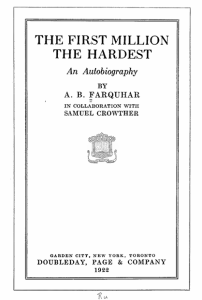
Arthur Farquhar rose from apprentice to partner to sole owner of a global agricultural company in the 19th century. His autobiography tells the story of business and life during the Civil War through 1921.
The Notes
- Founded A.B. Farquhar Company, an agricultural manufacturer.
- How Can I Make a Million Dollars?
- “I happened across an issue of Harper’s Magazine which described the successful men of New York, and immediately became fired with the notion that the way to get along in the world more rapidly than the next fellow was to find the secrets of those who had made the high scores.”
- He traveled to New York in 1858, before age 20, to ask prominent men of the time what their secret was.
- “I still consider that asking questions is about the most useful way that a young man can put in his time – provided that he uses a reasonable amount of intelligence in framing the questions and digesting the answers.”
- He contacted William B. Astor (Astor Hotel), John A. Stevens (Bank of Commerce), A.T. Stewart (A.T. Stewart & Co.), George S. Coe (American Exchange Bank), and James Gordan Bennett (New York Herald). Astor inherited his wealth and sent him to talk to the others.
- Stevens helped the U.S. Government finance the Civil War.
- “I find that the really great men of the country rarely have ostentatious offices, and I know of none who go in for extravagance in dress.”
- “The most striking recipe for success which they had to offer, as I remember, was about this: ‘Take care of your character, never break a promise, and give value for what you get. Avoid speculation.’”
- “They had no short cuts to suggest and curiously enough, not one of them even spoke of technical or other proficiency. They were concerned only with fundamentals. I gathered from them that if one were scrupulously honest, industrious, and economical, then the other business qualities came almost as of course – but without the fundamentals nothing else mattered… Having known many of the larger business men of the country during the last fifty years, I do not recall one who achieved any measure of permanent success who did not have these fundamental qualities. Men without them, indeed, have sprung up but their success has been ephemeral.”
- “Money is made by saving – saving and investing. You get your profit out of the leaks that you stop.” — A.T. Stewart
- “[A.T. Stewart] said that every penny which is saved ought to be invested. The place to invest was in your own business, up to the point that you can there use the money profitably; that it was best to save so that whenever your business needed money you could provide it yourself and not have to borrow. I believe this is a principle which he scrupulously followed.”
- “All of the men I met were the heads of one-man concerns… They were despots, absolute rulers, and they were inclined to be paternal.”
- Life
- Born in 1838.
- Grew up in Sandy Spring, Maryland, about 18 miles from Washington D.C.
- He had 5 brothers and 1 sister.
- Both parents were educated. They met when his father sought French lessons from his would-be future wife in exchange for chess lessons.
- His father taught school for two years, worked as a civil engineer for the railroad, started a boarding school, while running his farm.
- “The whole teaching of my father had been to the end that no one could properly be called a man who let his love for a dollar interfere with his love for a book – which is a precept that has always stayed with me.”
- “We lived so simply. There were no moving pictures, no shows, and no amusements, as we know them today. We took great delight in simple games, we had simple clothes. A box of candy was considered a magnificent thing.”
- Taught at home until age 9, then went to the local log schoolhouse a mile away. Studied French, German, Latin, and Greek. Attended Alexandria Boarding School.
- Managed his father’s farm for a year after boarding school. Got him interested in manufacturing agricultural machines.
- Married Elizabeth N. Jessop on September 26, 1860. Their “wedding journey” was to Niagara Falls.
- They paid $84/year to rent a house (domestic servants charged $3/month plus board, washer-woman was 25 cents/day, and farmhands were $10/month). A net worth of $20,000 was considered well off.
- They had 4 sons and a 1 daughter. One son followed him in the family business.
- He regretted working so many hours and not spending more time with his kids.
- W.W. Dingee & Co./Pennsylvania Agricultural Works/A.B. Farquhar Co., Limited
- Father sent him to be a machinist’s apprentice at W.W. Dingee & Co., in York, Pennsylvania, in April 1856.
- Manufacturing was not automated then. Machinists built everything by hand, including their tools.
- Machinists made about $1/day in wages. Farquhar was paid 25 cents/day as an apprentice his first year, 33 cents/day the second year, and $3/day after he became assistant manager.
- He studied drafting and took business school courses in the evenings to learn accounting.
- He was offered a partnership after 19 months. His father lent him a small sum to buy in as a partner.
- “It is safer to take something that is going than to start afresh.”
- Became a salesman after becoming a partner because the other partners hated traveling. He was selling threshers and seperators to wheat growers.
- Most of the business was done in Southern states. The Civil War ended that in 1861.
- The factory burned down not long after the Civil War started. They had enough cash to cover 25% of outstanding debts (mortgage and claims).
- Farquhar refused to agree to anything less than payment in full. The partnership was dissolved. He assumed all responsibility for the debt, renegotiated with the creditors to pay it off in 4 years, and reopened the business in a new warehouse at the same location. The creditors lent him additional funds to buy supplies.
- “I found that the very relation of creditor and debtor made them to all intents and purposes my silent partners. Every one of them aided me in every way he could. Within four years I paid all of their claims. Those were four hard years. I worked practically all of the time.”
- Renamed the new business the Pennsylvania Agricultural Works.
- “In our town the ordinary bills were paid but once a year – April 1st. On that day the people came in from all over the county and, cash in hand, went around to clean up all their bills. The town was thronged with people it was a kind of holiday, for the shops generally closed. If a man did not pay on that day he was as good as insolvent. We in business had to pay somewhat more often than once a year, but seldom did we pay more often than quarterly. But on the first of April we had to pay, or lose standing.”
- After the Civil War, production focused on thrashers, drills, cultivators, plows, and horse mowers.
- Steam-powered versions of each went into production with the invention of steam power.
- He had built a large export business by the 1870s. Foreign sales was done through commission agents. American farm equipment was seen as superior to European versions. Commission agents paid cash on delivery and took on the risk of shipping and selling the equipment overseas.
- Exports got the business through the economic fallout from the 1873 Panic. His workers agreed to a 25% pay cut with a promise to pay the difference if overall wages didn’t decline in six months. He was lucky to get long-term credit thanks to his reputation.
- “I covered my overhead expense by adding 25 percent to the naked cost of material and labor. With all our advance in cost accounting, I find little practical improvement upon my old method.”
- There was no telephone, no electricity, work was done under kerosene torches or gas lights.
- Advertising was done in trade journals and illustrated catalogs.
- “Working with the men, I knew all of them by name and if they thought that my management was too severe – though it never was – they had only to reflect that I never asked any man to do more than what I did myself.”
- His factory burned down a second time in 1876. He was wiped out again.
- “Fortunately, my credit was of the highest. I had followed the rule of Hamilton Fish never to break a financial promise; I always paid every note when due unless there was an understanding that it could be renewed.”
- He used the second fire as an opportunity to expand his business. He bought a building along the railroad, near his old factory. He also built a second factory to double the size of the business and cover his losses. Both buildings were bought on credit payable in the future. He bought raw materials on 6, 12, and 18 months of credit. His workers offered to work at a 15% pay cut for a month.
- “Ordinarily I would rather run the risk of paying the higher price than tie up my money in raw material speculation with the inevitable prospect of serious embarrassment when my valuable inventory suddenly became less valuable.”
- “Holding on to higher-priced stocks in a depression in the hope of higher prices generally is bad business, for then one postpones the time when he can buy and sell in the usual relation to the price level of commodities.”
- “I have always had a good part of my business directly with farmers and in all these years, trading with thousands of farmers, I have never heard one admit that prices were satisfactory, and only one, in my recollection, admit that he was making money.”
- International Harvester became his biggest competitor and leader in the market. Its formation forced him to drop production of sawmills, furnaces, and rolling mills because of an inability to compete on price.
- He led weekly meetings with foremen, managers, a committee of workers to discuss complaints, improvements, and the employees’ general well-being.
- He preferred bonuses over profit sharing because the company was not guaranteed to be profitable. Bonuses were a byproduct of extra profits.
- Was one of the first to export agricultural equipment.
- Exports kept the business running continuously and fully employed during every business depression.
- He used periods of recessions and when orders slowed to improve the factory and equipment. He would employ his workers to help build new buildings to keep them fully employed.
- A separate export business was run under the name A.B. Farquhar & Company out of New York. Sales were done wholesale through commission agents or merchants local to other countries.
- He printed a version of the Farquhar catalog in Spanish for Mexico and South American markets.
- The first direct shipment was to South Africa in 1866.
- “I think one does well rather carefully to ponder over whether the design is to go into foreign trade as well as domestic trade, or to supplement domestic trade with foreign trade.”
- “Delays are bad enough in domestic business; in overseas business they are fatal because, if you miss a ship, the goods may miss the season during which they were expected to be sold.”
- He incorporated the business in 1899, renaming it A.B. Farquhar Co. Ltd. It was done for estate planning purposes and give his sons a piece of the business.
- Civil War
- “The beginning of the Civil War did not call for any great drafts of men in our section and we had nothing like the recruiting enthusiasm that marked our entry into the war with Germany. Of course, we were all unsettled, but none of us really comprehended the sort of contest that was opening.”
- “We felt that slavery was a political question and we were more concerned with establishing the principle that all new states admitted to the Union – for then the admission of a new state was as personal a matter to every citizen as the election of a member to a small club – should be free states.”
- “Can the people of a United States territory in any legal way, against the will of any citizen of the United States, exclude slavery from its limits prior to the formation of a state constitution?” — Abraham Lincoln
- South Carolina was the first leave after Lincoln won the election. Georgia, Alabama, Louisiana, Mississippi, Texas, and Florida left before Lincoln’s inauguration.
- “We knew that the situation was serious; but, somehow, we could not adjust our minds to civil war. Neither side really believed that there was going to be a fight. The most that any one could conceive was an insurrection — an over-sized riot.”
- “You have no oath registered in Heaven to destroy the Government, while I shall have a most solemn one to preserve, protect, and defend it.” — Abraham Lincoln
- “Politics were usually violent. In most disputes, each side held as of course that the other was actuated by lower motives than had hitherto been known in the history of the human mind and that, as far as personal character was concerned, one would have to go back to the worst of the Roman emperors even to get a faint idea of the moral turpitude of the opponent. We were accustomed to violent invective; and seldom an election passed without a number of free-for-all fights. What we today would call a shockingly vituperative campaign would then have been classed as mild.”
- The seizing of Fort Sumter changed people’s view of the possibility of war. Lincoln issued a proclamation for 75,000 troops from state militias three days later.
- “Business dropped dead. Everybody started to drill. The banks closed; they stopped specie payments. We had an unofficial moratorium. Men wanted to get everything they owned converted into money and to be ready to go out and fight. Stocks and merchandise during those first days were sold at almost any price that was offered.”
- “There was no idea in the beginning that the country was to fight for its life. The first call for only 75,000 men to serve three months was an indication of the official view. We were generally more concerned with the quick punishment of Americans who had dared to fire upon the Stars and Stripes than we were with getting ready for a civil war – that was still inconceivable. Indignation superseded preparation.”
- “The noncombatants always hate more violently than the combatants.”
- Farquhar did not enlist (married men were not expected to enlist at the time). Instead, he sent a substitute and joined a local volunteer “home guard.”
- The Union eventually conscripted men between the ages of 18 and 45. Men could pay the Government to avoid serving or find a substitute. Substitutes could be bought for anywhere from $300 to $800. Fees were higher in areas where more men were drafted.
- The Confederates conscripted men between 18 and 50.
- “One of the early acts of the Confederacy was to declare that all debts owing to Northerners by Southerners were canceled as far as the original debtors were concerned, and payable into the Confederate Treasury. A similar statute was enacted by the Union.” The more honest businessmen paid some debts through Canada as a clearing house.
- “We did not particularly feel the expense of the war. We had a small tax on incomes over $1,000, a sales tax which did not last long, and bonds, of which the Government issued, for then, very large quantities, which were absorbed almost entirely by financial interests under the lead of Jay Cooke.”
- Battle of Bull Run
- General Fitzhugh Lee was headquartered in Fredricksburg, 40 miles from York, Pennsylvania. Farquhar’s home guard was sent to observe the situation. Most of the men dropped out after 18 miles.
- Farquhar continued on, met the General at his headquarters, asked his intentions, then returned and told the Governor of Pennsylvania that the Confederates were not going through York.
- Gettysburg
- Got word on June 27, 1863, the Confederates would be in York soon. Farquhar proposed to meet the Confederate army to negotiate the surrender of the city before they entered town.
- The Confederate Army requested: 165 barrels of flour or 28,000 pounds of baked bread, 3,500 pounds of sugar, 1,650 pounds of coffee, 300 gallons of molasses, 1,200 pounds of salt, 32,000 pounds of fresh beef or 21,000 pounds of bacon or pork, 2,000 pairs of shoes or boots, 1,000 pairs of socks, 1,000 felt hats and $ 100,000 in United States money.
- “The General had specified United States money but we argued that he should take Confederate money, a dollar of which was worth about 10 cents in Federal money – for we soon found that we could not raise as much as $ 100,000 in cash. We compromised on $ 28,610, as finally collected, in Federal legal tender, and about its equivalent in merchandise. We gave him a due bill for the balance which of course was never collected.”
- Farquhar volunteered in the Hospital Corps during the Battle of Gettysburg.
- After the Confederates lost, the townspeople called Farquhar a traitor. President Lincoln disagreed.
- “You were wise not to neglect an opportunity to be of service. Opportunity does not knock at a man’s door every day. The mistake you made was in worrying yourself over what people say about you. You should go through life doing what you believe to be right and not bother yourself over what people may say. They will soon forget their criticisms.” — Abraham Lincoln
- “Our aim in life should be to leave the world a mite better than we found it, and the only way we can do that is to contribute a little every day.” — Abraham Lincoln
- “About two o’clock in the afternoon of the next day – the third day of the battle there commenced a tremendous cannonade of some three hundred guns in one great battery, to clear the way for a charge on which the Confederates were to stake their all. They did not have enough ammunition to keep the artillery going as long as they had hoped, I learned afterward. Anyway, the cannonade ceased and then began a terrific din – the rattle of small arms, shouts, yells, orders for Pickett and his men were making their famous charge up Cemetery Hill… The waves ebbed; our men ceased to fire; the charge was over – and a failure. The Battle of Gettysburg was won.”
- General Lee’s retreat was hampered by flooding of the Potomac. The Union’s failure to pursue him was a missed opportunity to end the war.
- “I left a wife and children at home everything. Now here is a chance of ending this war and they are throwing it away.” — General Wadsworth
- Lincoln’s Gettysburg Address:
- “When a great thing happens, those who are there rarely have any notion of the greatness. The Tribune said that the President had “made a few remarks” and a Harrisburg paper, published the next morning, spoke sneeringly of it as being unworthy of a president.”
- Abraham Lincoln
- “Those who know the days of the Civil War only from books can have but little realization of the tense political struggles that were taking place in the North of the personal opposition to the President on the part of the extreme Abolitionists on the one hand and the Copperheads on the other, and of the movement led by the Tribune among them to force him out. They wanted to displace Lincoln with someone else whose sole thought would be the abolishing of slavery rather than the saving of the Union.”
- “By the time of Lincoln’s second inauguration his position had become more permanent. The personal opposition to him was negligible. But it was not until April 15, 1865, with the war ended, and Abraham Lincoln suddenly dead, that the country began to know what it had had and what it had lost in the way of a man.”
- Lincoln had a plan to rebuild and bring the South back to into the Union. His assassination ended that. President Johnson, Lincoln’s predecessor, was focused on punishment: “The American people must be taught to know and understand that treason is a crime…it must not be regarded as a mere difference of political opinion. It must not be excused as an unsuccessful rebellion to be overlooked and forgotten.”
- Business
- “Army contracting became a business of itself. Many unprincipled men were attracted to it in the hope of cheating the Government, and some succeeded. It is particularly reprehensible for men deliberately and shame- lessly to profiteer at the expense of suffering humanity during the throes of war; but there were such, for whom the hangman’s noose would be a fitting punishment.”
- Contractors formed rings that made it almost impossible for anyone outside the ring to do business with the Government. The rings recruited government inspectors to condemn products produced by businesses outside the ring.
- “The workman who before the war had been receiving $1.25 a day in gold, after the war received double that in greenbacks, but in gold little more than he formerly received.”
- Post-War
- “There were comparatively few able-bodied men about on my first journey to the South. Those who had formerly been rich had shoes, but most of the population, black and white, were barefooted. They had plenty of cornbread and some bacon, but that is all they did have. Their only money was in the worthless Confederate issues. The houses and plantations were run down. During the war there had been nobody to repair them. Now there was no money to pay anyone to repair.”
- A cotton export tax offered barely a return on cotton crops. Equipment to plant other crops didn’t exist (it had been consumed by the military effort).
- Carpetbaggers took advantage of laws to gain political power in the South after the war.
- Post-War Expansion
- A mass migration westward (Homestead Act) after the war created a boon for businesses that lasted until the 1873 Panic.
- “Between the conditions at the close of the Civil War and the conditions at the close of the World War are indeed some points of similarity. We had fairly high prices and about the same number of soothsayers predicting that prices immediately would drop and that there would be a return to pre-war conditions. As I look back over all these years in business, it seems to me that the general sentiment has always been that we were going to return sometime or other to something or other, but that under no circumstances do we ever return to exactly the same condition!”
- The economy took a while to get back to normal due to overproduction at the war’s end.
- Mass expansion of the railroads provided jobs for soldiers and expedited the migration west. Demand for materials and products jumped as they built out the west.
- “Many people speculated in government securities and in greenbacks. I had a friend in Holland who bought bonds at 45 cents on the dollar in gold and later sold them at 105 in gold.”
- Most of the population were farmers. The post-war expansion began the shift from farms to factories.
- “Business went forward rapidly; so rapidly that everyone began to talk of the marvellous prosperity and became a little conceited about it. And they wondered whether the years to come would bring forth the inventions and the numerous progresses of the years that had passed. We lived buoyantly and only a very few gave much thought as to what we were really living on or whether the foundations of our prosperity were planted in sand or on rock. The panic of 1873 answered that question.”
- Panic of 1873
- “In January, 1873, J. L. Mott, the president of the Iron and Steel Association, said before its New York meeting that the country would never see pig iron selling below its then price of $ 40 a ton— that it could never get below that price but that it would go higher. That prediction made a great impression on the country, for Mott was an authority. Within the year pig iron dropped to $18 and $20 and at one time it was offered at $13- practically without takers!”
- “Everywhere we heard detailed prophecies showing exactly why high prices and prosperity were with us forever. If anyone suggested that perhaps the prices of the future were in the laps of the gods and not in the minds of men, he was promptly squelched as a calamity howler!”
- “A few minutes before noon on September 18th, 1873, the message came over the wire to York: ‘Jay Cooke & Company have suspended.’” It was a Thursday.
- Jay Cooke was the financier of the country at the time and helped finance the Civil War. It was unthinkable that his firm could fail. Cooke was overextended in Northern Pacific bonds. That set off a panic that spread nationwide.
- “They saw Jay Cooke as the banker of the people. He was, I think, the first to sell bonds by great campaigns of advertising in which the services of practically all the newspapers in the country were enlisted… Cooke had sold the war bonds in this fashion. He sold Northern Pacific bonds after the same manner… The railroad bonds were pledged as collateral with banks all over the country. The whole credit structure rested on them.”
- “The 18th fell on Thursday; by Friday morning nearly everyone with a bank account was outside his bank’s doors foaming at the mouth for his deposit. No one thought of doing business.”
- Every bank in York, Pennsylvania experienced a run. Same for the rest of the country.
- Banks and the NYSE closed on Saturday.
- “No man wanted to listen to reason; the bottom had fallen out of the country and the only thing in the world that counted was hard money. A currency panic is not pretty; it is a mad, unseeing, unthinking scramble for money – I saw hundreds fighting tooth and nail to get into banks – fighting as cowards fight their way out of a burning theatre. It was a terrible orgy of crude greed when a gold dollar ranked above every sentiment that makes life worthwhile.”
- “In the panic of 1873 hundreds of farmers and small businessmen drew their money out from the banks and gave it to the Smalls. The same thing happened to Andrew Carnegie in the panic of 1907. In fact, he had to engage a man merely to keep account of the money that was sent to him for safekeeping by people that he did not know and had never heard of.”
- “In the higher financial circles there had been a long period of nervousness. The money market was in the hands of speculators and almost any day they, like Jay Gould or Jim Fisk, could get up a corner in money. It may be remembered that the speculators almost brought about a panic on the Black Friday of 1869 by their attempt to corner gold.”
- “I find, looking back through all these years, that the men who, as buyers or sellers, keep level heads and do not force their transient advantages, in the long run, reap the real profits.”
- “The blow of the panic was so sudden, so swift, and so tremendous, that it left the country literally paralyzed. Those who had been shouting prosperity began dolefully to whine that the country was done for, that it was dead forever and a day, that there was no use trying to do anything because there was nothing to do.”
- “One of the several causes for the long duration of the panic was the breakdown of every kind of credit; we cannot do business without credit, and whenever any considerable number of men in business or banking become so frightened that they will not extend credit, then business ceases. Business is founded on confidence; when confidence is withdrawn as a general commodity, then business itself must topple and fall… The man who never extends credit is a greater menace than the man who extends credit too freely.”
- “Even a strong man will not come through a panic unharmed, but as compared with weaker competitors he will be relatively stronger at the end than he was at the beginning.”
- It took until 1879 before the economy fully turned around. That lasted until the depression of 1884 and a panic in 1893.
- The U.S. adopted a gold standard in 1879.
- “Looking back over all of the various recurrent depressions in business I find that they come about largely through the lack of confidence and they leave with the renewal of confidence. It is a trite but a true saying that business is built upon confidence.”
- “Our business depressions come rather far apart and only a small fund of knowledge carries over from one to another. Those who hang on to prices the longest fall the hardest. And, although they may die, they never learn!”
- “Prices always follow confidence; confidence never follows prices.”
- Andrew Carnegie
- Farquhar considered Carnegie the greatest businessman of all time.
- “You must be a lazy man if it takes you ten hours to do a day’s work. What I do is to get good men, and I never give them orders. My directions seldom go beyond suggestions. Here in the morning I get reports from them. Within an hour I have disposed of everything, sent out all of my suggestions, the day’s work is done, and I am ready to go out and enjoy myself. “
- Carnegie owned stock in several railroads but none on margin. He was unhurt during the Panic of 1873, unlike others who were hit by forced margin sales.
- Farquhar met Carnegie during the Civil War, when Carnegie was a telegraph operator for a railroad.
- “He had Scotch caution in plenty but so quick was he to turn over every phase of a subject that one might easily think some of his decisions were at first impression when really he had simply considered every phase in a moment.”
- “Carnegie was as keen a business man as ever lived; he was keen in the large way he saw not merely tomorrow but the day after. And one of the reasons that he so quickly got into large business was that through his study of the literary masterpieces he came to know human characteristics. For after all, great literature is only the preservation of the best thought on human nature.”
- “He kept in close touch with the affairs of the world – he read and traveled widely. Thus he gained a perspective that enabled him usually to see what was coming and then to arrange his affairs accordingly. He believed that knowledge was power and demonstrated that fact.”
- Carnegie had access to Colonel Anderson’s library, which he took full advantage of. It inspired him to create the Carnegie library system.
- “He is said to be the first man to employ chemists in analyzing products needed in iron- and steelmaking. He built on what his competitors threw away.”
- Carnegie took advantage of depressed prices during recessions to buy competitor’s plants and equipment.
- “He conspicuously differed from the other big figures of his day in being a manager of men rather than an expert on his own account. Many men knew more about iron and steel but none knew so much about iron and steel and men and business.”
- Carnegie began the era of big businesses in the U.S.
- Johns Hopkins
- Had two main interests: money and building a hospital/university.
- He was beyond frugal, saved his money, and lent it at high interest rates. He added endorsing notes for a fee of up to 5%.
- Was the President of the Merchants’ Bank of Baltimore.
- “He told me that the secret of success was: “‘Do not waste anything. Make everything you do, and every cent you have, count. The reason why people are poor or unsuccessful is that they waste. Any one can succeed who does not waste.’”
- “I never heard of any one who loved Johns Hopkins, but also I never heard of any one who ever had the shadow of a doubt of his financial integrity.”
- “He regarded the people who came to him for money more as credit risks than as human beings and those who came to him for other purposes than money he had little regard for.”
- Era of Big Business
- Business structures began to change in the 1870s from individual or partnerships to corporate forms.
- Railroad companies were the few at the time that offered publicly traded stocks and bonds. Railroad companies influenced the shift into other industries.
- Most states passed laws allowing charters and corporate associations.
- Industrial securities appeared around this time but railroads dominated public markets for decades.
- “Most of these industrial corporations as at first formed were really only partnerships with the stock very closely held and amounting to all intents and purposes, excepting from a legal standpoint, to no more than partners’ interests. A little later it was discovered that additional money might be had without losing control by the issuance of bonds, and still later came the non-voting preferred-stock idea.”
- Corporate Boards realized that issuing preferred stock to raise money might be safer than bonds because interest had to be paid on bonds whether the company was profitable or not. Preferred stock offered more flexibility in early years and recessions.
- “It was not at first realized by the general public, and perhaps it is not yet realized, that the issuance of a share of corporate stock of the par value of $100 does not make that stock worth $100 or worth anything beyond the earning power of the property it represents.”
- The biggest advantage of the corporation was the ability to more easily raise capital through public markets. That created the ability to install new machinery, produce in quantity, increase growth, and led to larger companies. Larger companies led to specialized labor needs.
- “The real growth of the truly big corporation was due to the fact that it could manufacture and sell goods more cheaply than could the less efficient small producer. And the more goods we get at low prices the better off is the country.”
- Large trusts and monopolies began to form by the 1890s.
- Larger companies also led to organized labor and unions. The American Federation of Labor was founded in 1886.
- “I have no quarrel with the unions. The right to organize for mutual protection and benefit is not questioned; neither is there any question but that through the instrumentality of unionism the workers in some cases have secured for themselves desirable and beneficial reforms which otherwise might not have come, or come only after long delay, having been grudgingly conceded under the pressure of competition by autocratic and unprogressive employers. Unionism’s danger, however, is that of becoming autocratic itself. One of its principal objects appears to be, in all too many cases, that of getting a stranglehold upon an industry and then putting on the screws.”
- 1895 Currency Crisis
- The U.S. was near default because foreigners were exchanging U.S. currency for gold at a faster rate than they could resupply the gold reserves.
- President Cleveland turned to J. Pierpont Morgan to save the day. Government bonds were sold to Morgan, with the help of the Rothschilds, paid for in gold.
- “I have always believed that in a normal life one should grow happier with added years.”
- “I have known most of the great figures of the nation during the last sixty years. I have seen the change from a farming to a manufacturing country, and have seen manufacturing grow from little-shop hand work to great-shop machine work. Many of the things that we use today and deem necessities were unknown to business when I first entered it.”
- “I hold that yesterday is important mainly as its experience becomes a mentor for today.”
- “Happiness is said to be a freedom from want. We have all been educated to want more.”
- “Many of the older men kill themselves by trying to work through the hours they used to work — they do not realize that the score and not the hours is what counts. Under modern conditions they should not attempt to work twelve hours a day. I am not certain that eight or any other arbitrary figure is right. It all depends upon the work. It is hard to get away from calculating work by hours instead of by results.”
- “It often happens that the less you know about a subject, the more fanatical you can become.”
- “To the man intent upon his work, the snow is but a color.” — Emerson
- “The human political and business mind seems to travel through cycles and after every business depression comes the incessant, unreasoned, unreasoning, blatant demand for a high tariff and cheap money. We have never yet as a people failed to respond to the politician who promises something for nothing.”
- “Books have become to me, in that intimate and personal way which is so enticing to the true book lover, ‘the ghosts of my former friends.’”
- “The first time I talked through the telephone was at the Centennial Exposition in Philadelphia… It seemed to me one of the most astonishing things man could conceive of, but no one then seemed to imagine it would become one of the world’s greatest time savers.”
- “Failing all else, we always blame the Government for bad business and always the quacks come forward with sure remedies.”
- “One gains strength by overcoming obstacles; I took a positive interest in surmounting difficulties, in improving methods of work, and in keeping in the closest touch with my customers. And so my life, in spite of the seemingly long hours, has been very happy.”
- He was all about free markets. He believed tariffs were anti-competitive and encouraged price fixing and higher prices.
- “If infant industries could begin with large capitalization they would not need protection, for they could finance themselves over the losing years but it is not reasonable to expect that such a large amount of capital will be subscribed to a new venture and hence a tariff is sometimes valuable in permitting the experiment to be made on a smaller capital.”
- “Even practical men are often deluded, and that almost any man is prone to put powerfully the side of a question on which he sees his own interests.”
- “It is always popular to bring out a quack and shortsighted remedy and it is always unpopular to suggest that tomorrow will be another day. And that always behind these quack and immediate remedies put forward for the good of the people is a considerable special interest which, being also extremely nearsighted, thinks it can make a turn at the expense of the welfare of the country.”
- “I have found that the best antidote for acute economic insanity is ownership of property.”
- “I had always favored any policy which gave the greatest good to the greatest number and I felt that I should accord honor and not malice to any man who, by better methods, successfully competed with me. That rule has brought me business in ample volume and I have consistently followed it even to the point of taking the initiative and refusing an order when I knew the prospective buyer could get more for his money elsewhere. This is not only sound economics but good business.”
- “Personally I have never been able to understand envy or malice. Why should not one be glad to see another get on? Why is it not a satisfaction to see any man honestly accumulate property and gain wealth? Why is it not pleasant to have a successful man build himself a handsome residence? I, standing outside, can have all the pleasure and appreciation of its beauty, while he, standing inside, has to pay the taxes!”
- “No happiness or contentment can grow out of the seeds of envy and hatred.”
- “Campaigns in favor of home-made products are being gotten up from time to time all over the world, but nobody ever pays much attention to them unless the home-made article happens to be better and cheaper, in which case it would be bought without any campaign… The man who is actually going to buy gives lip service to all of these patriotic movements and then goes round the corner and buys according to the value of his dollar.”
- “There has never been a time when it has been impossible to organize the malcontents. I am beginning to think we should not be normal without them.”
- “What have these years taught me? Nothing of a startling nature the incidents fade – but these principles remain:
- That it is, as a rule, safe to trust human beings. Comparatively few are unfair, if you are fair yourself.
- That troubles and apparent difficulties are but stepping-stones to progress – the most practical way of learning — and, as Greeley said, “The way to resume is to resume.”
- That there is nothing that will take the place of work, either to gain success or to gain happiness or to gain both – and I think it is possible to gain both if, in the striving and working for success, the dollar is not put above the man.
- That one can and must keep faith with oneself.
- That God is not mocked. You cannot break his laws without suffering.
- That one’s only dangerous enemy is oneself. In the ultimate no one can hurt you but yourself.
- That friends are among the greatest assets – and the way to get friends is to be a friend.
- That one should never seek anything for which one does not give value. This avoids the disposition to speculate – which is one of the greatest dangers that beset the businessman.
- Following these rules, the world grows in interest and life is happier with gathering years.”
Buy the Book: eBook