
Buy the Book: Print
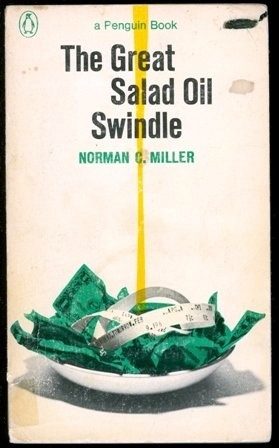
The Great Salad Oil Swindle tells the wild story of how Tino De Angelis grew a vegetable oil company into an industry leader only to be uncovered as one of the largest fraud cases in the 20th century.
The Notes
- The author worked for the Wall Street Journal during the time of the scandal. He won a Pulitzer Prize for his stories in 1964. The book expands on his reporting.
- Anthony (Tino) De Angelis
- Born in 1915.
- Grew up in the Bronx, one of five kids, to Italian immigrants.
- First job was in the meat and fish market. Led to a job in a hog-processing plant for City Provision Company.
- Married Virginia Bracconeri, had a son Thomas.
- 1938, opened his own business, M&D Hog Cutters. He claimed it was a huge success, making a $300,000 in profits a year by the third year.
- He allegedly profiteered during WWII through black-market meat sales.
- Charged with tax evasion in the 1950s, for evading $1.5million in income from 1944-1946 and 1950-1954. He settled out of court by paying $50,000 immediately and $200,000 in $5,000 installments every three months for 10 years. The IRS never collected the full amount.
- Rumored to be associated with the mob, that used his business to launder money. Nothing was proven.
- Tino owned 1/3 stock in Oak Crest Refining Corporation in Chicago. It was denied a fat-rendering license by Chicago police because employees were associated with the Cosa Nostra mob.
- As the fraud spiraled, Tino complained of a conspiracy within the Agricultural Department and competitors to run him out of business.
- “No one in the world ever did more for the economy of this country than I did.” – Tino De Angelis
- “The reason that I could do the volume of business I did was because I built confidence in people all over the world, I could never have done the business unless I had people who had faith in me.” – Tino De Angelis
- “I have a brilliant and productive mind and I could do more for our fats and oils business than anyone else in the world.” Tino De Angelis
- “His basic interest in money was how it could further his reputation as an important person. He wanted to be known as a big shot in the community, as well as in the commodity trade.”
- Tino had a mistress on the side, Lillian Pascarelli. She was on Allied’s payroll at $25,000/yr, plus $100/week from an Allied affiliate company. There was also $70,000 in jewelry and fur coats and $40,000 for a down payment on a $65,000 house from Tino.
- De Angelis Packing Company
- Opened after the WWII, in North Bergen, New Jersey, to export products.
- First contract, in 1947, to sell lard to Yugoslavia. The Yugoslavian government sued Tino for sending a substandard product. Tino settled for $100,000.
- Other contracts with foreign governments followed a similar pattern.
- Adolph Gobel Company
- Meat packing firm in North Bergen, New Jersey.
- Tino bought controlling interest in stock in 1949. Named himself president.
- Got a U.S. Agriculture contract to supply 18.9million pounds of meat for Federal school lunch program.
- In 1952, the Government charged that that Gobel overstated the weight, thus overcharged for product and sent 2million pounds of uninspected, thus tainted product.
- February 1953, settled with the government for $100,000.
- March 1953, the SEC charged Gobel with understating its 1952 loss.
- Trading in Gobel stock was suspended on the American Stock Exchange.
- July 1953, Gobel placed in bankruptcy. Tino was removed as president.
- The investigation concluded that Tino borrowed money using fake inventory as collateral.
- Justice Department charge Tino with perjury during the SEC investigation but the charges were dismissed after a witness changed their testimony.
- 1958, Gobel emerged from bankruptcy. Its creditors urged the bankruptcy court to appoint Tino as president because, by then, he was so respected in the business community.
- Salad Oil Commodity Trading Overview
- Salad oils and amber oils (used in shortening, margarine, mayonnaise) are used in food stuff, paints, cements, resins, soaps, lubricants and other industrial products.
- At the time, US farmers planted cotton, soybeans, and other crops to make 7 billion pounds of edible oil, in a good year, valued at least $650 million.
- Edible oil production jumped during WWII.
- Soybean production totaled 669 million bushels in 1963, double from 10 years earlier. 60-pound bushels yield 11 pounds of oil.
- Total edible oil production exceeded demand by about 25%. A competitive world market for oil, makes it difficult to sell overseas.
- “As is politically customary when excess supply threatens to depress the price of farm products, the Government has devised a program to support the price of vegetable oil. As it applies to exports, the Government’s vegetable oil program is a hybrid of humanitarianism and politics. The compelling reason for the program was that politicians want to keep farmers happy with high crop prices; the notable solution to this pressing political problem was to distribute surplus oil in poor countries to help feed starving people. Thus the Food for Peace program, more formally known as Public Law 480, was enacted in 1954 to distribute not only vegetable oil but grain and other surplus crops from America’s bountiful farms.”
- Food for Peace Program
- “In the main, the surplus foods aren’t simply given to foreign countries. In complex transactions, the U. S. Government underwrites the cost of foods exported to foreign governments by private U. S. companies under the Food for Peace program.”
- Rather than subsidize crop prices directly, the government relied on private companies to do it.
- A foreign government in need of food, first gets a quota from Agricultural Department, then asks for bid prices from private US companies.
- Companies get approval to bid from the Agricultural Department.
- Winning bidders buy the food in the open market (or from Government stocks) and ships the food.
- The foreign government pays the US Government agency for the shipment, in its own currency, under the agreement that the payment will never be withdrawn from the country. The payment is often returned to the foreign government in the form of US aid programs.
- The private US company submits documents certifying delivery to their bank, the bank sends it to the Agricultural Department, which pays the bank, and deposits it in the company’s account.
- “Thus, after all the papers have been shuffled, the vegetable oil in fact has been given away and the U.S. taxpayers have paid the companies for handling the deal—at a profit, of course.”
- A Congressional investigation into Public Law 480 found frequent windfall profits at taxpayers’ expense. Price manipulation was common. One way was to mark the purchase date different from when it was actually bought, when the commodity price was higher.
- Other investigations found insider information leaked to private companies and commodity traders, who to front run other companies and large open market orders.
- At the time, about $1 billion in farm products is sent overseas in US subsidized programs. Over 100 million tons of commodities were shipped from 1954 to 1964.
- Bunge Corporation was one the largest US based exporters. It was privately owned and one of over 50 companies around the world, controlled by the Bunge & Born trading group in Buenos Aires, that was originally founded in Belgium in 1915.
- The Agricultural Department requires that approved export companies have an office in the US to qualify for the program.
- Bank lending against commodities as collateral is a big business.
- Often done without every seeing the goods.
- Warehouse receipts for commodities are used as collateral for loans.
- Borrower must have the commodities stored in an independent warehouse company.
- The warehouse company assumes responsibility for the goods, issues a receipt to certify the quantity as collateral for a loan.
- The warehouse company may hold the commodities in a public warehouse or in a field warehouse on the property of the company borrowing money.
- A common issue in field warehouses is fraud. Warehouse company and commodity company employees commingle. Goods disappear, phony receipts are issued for poorer quality or no commodities, etc. The problem can be traced back to the US Civil War.
- Despite the frequency of fraud, banks still lend because the interest charged on loans is high and employees see big profits.
- Lax lending standards, ignorance of the commodity business, never inspecting the goods, and plain old greed are common reasons for bank losses.
- Futures Markets
- 17 commodity exchanges existed in the US at the time covering 26 commodities.
- Futures contracts traded in 1964, totaled $60.4 billion in value.
- “The futures contracts are agreement to deliver or accept a commodity at a specified future date at a set price. The buyer of a futures contract hopes to profit by an increase in the price before the delivery date that will enable him to sell his contract at a profit. Conversely, the seller of a futures contract hopes the price will decline, enabling him to profit by buying an offsetting contract which will wipe out his delivery commitment. There is a built-in conflict among traders of futures contracts, since the making of a contract requires a buyer and a seller, each hoping to profit at the other’s expense.”
- The unpredictability of future commodity prices can lead to violent price swings, rumor mongering, and speculators.
- Major companies reliant on commodities in their finished products use commodity futures to hedge against price changes. They hedge to avoid losses by “going short” or “going long” to offset losses due to falling or rising prices.
- Exchanges, at the time, were primarily controlled by companies doing the trading.
- Limited rules and restrictions allowed qualified hedgers to buy and sell futures contracts with no money down (no margin) on some commodities — notably soybean and cottonseed oil. Margin requirements for other commodities rarely exceed 10% of the contract.
- Exchange rules require losses — from margin calls — be covered immediately.
- One futures contract for cottonseed oil represented 60,000 pounds of oil, worth about $7,800. A 1/2 cent drop in the price resulted in a $300 drop in value of the contract.
- The Commodity Exchange Authority, part of the Agricultural Department, regulated the exchanges. It had only 119 employees in 1963. 25 employees were investigators and auditors.
- “As C.E.A. officials interpret the law, they have no power to move against an operator in the futures market who is trying to corner the supply of a commodity so he can dictate prices. ‘It is only against the law to succeed in a corner,’ said an agency official. ‘We are in the position of someone with a time bomb who can’t do anything until it goes off.’”
- Allied Crude Vegetable Oil Refining Corporation
- November 14, 1955, Tino opened the company in Bayonne, New Jersey, on a site with old petroleum storage tanks.
- Tino saw an opportunity in the Food for Peace Program to export excess soybean and cotton oil.
- Started with $500,000 in capital and 22 loyal workers but needed millions of dollars more to build a competitive business.
- Some of the employees had important jobs but not all. They were paid $400/week, drove Cadillacs (some paid for by the company), and got benefits (cash gifts) up to $10,000.
- U.S. companies based in the Midwest dominated the industry. They were centrally located near farmers and shipped product cheaply on the Mississippi River to New Orleans.
- Tino approached New York based export commodity companies. He would buy the oil, ship it to Bayonne, refine it, and sell it to them at a small markup, where they would export it overseas. The export companies loaned him millions, at high interest rates, to get started.
- “No one could figure out how he was making money from his operation. Allied was paying the highest prices in the market for crude oil to discourage its big Midwest competitors. It was adding on costly rail freight rates. It was selling oils to export companies at prices so low that other suppliers were hard-pressed to compete.”
- The export companies didn’t care how Tino did it. They profited from selling oil abroad and the loan interest.
- Continental Grain Company and Bunge Corporation were Allied’s two biggest customers. Combined, they exported $2 billion in commodities per year.
- Late 1950s, Allied supplied more 75% of edible oils shipped overseas. Allied (including affiliate companies) had sales over $200 million.
- The Midwest-based competitors not only gave up on exporting (Tino was always the low-bidder on contracts somehow), but they joined him. They shipped to Allied to take advantage of the high prices offered. Tino paid 1/4 cent a pound over market prices.
- November 1958, US Agricultural Department filed a civil fraud suit against Allied for falsifying shipping records (to make the sale appear after the department approved it) on a $42 million Food for Peace contract with Spain. The suit alleged that $1.2 million in funds were fraudulently collected. The suit dragged into 1960, and the claim was settled with $1.5 million payment after Allied was suspended, from the Food for Peace program. Allied was allowed back into the program.
- Landed a $70 million Agricultural Department contract to supply salad oil for relief agencies. Allied supplied 347 million of 400 million pounds of oil/shortening in donations for relief agencies from July 1961 to June 1962.
- The contract was issued 10 days after Allied settled the fraud suit with the government.
- The oil turned out to be leaking on delivery and rancid.
- Government tested the packaging and found it below standard. Tino was boosting profits using low quality containers for the oil.
- One U.S. Senator took notice, John J. Williams, but nothing was done.
- Both First National City Bank of New York and Marine Midland Bank of New York closed Allied accounts because of problems of bounced checks in 1960.
- Tino regularly paid off people using “petty cash” ranging from $300 to $10,000 to cover up problems, complaints, payoff other company’s employees…grease the wheels to keep the fraud going.
- Allied owned two yachts moored in Islip, Long Island.
- Allied’s storage facilities were never licensed by Government agencies or commodity exchanges. No regular inspections were ever made by either to check against inventory claims.
- 1957 – Allied hires American Express Field Warehousing Corporation to manage oil in exchange for warehouse receipts used to retain loans from export companies. (see below)
- June 6, 1960 – Tino expanded Allied’s storage capacity, or the appearance of its storage capacity, by hiring Harbor Tank Storage Company to operate 24 tanks on the Bayonne property. The tanks didn’t belong to Allied. The person hired by Harbor Tank to run the tanks, worked for Allied, and issued warehouse receipts under Harbor Tank’s name.
- Elaborate records were kept to deceive the Harbor Tank owners show regular inspections on fake inventory in tanks, the amount of supposed inventory, and the amount of receipts issued.
- It worked so well, Tino increased capacity with Harbor Tank over the next three years from 24 to 41 tanks.
- None of the tanks were owned by Allied. 23 of those tanks were leased to petroleum storage companies, 7 were unfit for use, 1 didn’t exist, and 10 were legitimate.
- Total fraudulent capacity stated at 14.4 million pounds to 411.8 million pounds by 1963.
- Less than 19.2 million pounds of oil were actually in the 10 legitimate tanks.
- The Allied employee running it all, was paid $108, 495 in kickbacks from Harbor Tank, plus $52,256 from Tino, on top of his $200/week paycheck. He set up two companies to receive the payoffs in an attempt to avoid income tax.
- Tino did a similar deal as Harbor Tank but with American Express Field Warehousing Corporation.
- September 1961 – Agricultural Department investigated Allied under the False Claims Act for falsely collecting money after substituting soybean oil for cottonseed oil in a shipment to Spain. American Express Field Warehousing was also notified, at the time, about potential fraudulent inventory.
- “Tino’s greatest tick was pumping salt water into tanks so they would appear to be full. In many of the tanks he didn’t bother to build false compartments or to insert pipes to fool the inspectors. When the tanks were drained, many of them were found to contain forty feet of water with a two-foot oil topping.”
- 1961 – $166.6 million deposited in Allied’s banks against $167.2 million in withdrawals.
- Bunge Corporation was one of the exporters Allied worked with. It loaned Allied money against warehouse receipts. It charged 7% on the loans. It also loaned money against railroad bills of lading. It also loaned against Allied and its affiliate companies’ stock and wrote at least one personal loan to Tino. In exchange Tino sometimes sold oil to Bunge at below-market prices.
- January 1961 – Bunge became suspicious of Allied’s inventory claims.
- August 1961 – The downfall starts. Tino got the biggest order ever from Spain for 275 million pounds of soybean oil. He began buying in futures to cover the amount (he didn’t have the inventory to cover). Spain cancelled the order, leaving Tino with futures contracts.
- It’s estimated that Tino held at least 3,300 futures contracts for 200 million pounds of oil. $18 million was owed if contracts came due.
- The Agricultural Department forecast for 1962 was record exports for vegetable oils. It was advisory not assured but Tino used it as an excuse to continue buying futures contracts.
- Tino tried to hide his futures buying by spreading across several accounts. He brought in Sam Ingal, who owned a commodity brokerage firm, who lined up 200 accounts to augment Allied’s futures buying. He also convinced a Gobel board member, Dr. Michael Aria, to open a account to trade futures, and gave Ingal power of attorney on the account.
- Tino set up a dummy company through defunct paultry processor, Freehold Farms, to supplement his futures trading.
- Futures trading was done with J.R. Willison & Beane, D.R. Comenzo & Company, and Ralph N. Peters & Company.
- He was denied accounts by Merril Lynch, Pierce, Fenner, & Smith, Inc, Goodbody & Company, and Shearson, Hammill & Company due to his past history with Gobel.
- Tino wanted to pay margin on futures contracts with fake warehouse receipts.
- 1962 – Warehouse receipts totaled $320.2 million for the year ($35 million was Harbor Tank). Almost all of it went toward his futures swindle.
- “”A good deal of the money from the swindle was squandered. Interest charges on the warehouse receipts were high, often well over 10 percent. Cash oil and futures contracts up for delivery were sold at losses to avert more costly storage and shipping charges. Legitimate export deals lost money as Tino undercut competitors’ prices to maintain Allied’s number one spot. Construction on a new refinery at Bayonne, which would cost over $3 million, was started so Tino would have a showpiece to impress his financiers.”
- Tino needed a huge deal to save him and he was confident it would come in 1963, as the Agricultural Department, again, forecast record export sales.
- “I could not imagine that they would be wrong two years in a row.” – Tino De Angelis
- “During 1963 the oil supposedly stored at Bayonne, according to warehouse receipts, swelled to almost twice as much as the Census Bureau counted in the entire country.”
- March 1963 – Chicago Board of Trade discovered Tino illegally traded with himself to avoid taking delivery on futures contracts. He was suspended for 30 days.
- His suspension led to the Commodity Exchange Authority to investigate. The CEA found out Tino used dummy accounts.
- May 1963 – Dr. Michael Aria was questioned by the CEA over his trading. He had no idea.
- CEA did nothing to stop the dummy trading.
- May 1963 – Ira Haupt & Company agreed to trade for Allied. Haupt was a stock market trading firm and had limited expertise in futures trading. New partners wanted the firm to expand.
- Haupt limited Allied’s account to loans of no more than $2.5 million not to extend past 90 days, proof that Allied was buying futures to hedge oil sales, and pay margin requirements in cash not warehouse receipts.
- April 1963 – Tino cut the fake receipts from 653 million pounds of oil to 607 million.
- Actual salad oil supply for 1963 came in below forecast, big oil deals never materialized, but Tino refused to accept it.
- May 1963 – Tino sets up a check-kiting swindle to easy costs from futures trading and growing losses.
- “Allied’s friendly agreement with Bunge Corporation, whereby Bunge delayed depositing checks until it got the go-ahead from Allied, was a perfect opening for a check kiting swindle. All that was needed was a confederate within Bunge who would agree to credit Allied with a payment on Bunge’s books—while surreptitiously withholding the checks from deposit in Bunge’s bank. Such a scheme would save Allied many thousands of dollars in interest charges.”
- Tino expanded the check-kiting swindle to include warehouse receipts: “Allied needed these receipts because the exchanges wouldn’t accept unregistered receipts from Bayonne for delivery of oil against maturing futures contracts. If Tino could get someone within Bunge to clandestinely hold Allied’s checks for registered warehouse receipts as well as checks for loan payments, Allied not only would be getting interest-free loans from Bunge for phantom oil, it would be stealing real oil from the export company.”
- Tino found a clerk in Bunge’s finance department to go along with the swindle by adding false entries in Bunge’s books.
- 25 checks in total were never deposited, in addition to checks to cover loan payments. Undeposited checks, at any one time, never exceeded $5 million.
- Tino’s futures trading gained attention on the exchanges. Often bought over $1 million of contracts per day, representing 90% of all cottonseed oil buying on the Produce Exchange. Soybean oil contracts bought matched a similar amount but accounted for less than 50% of the volume on Chicago’s Board of Trade.
- July 1963 – Produce exchange member recommended the board investigate the “unprecedented buying.” Nothing was done. Tino’s buying was too profitable for the exchange. Tino paid over $100,000/month in trading commissions (at $30 a trade) on the Produce Exchange. He paid a similar amount to the Chicago Board of Trade.
- The futures buying created a problem. If the price of oil dropped, margin requirements would kick in, and cash was needed to cover it. The strategy Tino used, was to flood the market with purchase orders near the market close to keep prices at or above the prior day’s close.
- “Tino’s buying had reached such illogical proportions that futures prices of soybean oil and cottonseed oil had been pushed to artificial heights. The futures prices of the oils close to delivery dates had pushed past the price of cash oils by as much as $300 per 60,000-pound contract—the reverse of the historical price pattern.”
- Tino’s futures buying pushed price so high that disincentivized foreign buyers from ordering product.
- Allied’s total oil holdings at Bayonne and in futures contracts came to 2 billion pounds — more than the US ever exported in the single year.
- Most of the exporters, exchanges, brokers, and bankers assumed the futures buying was Tino, but they were less worried because their loans were backed by warehouse receipts. They could always take possession of the oil if he went bust.
- July 1, 1963 – Created Old Bridge Brokerage Company, bought a membership on the Produce Exchange, with the intent to introduce exchange brokers to Allied for a commission on trades. A kickback on the commissions was paid to Old Bridge to save on trading costs and keep the futures buying scheme going.
- August 1963 – Tino owned 79% of cottonseed oil futures contracts on the Produce Exchange and 20% of soybean oil contracts on the Board of Trade.
- Agricultural Department reduced estimates of exports for the years from 2.2 billion to 1.6 billion, putting pressure on futures prices.
- Tino was forced to double down on his futures buying and more fake American Express warehouse receipts was his solution.
- August 30 to September 37, 1963 – Tino got receipts on 185 million pounds of oil. Total receipts climbed to 937 million pounds, equal to the total stock in the US, based Census Bureau data. 800 million pounds didn’t exist. $60 million in warehouse receipts were fake. Harbor Tanks fake receipts also grew.
- Mid-September – Tino pushed rumors of a big vegetable oil deal to 1) explain his buying, and 2) prevent shorts from moving against him.
- Tino’s final push was the corner the cottonseed and soybean oil markets to force buyers to pay whatever price he wanted. He wrongly believed that would get out from under his growing futures holdings. he failed to realize the supply of futures contracts is only limited by the size of the crop, and a new crop was being harvested in October.
- To keep his futures buying spree running, Tino stole a pad of AEFWC warehouse receipts. He decided the amounts for each receipt based on financial needs, faked the signature, and issued it to himself.
- September 30, 1963 – Haupt removed its limits on Allied’s accounts (the partner who enforced the limits, was hospitalized – other partners got greedy with him gone). Haupt loaned Allied an additional $2.5 million, and warehouse receipts were accepted as collateral instead of cash for margin requirements.
- October 13, 1963 – “Watch out for the fellow who is inclined to pyramid his position in either futures or cash commodities. They invariably start by buying futures but, instead of depositing cash margin, they persuade the broker to accept ‘just a few’ warehouse receipts in the same commodity to cover both original and variation margin calls. The next step is to direct the broker to accept delivery of futures. To make that good, more warehouse receipts are accepted by brokers. The buildup is in the making…” – Frederick S. Todman, senior accounting firm partner, at an association of credit officers meeting.
- October 14, 1963 – Tino issued the first stolen AEFWC warehouse receipt for $6 million. He issued a total of $39.4 million over the next 5 weeks.
- October to Mid-November 1963
- Haupt increased its loans to Allied to $10 million.
- The Continental Illinois National Bank & Trust Company accepted receipts on 331.5 million pounds of soybean oil totaling $30 million. The equivalent of 1/3 of the total oil in the US.
- Pacific National Bank, in San Francisco, accepted $2.68 million in warehouse receipts in exchange for a loan for cash.
- The Bunge check-kiting/receipt stealing scam grew to $17.5 million.
- The price of soybean oil contracts rose from $5,520 to $6,180.
- The price of cottonseed oil contracts rose from $7,950 to $8,280.
- Allied held 22,600 contracts were valued at $160 million. It was almost entirely margined.
- “A one-cent-per-pound drop in price meant Allied must pay $13,560,000 in margin within twenty-four hours.”
- Haupt’s Allied account jumped from 2,500 contracts to over 15,000 contracts valued at $110 million. Haupt was responsible for 73% of all cottonseed oil contracts bought. Haupt was liable for any losses.
- November 13, 1963 – Produce Exchange contacted the CEA for an exact contact of Allied’s cottonseed oil contracts.
- November 14, 1963 – Allied owned 90% of 11,816 on the Produce Exchange. The CEA suggested that the Produce Exchange force Allied to liquidate its holdings at arbitrary prices to avoid panic. The Produce Exchange declined.
- November 14, 1963 – a worried senior partner at Haupt froze Allied’s ability to buy futures through them. Allied’s other brokers did the same.
- November 15, 1963 (a Friday)
- Tino tried to stave of selling pressure, by buying through dummy accounts. $7.7 million in phony warehouse receipts were issued to raise cash for the operation. They bought 541 contracts on cottonseed oil. It wasn’t enough.
- Losses on the 541 contracts bought that day totaled $316,000.
- Losses on the Haupt contracts totaled $5.1 million. Tino assured payment on Monday. Haupt covered the losses.
- The CEA began an investigation into Allied’s future trading.
- The Bunge check-kiting swindle blew up. All Allied checks, totaling $3,040,000, were deposited.
- Tino contacted Paul Kleinberg, a NY lawyer, to put Allied into voluntary bankruptcy on Monday.
- November 18, 1963 (Monday)
- Tino issued more warehouse receipts to cover trading losses totaling $11.5 million.
- Vegetable oil futures sank.
- Dummy Allied financial statements were produced for the bankruptcy filing. The court rejected the statements — poorly drawn up — demanding it be redone.
- Rumors of Allied bankruptcy plans hit the exchanges. Cottonseed and soybean oil dropped more than 1 cent per pound.
- Allied’s trading losses for the day was over $10 million.
- Bunge officials learned of the check-writing swindle.
- Allied’s losses at Haupt grew to $14.1 million.
- A partner at Haupt used bank day loans – a misappropriation of funds — to cover the losses. Day loans are used to pay for stocks during the course of business and due at the end of day. Customers stocks were pledged as collateral to secure overnight loans to cover the day loans.
- “This thing came as a terrific shock to me the night of the eighteenth. That was the first time I really knew just what in the world was going on here. It seems strange, a firm like this, that such a thing could happen — but it did.” — Morton Kramerman, managing partner of Haupt
- November 19, 1963 (Tuesday)
- Morton Kramerman ordered an audit of Haupt’s books. The 14.1 million in losses was almost offset by $13,135,000 in warehouse receipts. But the firm exceeded the NYSE rule of liabilities not over 20x net capital.
- “It never entered our minds that the warehouse receipts were invalid. We felt we were quite solvent.” Haupt partner
- NYSE announced it was looking into the finances of two unnamed brokerage firms – Haupt and Williston & Beane (dummy accounting trading).
- Soybean oil prices dropped over 1 cent per pound, in record trading volume. Cotton seed oil prices dropped only 1/4 of cent per pound, thanks to limits on maximum price changes at the exchange.
- A partner at Haupt used again new day loans to cover losses on the day.
- Allied’s losses at Haupt climbed to $18,650,000.
- Bunge inspected their oil at Allied, only to find some was sold (Bunge’s stolen warehouse receipts in check-kiting scam) and the other tanks were empty.
- Allied’s bankruptcy filing was accepted by the court. The court appointed Daniel DeLear as bankruptcy trustee.
- Allied filed financial statements listed $132,564,976 in assets and $166,619,400 in liabilities.
- Haupt realized Allied would never come up with cash for the losses. Its checks to cover the day loans bounced. Haupt was in trouble.
- The Produce Exchange realized the extent of the problem. Haupt, Williston & Beane, Ralph N. Peters, and D.R. Comenzo firms all held losses on Allied’s behalif. None could cover it.
- November 20, 1963 (Wednesday)
- The Produce Exchange closed for the day to liquidate all the cottonseed oil contracts. Contracts were sold at a 2 cent per pound loss, a total loss of $12.7 million.
- The Chicago Board of Trade stayed open. Allied’s soybean oil losses totaled $20 million.
- NYSE suspended Haupt and Williston & Beane for insolvency. It was the second time in NYSE history that a member firm was suspended.
- Worries about nonexistent oil secured by warehouse receipts grew.
- An American Express lawyer told DeLear, only 500 million pounds of something could be found in the tanks. 400 million pounds of oil was “missing.” They had no idea how many tanks they operated, how many Harbor Tank operated, or who controlled which tanks.
- The FBI was called.
- November 21, 1963 (Thursday)
- Bunge filed suit against AEFWC for 160 million pounds of lost oil.
- AEFWC declared Haupt’s warehouse receipts were forgeries.
- November 22, 1963 (Friday)
- Williston & Beane got a last-minute loan for $500,000 from two other brokerage firms to meet net capital requirements.
- Haupt owed $37,135,000 to 10 US and British banks. Its 20,700 customers owned $450 million in stocks through the firm. Customers could do nothing with their accounts while the firm was suspended.
- President John F. Kennedy was assassinated in Dallas.
- Dow dropped 24 points, with over 2.6 million shares traded.
- NYSE closed the exchanged early at 2:07 pm.
- FBI impounded Allied’s records. Companies that did business with Allied learned of the oil shortages.
- November 23 to 25, 1963
- “You could be looking at a tank you think is filled with stuff, and it’s being drained out someplace else right under your nose.” — Morris Ravin
- Tanks that should have been filled with oil were filled with anything but oil. Most of the tanks held a small amount of oil floating on top of water. Other tanks held, petroleum oil, gasoline, soap stock, and sludge.
- Tino was missing, hiding out at Lillian’s.
- A court order was issued barring removal of any commodity in the tanks.
- NYSE closed on Monday the 25th, a national day of mourning.
- NYSE planned to liquidate Haupt. It would supply $12 million to cover Haupt’s debts to customers, banks would defer the $24 million in loans, and securities would be returned to customers. And prohibited Haupt from filing bankruptcy. Haupt’s general and limited partners were ruined.
- NYSE would recover the funds to cover the debt by increasing members’ dues by 50% for 3 years.
- November 29, 1963 – Total oil inventory shortage came to 1,854,000,000 pounds of oil valued at $175 million!
- Fake warehouse receipts were held by 51 companies and banks!
- December 1963 – Only 124 million pounds of stuff was found in the tanks, not including salt water. About half was soap stock, a residue in salad oil refining.
- December 2, 1963 – The Wall Street Journal reported the swindle for the first time publicly.
- DeLear found only $6 in petty cash and $6,453 in Allied’s bank accounts. Unbeknownst to him, Tino and other employees cleaned it out.
- The value of Allied’s “modern plant” came to $225,000 at auction.
- American Express Company
- “American Express Company is famed around the world for its travelers check, credit card and tourist services. People everywhere believe travelers checks are as good as money, and American Express has nurtured the faith in its integrity into a fabulously successful business.”
- 1963 marked 122 years in business for the company.
- The company sold $5 billion in travelers checks, money orders, airline tickets and package tours in 1963.
- Over 1 million people used American Express credit cards, at the time. The company was paid 4% on every transaction.
- The company had commercial banking offices overseas with deposits totaling $366 million.
- American Express Field Warehousing Corporation (AEFWC)
- A subsidiary of American Express founded in 1944.
- It warehoused commodities for a fee and issued warehouse receipts against inventory so exporters and other commodity companies could use as collateral for loans.
- The name recognition of American Express made it easier for banks to trust the source of warehouse receipts.
- Yet, AEFWC was the only unprofitable operation in American Express.
- From 1944 to 1958, it lost $463,000 from warehousing operation.
- Donald K. Miller ran the warehousing operation and was under pressure to make it possible.
- Tino’s cousin, Michael De Angelis approached AEFWC to open an American Express field warehouse on Allied’s Bayonne property.
- Despite Miller knowing about Tino’s past trouble with Gobel bankruptcy and tax evasion (Dun & Bradstreet credit report), he presented the idea to a committee from the parent company, and they agreed to work with Allied. He was desperate.
- American Express issued warehouse receipts to export companies (banks wouldn’t lend to Allied at the start), in exchange for loans to Allied.
- They hired workers from Allied’s staff to run the field warehouse.
- The workers were responsible for inspecting and maintaining inventory and issuing warehouse receipts.
- 1957 – less than $2 million in receipts were issued to secure loans for Allied. Allied was the largest account for AEFWC that year.
- Inventory inspections were supposed to be done on a regular basis. Memo’s sent to Miller suggest that “no actual physical inventories are ever taken at the greater number of warehouses called on.”
- September 1958 – An inspection called by Scarburgh Company, found soybean oil instead of crude oil. Bank of New York also found 100,000 pounds of cottonseed oil released without authorization. It was the first signs of trouble. Tino offered a plausible explanation.
- An AEFWC employee recommended inventory inspections every 30 days and the company hire their own site supervisor and crew. Nothing was done.
- Freezer House, a subsidiary of Allied, began working with AEFWC. Warehouse receipts were issued against frozen foods.
- 1958 – total warehouse receipts issued and outstanding was over $3.7 million. Allied did 7 times the business than AEFWC next largest client. AEFWC made over $150,000 in storage charges from Allied and was finally profitable.
- The parent company audited AEFWC and reported the credit risk associated with the accounts.
- Miller started getting anonymous calls in June 1960 claiming fraud. Receipts were being issued against fake inventory. They claimed that storage tanks were fitted with an internal chamber to make the tanks appear full but only the false chamber held oil while the rest of the tank was filled with water.
- A surprise inspection was scheduled. Unusual amounts of water were found in 10 of 70 tanks. It was believed that more than enough oil was on hand to cover inventory receipts. Excess water was explained by “broken steampipes.”
- Out of caution AEFWC fired the previous Allied workers and hire their own staff to run the field warehouse and issue receipts. Some of those workers had ties to Tino.
- November 1960 – The anonymous caller went above Miller’s head, contacting the executive assistant to Haward Clark, president of American Express. Nothing was done.
- Despite rumors of fraud, exporters and banks were not concerned about Allied’s business dealing because the American Express name was on the receipts.
- 1961 – the fake inventory amounted to 172 million pounds of oil against receipts for 157 million pounds. Only about 62 million pounds of oil existed.
- 1962 – Earned $210,000 from Allied on receipts for 480 million pounds of oil, worth $45.2 million. AEFWC leased 560 millions of tank space. Only 137 million pounds of oil existed.
- Miller arranged a $600,000 loan from American Express to Allied, using an AEFWC receipt as collateral.
- April 1963 – Miller to Cargill, Inc.: “We can assure you that our employees are on an around-the-clock basis and the surreptitious disappearance of the oil is an unlikely possibility.”
- May 1963 – American Express wanted to sell AEFWC. The largest warehousing company in the US, Lawerence Warehousing Company, wanted to buy it. Miller convince Howard Clark to sell everything but the Allied accounts. Clark agreed.
- AEWFC was reorganized as American Express Warehousing, Ltd. after the partial sale.
- March 31, 1962 – American Express receipts totaled 53.5 million pounds.
- Mid-year 1962 – American Express receipts totaled 164.4 million pounds.
- October 1, 1962 – American Express receipts totaled 312 million pounds.
- 1963 – Receipts peaked at $87.4 million on 937 million pounds of oil. Only 100 million pounds actually existed.
- Howard Clark pushed for an investigation of AEFWC after he found out Miller bought 1,000 shares in Gobel stock. But the investigation was just an audit of Allied’s books. No tanks were inspected.
- September 1963 – $20 million of receipts was issued in the month. Total receipts climbed to $87.4 million
- Clark and other officials at American Express were worried about the jump in issued receipts and decided to sell the warehousing unit. Miller was forced to resign.
- Lawrence Warehousing Company agreed to buy the rest of AEFWC. The deal would go through December 1, 1963. The deal fell as the scandal went public.
- December 30, 1963 – AEFWC filed for bankruptcy.
- $210 million in claims were filed against AEFWC.
- October 28, 1963 – “We have encountered no problems and are certain that the transition to Lawrence, which is the largest company in the business, will proceed smoothly.” – American Express Board minutes
- November 21, 1963 – “If for some reason — and I certainly can’t conceive of any — there were some error, we would be covered by insurance.” — Howard Clark
- December 1963 – “We do not yet know the extent of anyone’s ultimate losses or responsibilities arising out of the inventory shortages and bankruptcy of Allied. We do not know whether there will be losses in excess of liabilities covered by our warehouse subsidiary’s insurance, Allied’s insurance and other covering insurance policies… I do want to assure you, however, that if our subsidiary should be held legally liable for amounts in excess of its insurance coverage and other assets, American Express feels morally bound to do everything it can, consistent with its overall responsibility to see that such excess liabilities are satisfied.” — Howard Clark
- Total insurance coverage between Harbor Tank and AEFWC was $82 million.
- Companies and banks caught in the swindle turned to American Express to be made whole.
- “A default on the warehouse receipts would be comparable to a refusal by American Express to cash a travelers check because some swindler had persuaded the company to issue them. The warehouse-receipt swindle threatened to destroy the one asset that American Express could not afford to lose: faith in its integrity.”
- 1963 – American Express had over $1 billion in assets, $56 million in cash.
- Banks got two-thirds of a 1% service fee charged for travelers checks — over $2.5 million per year.
- American Express held over $266 million in deposits at banks in 1963.
- January 28, 1964 – First Federal Court hearing for AEFWC creditors.
- April 22, 1964 – American Express first proposed payment plan for creditors.
- It would pay $35 million to valid claims under the condition the IRS ruled payments could be charged as business expenses and its stockholders don’t block it.
- Another $10 million would be paid in 3 annual installments.
- It would guarantee at least $10 million from insurance claims.
- $5 million would be added from any salad oil sales.
- 90% of the receipt holders must accept the plan to be bound by it.
- Miller testified in court that American Express officers had a say in AEFWC day-to-day business, opening the parent company up to creditor lawsuits.
- Insurance companies refused to pay claims for losses due to fraud.
- Lawrence Warehouse Company filed for bankruptcy after losing a $9 million suit for its connection with AEFWC, and its partial buyout of its business. In return, Lawerence sued American Express.
- American sweetened its offer to $60 million plus insurance claims.
- Settlement talks were still ongoing when the book was published.
- American Express stock dropped 33% at the time of the swindle and hadn’t recovered over a year later.
- Fallout
- Haupt collapsed, D.R. Comenzo & Company went bankrupt, Williston & Beane was forced to merge with another firm, H.M.F. Faure & Fairclough, Ltd. of London was forced to reorganize. Gersony-Strauss Company (exporter) went bankrupt, American Express Warehousing and Harbor Tank Storage went bankrupt.
- Tino refused to comply with requests from DeLear for information necessary with the bankruptcy process.
- December 23, 1963 – Tino was indicted on 18 counts of circulating $39.8 million in forged warehouse receipts by a Federal grand jury. He pled not guilty and released on $5,000 bail.
- Tino admitted to embezzling $500,000 from Allied in Swiss bank accounts, which he returned to the bankruptcy trustee. He was tried for contempt of court for lying about the money, convicted, sentenced to 4 months jail, appealed and overturned the verdict.
- Tino was indicted a second time by a Federal grand jury for circulating $1000 million of fake warehouse receipts. 3 of his employees were also named as conspirators. Total charges would net a maximum sentence of 185 years.
- A Hudson Country, NJ grand jury indicted Tino on 10 charges of conspiracy, forgery, false pretense and issuance of fraudulent warehouse receipts.
- Testimony in bankruptcy proceedings revealed that Tino worked behind the scenes to get reestablished in the salad oil business, through a company called Commodity Trading Corporation, with money taken from Allied. Some of the money bought auctioned salad oil held by Allied.
- Only $3 million from Allied asset sales existed to cover claims of almost $200 million.
- A Price-Waterhouse audit of Allied’s bank records showed 100s of millions of dollars over the course of year was withdrawn almost immediately after deposit every month going back to 1961. Total deposits/withdrawals came to almost $1 billion.
- It later came to light that Tino siphoned money overcharged for freight, and other things, and moved the excess money charged was moved through multiple banks before ending in a personal Swiss account.
- “During Allied’s last six months it paid $214,450,000 to companies which were major dealers in salad oil, while these companies paid Allied $382 million — $167,550,000 more than they received. During the same period Allied paid
- hundreds of companies and individuals $169 million — while receiving less than $2 million from these sources.” Most of the 100s of companies were paper entities only controlled by Tino and his pals.
- Most banks wrote off loses from the swindle as expenses lowering their income tax.
- Some banks still earned interest on the loans against fake oil.
- NYSE changed its rules on firms dealing in commodities by requiring more capital on hand. It also created a $25 million fund to pay debts to customers of firms that become insolvent.
- Chicago Board of Trade prohibited members from lending money against warehouse receipts without inspection by agents of the board.
- Neither commodity exchanges changed their low margin requirements for futures trading, claiming it would hurt customers and consumers.
- Chicago Board of Trade cut its margin requirements by 33% or more for several commodities four months after the swindle.
- Trading volume on the CBOT dropped from a record 668,000 soybean oil contracts in the first 6 months of 1963 to less than 254,000 in the first 6 months of 1964.
- January 8, 1965 – Tino settled with the government. He plead guilty on 4 charges with a maximum sentence of 35 years and $35,000 fine.
- Tino was sentenced on May 28, 1965, to 10 years in jail, with the four counts running concurrently.
- “It is the experts prideful boast that they know the market and everyone in it.”
- “We felt and we still feel that our procedures for handling warehouse-receipt loans are as ironcald as we can make them.” — Lloyd Mazera, executive VP, Bank of America
- “Tino succeeded mainly because bankers, brokers and businessmen, despite the glaring indications that they were dealing with a crook, could not resist the bait of big profits. In a sense, Tino bribed his powerful business associates, just as he passed out cash to lesser figures to enlist their help.”
- “When a man is measured only by a balance sheet, the system breeds a pursuit of a dollar by any means and thus may destroy ethics. And the disturbing fact is that in recent years evidence has been accumulating that many companies, which are perfectly capable of prospering without resorting to chicanery, are so obsessed with profits that their policies actually encourage lawbreaking by their officials.”
Buy the Book: Print