
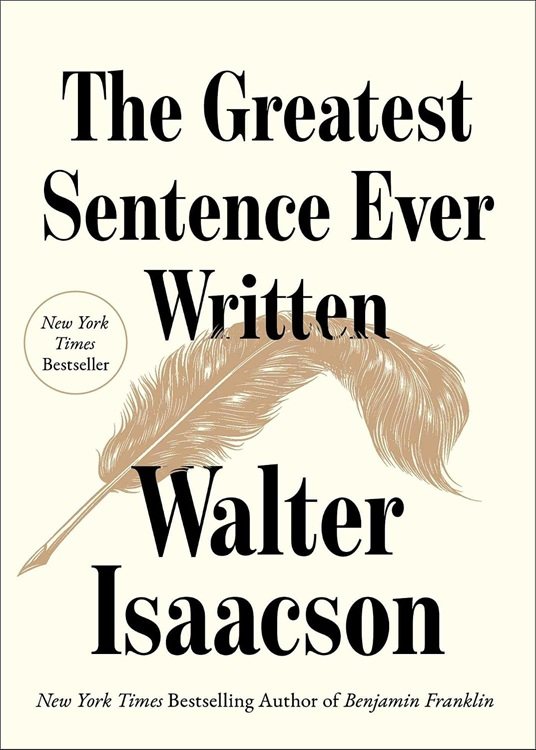
Walter Isaacson dissects the second sentence of the Declaration of Independence, gives background on the editing process from first draft to final form, and explains the meaning behind the words.
The Notes
- January 1776: Common Sense is published by an anonymous author (Thomas Paine). 120,000 copies sold in Philadelphia alone. Paine argued that hereditary rule was unnatural. It had a huge influence on the Continental Congress and their decision to move for independence.
- “Of more worth is one honest man to society and in the sight of God, than all the crowned ruffians that ever lived… Every thing that is right or natural pleads for separation.” — Thomas Paine, Common Sense
- June 7, 1776: a five-person drafting committee — Thomas Jefferson, John Adams, Benjamin Franklin, Roger Sherman, and Robert Livingston — was appointed by the Continental Congress to write their declaration.
- Jefferson wrote the first draft of the Declaration of Independence. He was 33 years old.
- June 21, 1776: Jefferson sent the first draft to Franklin on a Friday.
- First Draft: “We hold these truths to be sacred & undeniable; that all men are created equal & independant, that from that equal creation they derive rights inherent & inalienable, among which are the preservation of life, & liberty, & the pursuit of happiness…”
- The committee spent the next 10 days editing his words down to its final form.
- Final Draft: “We hold these truths to be self-evident, that all men are created equal, that they are endowed by their Creator with certain unalienable Rights, that among these are Life, Liberty and the pursuit of Happiness.”
- July 2, 1776: The Continental Congress voted in favor of independence then set about heavily editing the rest of the Jefferson’s Declaration.
- Franklin encouraged Jefferson, who watched his work being gutted, with a story about a hat maker wanting a sign for his shop:
- “‘John Thompson, hatter, makes and sells hats for ready money,’ with a figure of a hat subjoined. But he thought he would submit it to his friends for their amendments. The first he showed it to thought the word ‘Hatter’ tautologous, because followed by the words ‘makes hats,’ which showed he was a hatter. It was struck out. The next observed that the word ‘makes’ might as well be omitted, because his customers would not care who made the hats… He struck it out. A third said he thought the words ‘for ready money’ were useless, as it was not the custom of the place to sell on credit. Everyone who purchased expected to pay. They were parted with; and the inscription now stood, ‘John Thompson sells hats.’ ‘Sells hats!’ says his next friend; ‘why, nobody will expect you to give them away. What then is the use of that word?’ It was stricken out, and ‘hats’ followed, the rather as there was one painted on the board. So his inscription was reduced ultimately to ‘John Thompson,’ with the figure of a hat subjoined.”
- July 4, 1776: John Dunlap, a Philadelphia printer, was consigned with making the first 200 copies to be distributed to the colonies. Copies were sent the next morning. Franklin chose the typeface.
- August 2, 1776: “At the official signing of the parchment copy of the Declaration, John Hancock, the president of the Continental Congress, wrote his name with his famous flourish. ‘There must be no pulling different ways,’ he insisted. ‘We must all hang together.’ Franklin replied, alluding to what would happen to them if their revolution failed, ‘Yes, we must, indeed, all hang together, or most assuredly we shall all hang separately.’”
- We
- Jefferson and the other Founders were influenced by John Locke’s version of the social contract.
- “We” refers to an agreement, a social contract, to form a government ruled not by kings but by the collective will of the American colonies.
- Of course, “We” did not refer to everyone.
- “The only way whereby any one divests himself of his natural liberty, and puts on the bonds of civil society, is by agreeing with other men to join and unite into a community for their comfortable, safe, and peaceable living one amongst another, in a secure enjoyment of their properties.” — John Locke, Second Treatise of Government
- “The people, if we trace government to its first origin in the woods, are the source of all power and jurisdiction, and voluntarily, for the sake of peace and order, abandoned their native liberty and received laws.” — David Hume, Of the Original Contract
- “Filtering out the inessentials, the social compact comes down to this: Each of us puts his person and all his power in common under the supreme direction of the general will, and, in our corporate capacity, we receive each member as an indivisible part of the whole.” — Jean-Jacques Rousseau, The Social Contract
- Truths to be Self-Evident
- Franklin made the change from “sacred & undeniable” to “self-evident.”
- The influence, again, came from Hume. Franklin spent a month with Hume in 1771, trying to sway him to the colonies’ side.
- Hume’s Fork: A theory, by Hume, that there are two types of truths:
- Synthetic truth: a truth contingent on evidence and observation.
- Analytic truth: a truth by reason and definition.
- A “self-evident” truth was an analytic truth. It implied a truth by definition.
- It was controversial, at the time, for what it suggested: “that all men are created equal” with rights.
- All Men
- “Even if the rhetorical flourish of ‘all men’ conveyed a broad scope, they consciously and intentionally did not mean in most instances to include women, slaves, Native Americans, and in some cases even non–property owners.”
- Abigail Adams urged her husband to consider women’s political rights to no avail. Women couldn’t vote, hold office, or fully own property.
- “I cannot but laugh… We know better than to repeal our Masculine systems.” — John Adams
- Created Equal
- The social contract implied that all individuals involved had equal political and social rights unlike the British system where heredity gave one more rights than another.
- Except, a hereditary system existed in the colonies. About 500,000 slaves, or 20% of the population, were in the colonies.
- The editing attempted to delicately handle the contradiction, appease everyone, and ensure a united front.
- Some struggled with the idea of slavery more than others:
- “Jefferson’s original draft called the slave trade ‘a cruel war against human nature’ and resoundingly condemned King George III for imposing it on the colonies. In his ‘Notes on the State of Virginia’ in 1785, he called slavery a ‘moral depravity’ and ‘hideous blot.’” Yet, he owned over 600 slaves. Jefferson’s passage was edited out of final draft.
- “I always feel a kind of indignation at the sight of a slave… and I am persuaded that the practice of holding men in slavery is equally repugnant to the spirit of liberty and the ideas of happiness.” — John Adams
- “The practice of slavery is a reproach to any people who boast of liberty and equality… How can those who advocate the rights of man hold their fellow creatures in chains? It is a contradiction that must wound the conscience of every honest man.” — Abigail Adams
- Franklin owned 2 slaves who worked in his printer shop. He didn’t pursue them when they fled in the 1760s. He became outspoken against slavery in the 1770s.
- “I hope in time that the friends to liberty and humanity will get the better of a practice that has so long disgraced our nation and religion.” — Benjamin Franklin
- Of the 56 signers of the Declaration of Independence, 41 owned slaves. All 13 colonies permitted slavery.
- “If there be an object truly ridiculous in nature, it is an American patriot, signing resolutions of independency with the one hand, and with the other brandishing a whip over his affrighted slaves.” — Thomas Day
- Endowed by Their Creator
- Jefferson, Franklin, and others were Deists. The original wording was a reflection of those beliefs.
- “Deists believe that God set the universe in motion with wondrous laws but did not intervene in human affairs after that. Deism was the creed of most thinkers of the Enlightenment, the eighteenth-century Age of Reason that emphasized rationality, science, individualism, and natural rights.”
- Adams had more traditional religious views, as a Unitarian, than Jefferson and most likely suggested the change from “from that equal creation they derive rights” to “endowed by their creator.”
- Certain Unalienable Rights
- Jefferson used inalienable.
- Somewhere along the line of copying and printing, someone changed it to unalienable. Possibly Adams or someone else.
- “What does it mean? For that, it’s again useful to go back to what George Mason had published a month earlier in his Virginia Declaration of Rights: ‘All men are by nature equally free and independent and have certain inherent rights, of which, when they enter into a state of society, they cannot, by any compact, deprive or divest their posterity.’ In other words, there are certain rights that are inherent to a person’s existence in a state of nature that, even when they make a social contract, they cannot divest. Nor can any government or monarch deprive them of these rights.”
- Life, Liberty, and the Pursuit of Happiness
- Locke identified three fundamental rights: life, liberty, and property.
- George Mason instilled Locke’s rights in Virginia’s Declaration of Rights: “All men are by nature equally free and independent and have certain inherent rights… namely, the enjoyment of life and liberty, with the means of acquiring and possessing property, and pursuing and obtaining happiness and safety.”
- Jefferson summed up what Mason wrote, with simply “the pursuit of happiness.”
- The next question was how to structure a society for all to benefit but still allow individuals to profit from their work?
- Franklin was a successful businessman, among other things. He was also influenced by Cotton Mather’s book Essays to Do Good, which pushed for the creation of institutions for the common good.
- Franklin setup a number of common goods through his “Leather-apron Club.” It was a group of Philadelphia business owners. He started a street-sweeping corps, volunteer fire, night watchman, hospital, library, and an academy that became the University of Pennsylvania.
- The motto of Franklin’s library was: “Communiter Bona profundere Deum est, To pour forth benefits for the common good is divine.”
- “Both freedom and economic growth require that we allow individuals to reap the benefits that come from their labor. Our system does, and should, give ample rewards to builders and entrepreneurs and those who work hard, take risks, and even just have good luck. But in doing so, we should keep in mind the moral and practical value of the commons.”
- Some of Franklin’s common goods help create opportunities for others.
- “The American Dream is not a dream of motor cars and high wages merely, but a dream of social order in which each man and each woman shall be able to attain to the fullest stature of which they are innately capable, and be recognized by others for what they are, regardless of the fortuitous circumstances of birth or position.” — James Truslow Adams, The Epic of America
- “Franklin and Jefferson understood balance. They were part of an Enlightenment era that embraced the scientific method of testing and revising beliefs based on evidence. Both of them studied Isaac Newton, whose mechanics explained how contending forces could be brought into equilibrium. Their goal on contentious issues was not to triumph but to find the right balance, an art that has been lost today. Compromisers may not make great heroes, Franklin liked to say, but they do make great democracies.”
- “The technology that promised to connect us found a better business model in dividing us.”
- “Every man has a property in his own person: this no body has any right to but himself. The labor of his body, and the work of his hands, we may say, are properly his… This labor being the unquestionable property of the laborer, no man but he can have a right to what that is once joined to, at least where there is enough, and as good, left in common for others. The only way whereby any one divests himself of his natural liberty, and puts on the bonds of civil society, is by agreeing with other men to join and unite into a community for their comfortable, safe, and peaceable living one amongst another, in a secure enjoyment of their properties… When any number of men have so consented to make one community or government, they are thereby presently incorporated, and make one body politic, wherein the majority have a right to act. If man in the state of nature be so free, as has been said; if he be absolute lord of his own person and possessions, equal to the greatest, and subject to no body, why will he part with his freedom? Why will he give up this empire, and subject himself to the dominion and control of any other power? To which it is obvious to answer, that… the enjoyment of the property he has in this state is very unsafe, very unsecure. This makes him willing to quit a condition, which, however free, is full of fears and continual dangers: and it is not without reason, that he seeks out, and is willing to join in society with others, who are already united, or have a mind to unite, for the mutual preservation of their lives, liberties and estates, which I call by the general name, property.” — John Locke, Second Treatise of Government
- “That all men are by nature equally free and independent, and have certain inherent rights, of which, when they enter into a state of society, they cannot, by any compact, deprive or divest their posterity; namely, the enjoyment of life and liberty, with the means of acquiring and possessing property, and pursuing and obtaining happiness and safety. That all power is vested in, and consequently derived from, the people; that magistrates are their trustees and servants, and at all times amenable to them… That no free government, or the blessings of liberty, can be preserved to any people but by a firm adherence to justice, moderation, temperance, frugality, and virtue and by frequent recurrence to fundamental principles.” — Virginia Declaration of Rights, June 1776