
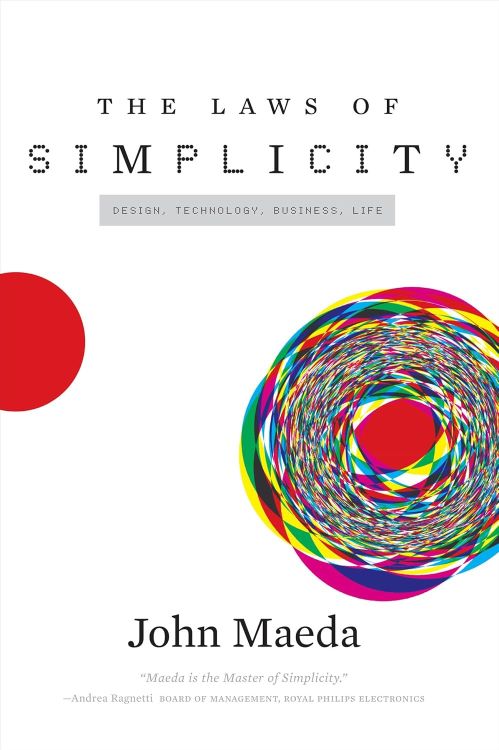
The Laws of Simplicity cover the intersection of design, technology, and business. It offers ten guiding principles for designing simpler systems.
The Notes
- “Technology has made our lives more full, yet at the same time we’ve become uncomfortably ‘full.’”
- Claims of “new and improved” usually means more.
- Simplification of products or services is not the norm. Yet, simplicity sells. (In the case of Apple products, it comes at a premium price.)
- “Simplicity is a quality that not only evokes passionate loyalty for a product design, but also has become a key strategic tool for businesses to confront their own intrinsic complexities.”
- Reduce
- The easiest way to simplify something is remove functionality.
- It’s a balance between how simple we can make something versus how simple does it have to be. It’s a tradeoff between ease of use versus does it do everything we want it to do.
- “The simplest way to achieve simplicity is through thoughtful reduction. When in doubt, just remove. But be careful of what you remove.”
- Shrink, Hide, Embody (SHE) are ways to “reduce” and simplify a system after everything can be removed is gone.
- Shrink – make it smaller, less noticeable without hurting functionality.
- Designs that make objects appear fragile, light, or thin give the impression of being small or humble thus simpler than they are.
- The Apple iPod’s mirrored back created the illusion of thinness because it blended into is surroundings. The plastic top layer was visible, the mirrored back less so.
- Beveled edges create a similar illusion of thinness.
- Hide – hide complexity through brute force methods.
- “Evolutions are driven by a market that demands innovation and is willing to pay for clever ways to HIDE complexity.”
- Operating systems and software hide functionality in menu bars.
- “If the deceit feels less like malevolence, more like magic, then hidden complexities become more of a treat than a nuisance… Thus complexity becomes a switch that the owner can choose to flip into action on their own terms, and not by their device’s will.”
- “Technology creates the problem of complexity, but also affords new materials and methods for the design of our relationship with complexities that shall only continue to multiply.”
- Embody – perceived value or quality is critical factor when choosing to simplify a product.
- Consumers are drawn to smaller, simpler products if it offers a higher sense of value than bigger, feature-rich products.
- Quality can come from better materials or higher craftmanship. Ex: Ferrari.
- Perceived quality comes from better marketing. Ex: Nike.
- “The power of suggestion is powerful.”
- “The upside of materialism is that the way something we own feels can change how we feel.”
- “Lessen what you can and conceal everything else without losing the sense of inherent value.”
- Organize
- Organization brings structure to the chaos of a system.
- You can HIDE clutter, but an organizational structure is needed for long-term simplicity.
- “Organization makes a system of many appear fewer. Of course this will only hold if the number of groups is significantly less than the number of items to be organized.”
- Sort, Label, Integrate, Prioritize (SLIP)
- Sort – sort data or functions into groups.
- Label – each group gets a relevant name.
- Integrate – combine similar groups. Fewer groups are better.
- Prioritize – prioritize groups and items within groups so those that get the most attention is more easily accessible. Focus on the vital few.
- Pareto Principle is a good starting point in organizing. 20% gets high priority, 80% gets low priority. Simplify from there.
- Gestalt design is built around the psychological belief that our minds naturally recognize patterns, organize and categorize things, and can fill in the blanks in empty spaces. Everything has a “fit.”
- “The best designers in the world all squint when they look at something. They squint to see the forest from the trees—to find the right balance.”
- Time
- Interactions that save time — like quick service — are viewed as simplified experiences.
- “When forced to wait, life seems unnecessarily complex. Savings in time feel like simplicity. And we are thankfully loyal when it happens, which is rare.”
- Reducing time spent waiting, is time available to spend on something more meaningful.
- “Of the infinite ways to whittle away at time, a superior solution is to remove all constraints…”
- Giving up the option of choice, like a randomized playlist on the iPod Shuffle or a music streaming algorithm that knows your preferences, simplifies the feature set a single “play” button.
- Algorithms that make product recommendations simplify the online shopping experience. Amazon’s “buy now” button simplifies the shopping cart experience to a single action.
- “At a macroscopic level, governments and corporations go to great lengths to shrink time and cut corners as a means to reduce cost; at a personal level we make similar sacrifices that realize similar rewards in the name of efficiency… Thus choosing when to care less versus when to care more lies at the heart of living an efficient but fulfilling daily life.”
- Hiding time creates the illusion that time is less important. Casinos do this. Also, not wearing a watch (though, cell phones defeat this).
- Progress bars within software or OS — like with file transfers — gives the illusion that tasks complete faster than compared to when the progress bar is not shown.
- Showing how much time is left to wait is becoming more popular. Crosswalk signals, waiting on hold, restaurant reservations, and more are gaining countdown displays.
- “Knowledge is comfort, and comfort lies at the heart of simplicity.”
- Design styles can make products appear faster through the illusion of motion or speed. Raymond Loewy created a “streamlining” style in the 1930s influenced by flight and jet propulsion onto household objects.
- “The speed of the Web sets our expectations to now.”
- Speed usually comes at a higher cost.
- Quality customer service is the only alternative when speed is not an option.
- It’s a tradeoff between shortening the wait versus making the wait more tolerable.
- “Saving time or staying in step with the flow of time—whichever costs the least to implement—will usually win the day.”
- Learn
- “Knowledge makes everything simpler. This is true for any object, no matter how difficult.”
- “The problem with taking time to learn a task is that you often feel you are wasting time… We are well aware of the dive-in-head-first approach — “I don’t need the instructions, let me just do it.” But in fact, this method often takes longer than following the directions in the manual.”
- The easiest way to learn the basics of something to teach it. The repetition of teaching is part of the learning process. Learning the basics then allows you to focus on the central concepts and simplify it.
- “Simplicity and repetition are relate.”
- Internal motivation is the catalyst for learning.
- “The best designers marry function with form to create intuitive experiences that we understand immediately—no lessons (or cursing) needed. Good design relies to some extent on the ability to instill a sense of instant familiarity. ‘Hey, I’ve seen this before!’ is a targeted reaction that builds the confidence to give it a try.”
- “Design starts by leveraging the human instinct to relate, followed by translating the relationship into a tangible object or service, and then ideally adding a little surprise at the end to make your audience’s efforts worthwhile.”
- “A metaphor used as a learning shortcut for a complex design is most effective when its execution is both relevant and delightfully unexpected.”
- “Difficult tasks seem easier when they are ‘need to know’ rather than ‘nice to know.’”
- “The most successful product designs, whether simple, complex, rational, illogical, domestic, international, technophilic, or technophobic, are the ones that connect deeply to the greater context of learning and life.”
- Differences
- “Simplicity and complexity need each other. The more complexity there is in the market, the more that something simpler stands out. And because technology will only continue to grow in complexity, there is a clear economic benefit to adopting a strategy of simplicity that will help set your product apart.”
- Design requires some form of complexity or contrast to complexity in order to establish a sense of simplicity.
- Complexity can make simple things seem simpler.
- Context
- “What lies in the periphery of simplicity is definitely not peripheral. The sixth Law emphasizes the importance of what might become lost during the design process. That which appears to be of immediate relevance may not be nearly as important compared to everything else around. Our goal is to achieve a kind of enlightened shallowness.”
- “A designer would choose to do their best to preserve the emptiness because of their perspective that nothing is an important something. The opportunity lost by increasing the amount of blank space is gained back with enhanced attention on what remains. More white space means that less information is presented. In turn, proportionately more attention shall be paid to that which is made less available. When there is less, we appreciate everything much more.”
- You can’t simplify without having a broad understanding of a system.
- Emotion
- “A strong sense of self-expression belies all of us humans, and many such decisions we make are not driven by logic alone.”
- “More emotions are better than less. When emotions are considered above everything else, don’t be afraid to add more ornament or layers of meaning.”
- “‘Form follows function’ gives way to the more emotion led approach to design: ‘Feeling follows form.’”
- The smiley — “;-)” — was first used by Scott Fahlman in 1982. Now emojis allow us to add emotions to text-based messages.
- Text still dominates communication despite the ability to easily send pictures and video.
- Animism is a belief that everything has a spiritual essence.
- Modernism rejected unnecessary ornamentation for a clean industrial look based on its underlying raw materials.
- Designing with emotions in mind can create an attachment with an object that will be cared for over time.
- “The best art makes your head spin with questions. Perhaps this is the fundamental distinction between pure art and pure design. While great art makes you wonder, great design makes things clear.”
- “Achieving clarity isn’t difficult… The true challenge is achieving comfort.”
- Trust
- Simplicity creates a level of trust, but it may come at a cost.
- Omakase is a Japanese term meaning “I leave it up to you” and refers to relying on the chef’s choice to choosing your meal at a restaurant.
- “Overconfidence is usually the enemy of greatness, and there’s little room for personal ego when pleasing a customer is the true priority.”
- Customer returns, warranties, etc. are ways to gain customer trust.
- “The more a system knows about you, the less you have to think. Conversely, the more you know about the system, the greater control you can exact.”
- “Privacy is sacrificed for extra convenience.”
- Failure
- “Some things can never be made simple. Knowing that simplicity can be elusive in certain cases is an opportunity to make more constructive use of your time in the future, instead of chasing after an apparently impossible goal.”
- Return on Failure (ROF) – learning from mistakes.
- Failure is a chance to shift perspective.
- “Simplicity is hopelessly subtle, and many of its defining characteristics are implicit.”
- “Simplicity is about subtracting the obvious and adding the meaningful.”
- Away
- “More appears like less by simply moving it far, far away. Thus an experience is made simpler by keeping the result local, and moving the actual work to a far AWAY location.”
- Software as a Service (SAAS) – the complexity of the software runs remotely. No need to install anything. Just a simple, clean UI for the user.
- Open
- “Openness simplifies complexity. With an open system, the power of the many can outweigh the power of the few.”
- Ex: Open-source software and APIs
- Power
- “Use less, gain more.”
- “Electronic devices can never be truly simple unless they are freed from their dependence on power. A seemingly unpowered electronic device may seem like an oxymoron, but it is critical to achieve.”
- “In the field of design there is the belief that with more constraints, better solutions are revealed.”
- Life
- Technology can enable or disable users.
- “Memories are all that matter in the end.”