 Buy the Book:
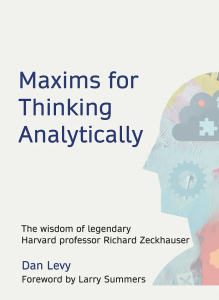
 The book is a collection of Richard Zeckhauser’s maxims for better decision-making. The maxims act as mental models to help understand and simplify a problem, handle uncertainty, and make decisions.

-
Weekend Reads – 7/12/24
·
Quote for the Week
I started by saying that you and I probably aren’t as important to the results as it would be fun to think we are. I meant that in the same spirit that Leroy Jolley meant it when he said, “The more I am around horse racing the more I think that the most underrated thing is the horse and that it is us trainers and jockeys and owners who are overrated.” There are some qualities you and I can bring to the races. But I think it is one of those cases where less is more. Here they are:
Simple Approaches. Albert Einstein said that “…most of the fundamental ideas of science are essentially simple and may, as a rule, be expressed in a language comprehensible to everyone.” The first time I heard that I thought, “Sure, that is easy for him to say.” But as long as there are people out there who can beat us using dart boards, I urge us all to respect the virtues of a simple investment plan.
Consistent Approaches. Look at the best performing funds for the past ten years or more. Templeton, Twentieth Century Growth, Oppenheimer Special, and others. What did they have in common? It sure wasn’t their investment philosophies. It was that whatever their investment plans were, they had the discipline and good sense to carry them out consistently.
A very special tolerance for the concept of “nonsense”, or what the Zen call “Beginner’s Mind.” I could have saved myself a lot of time if I hadn’t been so quick to label as “nonsense” a lot of ideas I now accept as good sense. Expertise is great, but it has a bad side effect. It tends to create an inability to accept new ideas. — Dean Williams (source)
-
2024: Q2 Returns
·
To say big tech is driving US markets this year would be an understatement. Through two quarters of 2024, the S&P 500 gained 15.3%, with dividends. Only two U.S. sectors performed better than that, as you’ll see below.
Much of the market concerns lately center around the AI boom and market concentration. Some of it is warranted but market concentration is nothing new and not all booms turn into wildly speculative bubbles. That hasn’t stopped folks from comparing the current boom with past bubbles to add weight to their predictions.
For tech innovation, it’s natural to look at the last time a new technology took the stock market by storm. The Dotcom Bubble is the most convenient choice. It’s the most recent, a good chunk of today’s investors lived through it, and the tech behind it was transformational.
Unfortunately, the AI boom is nothing like the Dotcom Bubble. At least, not yet.
Yes, there are similarities. New emerging technology, talk of a “New Era” that will transform life and work, high and rising valuations, unexpected companies hitting record-high market caps, old-world companies slapping “AI” on products to get in on the hype (much like they did with “.com”), and so on. Continue Reading…
-
Weekend Reads – 6/28/2024
·
Quote for the Week
While the classic growth companies may continue to generate new sources of earning power, the question is: Can they do this rapidly enough to justify the valuation placed on their current earning power?
One can repeat the question just asked: Is a growth rate triple the potential growth of the economy sustainable indefinitely? If a company can double its earnings over the next 6 years but then needs 10 years before its earnings double again—and perhaps 15 years the next time—then its present P/E ratio will fade with the passage of time. In other words, the price will rise more slowly than the earnings.
And at every moment the investor runs the risk that a change in management, a spry competitor, a shift in customer preferences, or a fundamental economic or social change may slow earning power a lot faster than anticipated. Admittedly, pleasant surprises may come along too, but 40 times earnings already anticipates those. — Peter Bernstein, 1973 (source)
-
Quarterly Reading – Summer 2024
·
Here’s what I’ve been reading for the past three months:
- To Engineer is Human – Engineering innovations are a byproduct of failed designs that create opportunities for improvement and success, while success can bring overconfidence, added risk-taking, and disaster. Henry Petroski’s book goes through the history of engineering failures and lessons learned that led to progress in the design of buildings, bridges, and more. (Notes)
- The Greatest Minds and Ideas of All Time – This book is a compilation of Will Durant’s essays and lectures. His personal lists of the greatest thinkers, poets, books, peaks of human progress, and dates offer a journey through world history. (Notes)
- The First Million is the Hardest: An Autobiography – Arthur Farquhar built a global agricultural manufacturer. He also faced hardship in that process — a factory that burned down twice, multiple depressions, and the Civil War. His autobiography offers a mix of U.S. history, business common sense, and name-dropping. He discusses presidents, politicians, and business leaders he met throughout his life. (Notes)
- Maxims for Thinking Analytically – Richard Zeckhauser is an economist and Harvard professor. The book uses practical examples to explain 22 of Zeckhauser’s maxims around analytical thinking and better decision-making. Notes to come.
- The Autobiography of Andrew Carnegie – The latest read is inspired by Farquhar, who viewed Carnegie as the best businessman ever. Carnegie immigrated with his parents to the U.S. at a young age. Carnegie started as a bobbin boy at a cotton factory at age 13. A job as a telegraph messenger boy a year later changed his life. Or so I expect from the man who built a steel empire, became the richest person in the U.S., and proceeded to give almost all of it away. Notes to come after I finish the book.
-
Weekend Reads – 6/21/24
·
Quote for the Week
One of the enduring features of the findings in behavioral psychology as it applies to finance, a subject I have discussed many times over the years, is the almost complete inability of those who are aware of them to actually apply them. You can attend Richard Zeckhauser’s seminars at Harvard, read lots of articles and case studies, be reminded of how recency bias, or anchoring, or the representative fallacy, or myopic loss aversion impair clear thinking and skew decision making, and still fall prey to them and others of their ilk the moment you are confronted with real world situations…
This is not unusual. Warren Buffett has often noted how any knowledgeable analyst would have pegged the value of the Washington Post at about 5x what it traded at in the 1974 bear market, yet no one wanted it at that price. The 2002 bear market saw some similarly amazing prices. AES traded under $1… Yet fear set its price, as it did those of Nextel, Tyco, Corning, Amazon, and a host of other companies at that time…
I am reminded once again of the quote that sits in the front of Ben Graham’s Security Analysis, from Horace’s Ars Poetica: “Many shall be restored that now are fallen and many shall fall that now are in honor.” (The quote does not say “all” by the way, just “many”). — Bill Miller (source)