
Novel Investor
  • Home
  • About
  • Invest with Me
  • Resources
  • Weekend Reads – 6/21/24

    June 21, 2024

    ·

    Jon

    Quote for the Week

    One of the enduring features of the findings in behavioral psychology as it applies to finance, a subject I have discussed many times over the years, is the almost complete inability of those who are aware of them to actually apply them. You can attend Richard Zeckhauser’s seminars at Harvard, read lots of articles and case studies, be reminded of how recency bias, or anchoring, or the representative fallacy, or myopic loss aversion impair clear thinking and skew decision making, and still fall prey to them and others of their ilk the moment you are confronted with real world situations…

    This is not unusual. Warren Buffett has often noted how any knowledgeable analyst would have pegged the value of the Washington Post at about 5x what it traded at in the 1974 bear market, yet no one wanted it at that price. The 2002 bear market saw some similarly amazing prices. AES traded under $1… Yet fear set its price, as it did those of Nextel, Tyco, Corning, Amazon, and a host of other companies at that time…

    I am reminded once again of the quote that sits in the front of Ben Graham’s Security Analysis, from Horace’s Ars Poetica: “Many shall be restored that now are fallen and many shall fall that now are in honor.” (The quote does not say “all” by the way, just “many”). — Bill Miller (source)
    Continue Reading…


  • Buffett’s Lessons from Long Term Capital Management

    June 19, 2024

    ·

    Jon

    The story of Long-Term Capital Management is an interesting episode in financial history. In the midst of the 90’s Internet Bubble, a bailout took place to prevent a ripple effect in the financial sector.

    In September 1998, Warren Buffett played a bit part in the bailout. His offer was eventually turned down. A few weeks later, he was asked about his role by a University of Florida student. Buffett’s answer offers some insight into the lessons of risk, probability, and leverage when math collides with behavior-driven markets. Continue Reading…


  • Weekend Reads – 6/14/24

    June 14, 2024

    ·

    Jon

    Quote for the Week

    Most financial principles and theories have a degree of good sense to them. It may be a large degree, but it never comes close to being absolute. None of them ever has the comforting reliability of Euclid’s comment about the length of the hypotenuse of a right-angled triangle. Consider the observable occurrence and reoccurrence of what economists traditionally call the business cycle. It exists, certainly enough. Stocks never go so high that they don’t fall down, and never sink so low that they don’t eventually go back up again. But the duration of this cycle is figured by some at the mystic and Biblical figure of seven years, and sometimes at six. However, there have been periods when it worked out to other numbers of years, such as three, two, or half a year. Or take the period of two and a half years preceding the morning on which these words happen to be written. (Summer, 1949.) While events of world importance have been taking place, the stock market has done nothing but drift listlessly a little lower, from prices which could be considered low to begin with, in view of corporate earnings at that time. Thus the riddle is propounded: can such a pattern be termed predictable?

    It is not likely that this riddle will ever be conclusively solved. It is fair to point out, however, that the tendency of the human heart is to plump for the idea that there is a sensible order in the rise and fall of prices, whether the evidence is good or nonexistent. People do not care for the idea that any important activity which affects them is as beyond their control as a pair of dancing dice. — Fred Schwed Jr. (source)

    Continue Reading…


  • Bernard Baruch’s Biggest Mistake

    June 11, 2024

    ·

    Jon

    Bernard Baruch lived a dual financial life early in his career. He remained cautious and ever-watchful over his client’s money but that conservative nature ended where his own portfolio began.

    Baruch tended to overtrade. He also ran a margin account and never left money in reserve. In other words, he liked to bet it all. But since he had little capital, he always put up the smallest margin possible.

    In those days, margin accounts allowed anywhere from 10% to 20% margin. So Baruch could buy a stock using his own money to cover as little as 10% of a stock’s price and borrow the other 90%. Which is exactly what he did. Except, having no money in reserve meant a tiny change in price would quickly wipe him out. And so it went.

    Anytime Baruch came across a stock or bond he felt sure of, he bet everything he had. Almost like clockwork, the market moved in the wrong direction, and he was broke again. It didn’t help that most of his ideas came from gossip and tips. This process repeated numerous times before he finally realized he needed a little bit of money in reserve in case the market moved against him.

    His big turning point, however, came in the spring of 1897. It was the first time Baruch changed his investment approach. He set his eyes on American Sugar Refining. He could afford to buy shares but before doing so he actually studied the company. Continue Reading…


  • Weekend Reads – 6/7/24

    June 7, 2024

    ·

    Jon

    Quote for the Week

    If you can throw your mind, as I can, as far back as 1914, you would be struck by some extraordinary differences in Wall Street then and today. In a great number of things, the improvement has been tremendous. The ethics of Wall Street are very much better. The sources of information are much greater, and the information itself is much more dependable. There have been many advances in the art of security analysis. In all those respects we are very far ahead of the past.

    In one important respect we have made practically no progress at all, and that is in human nature. Regardless of all the apparatus and all the improvements in techniques, people still want to make money very fast. They still want to be on the right side of the market. And what is most important and most dangerous, we all want to get more out of Wall Street than we deserve for the work we put in. — Ben Graham (source)

    Continue Reading…


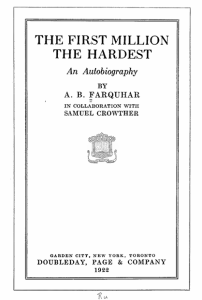
  • The First Million the Hardest: An Autobiography by Arthur B. Farquhar

    June 5, 2024

    ·

    "First Million is the Hardest" book coverBuy the Book: eBook

    Arthur Farquhar rose from apprentice to partner to sole owner of a global agricultural company in the 19th century. His autobiography tells the story of business and life during the Civil War through 1921.

    The Notes

    Continue Reading…


Previous Page
1 … 26 27 28 29 30 … 232
Next Page

Join the library.

Access over 1,100 research papers, writings, transcripts, and more from the brightest minds in finance.

Learn More

Learning

  • Investor Library
  • Book Notes
  • Investor Quotes

Return Quilts

  • Asset Class Returns
  • S&P Sector Returns
  • International Stock Market Returns
  • Emerging Markets Returns
  • Historical Returns Data

Connect

  • Bluesky
  • Twitter
  • Facebook
  • RSS Feed
  • Home
  • About
  • Contact

© Novel Investor · All Rights Reserved · Terms of Use · Privacy Policy · Disclaimer