
Novel Investor
  • Home
  • About
  • Invest with Me
  • Resources
  • Weekend Reads – 9/1/23

    September 1, 2023

    ·

    Jon

    Quote for the Week

    Some years ago I was the adviser to a profit-sharing trust for a large commodities dealer, I bought for them — I think the stock has been split 15 times since then — a block of Texas Instruments at $14 a share. When the stock got up to $28, the pressure got so strong (“Well, why don’t we sell half of it, so as to get our bait back?”) I had all I could do to hold them until it got to $35. Then the same argument: “Phil, sell some of it; we can buy it back when it gets down again.”

    That is a totally ridiculous argument. Either this is a better investment than another one or a worse one. Getting your bait back is just a question of psychological comfort. It doesn’t have anything to do with whether it is the right move or not.

    But, at any rate, we did that. The stock subsequently went above $250 within two or three years. Then it had a wide open break and fell to the mid-50s. But it didn’t go down to $35. — Philip Fisher (source)
    Continue Reading…


  • Wise Words on Value Investing

    August 30, 2023

    ·

    Jon

    Value investing strategies come in many styles. However, the two styles that stand out the most act like bookends to the value philosophy.

    Ben Graham pioneered the search for statistically cheap stocks. He originally looked for stocks selling far below liquidation value. That strategy worked throughout the depths of the Great Depression and well into the 1940s and ’50s. It fell out of favor during the Go-Go ’60s, back into favor with the 1973-74 crash, and bounced in and out (mostly out) of favor ever since.

    Some of Graham’s more ardent followers used his strategy outside the U.S. with much success. Others adapted as the market caught on and the classic Graham bargains disappeared. They looked for hidden assets, low price-to-book, etc. They redefined what a statistical bargain looked like.

    Overall, Graham’s strategy was built around estimating asset values, which change significantly less than stock prices. An investor, willing to dig through balance sheets, estimate assets conservatively, and with a little bit of patience, could earn a good return without much risk if they bought a stock cheap enough.

    At the other end of the spectrum was Phil Fisher. Fisher learned that he got better returns out of the stocks of growing companies that he bought and held for several years compared to those that he bought at a low price, sold at a high price, and repeated. Continue Reading…


  • Weekend Reads – 8/25/23

    August 25, 2023

    ·

    Jon

    Quote for the Week

    In emphasizing the difference between the man who sometimes quits a winner and the man who beats the game, the reader will understand that the hardest thing in the world is for a winner in any game of hazard to quit while winning. “Beginner’s luck” is probably true in Wall Street as anywhere else. But the man who says, “I will quit when I have made a certain sum” is the only man who is trying to beat the game. And the game always beats him. — Edwin Lefevre, 1915 (source)

    Continue Reading…


  • How We Know What Isn’t So by Thomas Gilovich

    August 23, 2023

    ·

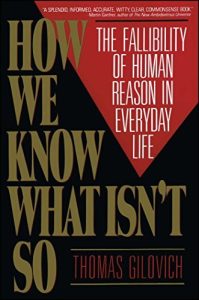
    "How We Know What Isn't So" book coverBuy the Book: Print | eBook

    Thomas Gilovich looks at why we form questionable or inaccurate beliefs and why we hold onto them. Through research and examples, he identifies cognitive biases we all share that distort our beliefs and decisions.

    The Notes

    Continue Reading…


  • Weekend Reads – 8/18/23

    August 18, 2023

    ·

    Jon

    Quote for the Week

    Almost all of the information in the investment management business is oriented toward purchase decisions. The competition in making purchase decisions is too good. It’s too hard to outperform the other fellow in buying. Concentrate on selling instead. In a Winner’s Game, 90 percent of all research effort should be spent on making purchase decisions; in a Loser’s Game, most researchers should spend most of their time making sell decisions. Almost all of the really big trouble that you’re going to experience in the next year is in your portfolio right now; if you could reduce some of those really big problems, you might come out the winner in the Loser’s Game. — Charles Ellis

    Continue Reading…


  • Ben Graham’s Last Investment Fund

    August 16, 2023

    ·

    Jon

    James Rea mailed a computer printout of his stock list to Ben Graham. Rea had never met Graham. He had no clue Graham existed. At least, not until clients said he should read an article by Graham.

    It turns out Rea’s list was filled with the type of stocks Graham wrote about for years. His letter eventually led to a phone call from the legend, which led to a meeting, then a research collaboration, and finally a private investment fund.

    After some debate, Rea and Graham agreed on 10 stock criteria to base their research around. The period covered was 1925 to 1975.

    Graham’s goal was simple:

    To try to buy groups of stocks that meet some simple criterion for being undervalued — regardless of the industry and with very little attention to the individual company.

    He wanted to bypass time-consuming analysis for a more diversified “group” approach to stock selection using a few simple metrics. And their research backed up the idea. Continue Reading…


Previous Page
1 … 38 39 40 41 42 … 233
Next Page

Join the library.

Access over 1,100 research papers, writings, transcripts, and more from the brightest minds in finance.

Learn More

Learning

  • Investor Library
  • Book Notes
  • Investor Quotes

Return Quilts

  • Asset Class Returns
  • S&P Sector Returns
  • International Stock Market Returns
  • Emerging Markets Returns
  • Historical Returns Data

Connect

  • Bluesky
  • Twitter
  • Facebook
  • RSS Feed
  • Home
  • About
  • Contact

© Novel Investor · All Rights Reserved · Terms of Use · Privacy Policy · Disclaimer