
Novel Investor
  • Home
  • About
  • Invest with Me
  • Resources
  • Weekend Reads – 1/24/25

    January 24, 2025

    ·

    Jon

    Quote for the Week

    Every bubble has two components: an underlying trend that prevails in reality and a misconception relating to that trend. A boom–bust process is set in motion when a trend and a misconception positively reinforce each other. The process is liable to be tested by negative feedback along the way, giving rise to climaxes which may or may not turn out to be genuine. If a trend is strong enough to survive the test, both the trend and the misconception will be further reinforced. Eventually, market expectations become so far removed from reality that people are forced to recognize that a misconception is involved. A twilight period ensues during which doubts grow and more people lose faith, but the prevailing trend is sustained by inertia. As Chuck Prince, former head of Citigroup said during the twilight of the super bubble: ‘As long as the music is playing, you’ve got to get up and dance. We’re still dancing.’ Eventually, a point is reached when the trend is reversed, it then becomes self-reinforcing in the opposite direction. Boom–bust processes tend to be asymmetrical: booms are slow to develop and take a long time to become unsustainable, busts tend to be more abrupt, due to forced liquidation of unsustainable positions and the asymmetries introduced by leverage. — George Soros (source)
    Continue Reading…

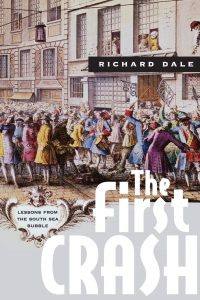
  • The First Crash: Lessons from the South Sea Bubble by Richard Dale

    January 22, 2025

    ·

    Buy the Book: Print | eBook

    The South Sea Bubble was the first to be felt internationally. The events surrounding the South Sea scheme offer lessons around bubble behavior that are still relevant today.

    The First Crash book cover

    The Notes

    Continue Reading…

  • Weekend Reads – 1/17/25

    January 17, 2025

    ·

    Jon

    Quote for the Week

    The difficult thing for the financial adviser and the client—and I learned this when I managed money—is that no one can really identify how he or she is going to react when surprises come along, and yet surprises are inevitably going to come. Somehow investment consultants need to condition people to this fact. I give a lot of talks where I stand up and say, “We don’t know what the future holds,” and I see all of the heads nodding up and down. But people act as if they do know what the future holds, and that’s what gets them into trouble.

    So it’s crucial that consultants try to get through to people that it’s impossible to know the future and that surprise is inevitable. As a result, we have to limit the nature of our bets, we have to be obsessive about diversification, we shouldn’t try to be too smart, we shouldn’t try to shoot the moon. All of these are very simple ideas, and people will accept them ahead of time, but it’s hard for them to live with humbly structured portfolios. However, they have to do so if they’re going to survive. The main thing that an investment consultant can do is to get through this idea that you can’t act as though you know the future if you want to be a survivor. The future may be better than you think, and it’s not necessarily going to be worse. But even if it’s better than you think, that’s also hard to handle. It’s that kind of philosophical teaching that consultants have to understand in their hearts, and then get it into the hearts of investors. Once you’ve got the philosophical grasp, the rest is easy. — Peter Bernstein (source)

    Continue Reading…

  • Quarterly Reading – Winter 2025

    January 15, 2025

    ·

    Jon

    Here’s what I’ve been reading for the past three months:

    • My Life and Work — Henry Ford his story from growing up, the beginnings of the Ford Motor Company, and his business philosophy — including an obsession with efficiency — that transformed manufacturing and dominated the early auto industry. (Notes)
    • The First Crash — England’s South Sea Bubble in 1720 was one of the first financial booms and busts in history. Richard Dale covers the birth of the South Sea Company, the boom, and inevitable bust. He details the South Sea Company’s financials, the parallels to the Mississippi Bubble in France, and the reaction of commentators and investors of the time. The historical significance and similarities to other bubbles that followed made it a fun, interesting read. Notes to come.
    • The Art of Worldly Wisdom — Baltasar Gracian was a Spanish Jesuit priest in the 1600s. He was also a philosopher and collector of maxims on life. The book offers a collection of pithy bits of wisdom and another example of how little human nature has changed in over 300 years. It’s a book you can spend a few minutes browsing through each day.
    • The Lords of Creation — I started this over the holidays. Published in 1935, the book delves into the rise of “big business” and the people behind it from the late 1800s to the Great Depression, and how it shaped the American economy, as we know it, today. Notes to follow once I finish.
    Continue Reading…

  • Weekend Reads – 1/10/25

    January 10, 2025

    ·

    Jon

    Quote for the Week

    The world seems to be subject to curious brainstorms — the crusades, the Mississippi scheme, and the south sea bubble, are examples. Let me quote from Mackay’s Popular Delusions, referring to what he calls the Tulipomania of the seventeenth century:

    Everyone imagined that the passion for tulips would last forever… The riches of Europe would be concentrated on the shores of the Zuyder Zee, and poverty banished from the favored clime of Holland. People of all grades converted their property into cash and invested it in flowers. Foreigners became smitten with the same frenzy and money poured into Holland from all directions… Holland seemed the very antechamber of Plutus.

    You will recognize some of these expressions. It seems incredible that so solid a nation as the Dutch should nearly ruin itself on such a thought, but is it any more credible than that we would go into debt to pay thirty times earning power, and even more, for common stocks of the “New Economic Era” on the theory that we also were going to ”banish” poverty by selling billions in manufactures to an almost bankrupt world by the expedient of continually lending our customers more money?

    We built up a tinsel tower of paper prosperity out of debts and speculative hopes and such other things as dreams are made of. It lies in ruins, but the debts remain. What shall we do? Are we to try to put, or keep, substance in things which had no substance in the beginning, or shall we clear away the wreck? I think our duty is clear, and that in taking it we must remember that delusions swing between extremes, like pendulums. Delusions of grandeur and unending wealth give place to delusions of unending gloom. One is as unreal as the other. — Bernard Baruch (source)

    Continue Reading…

  • 2024: A Year in Returns

    January 8, 2025

    ·

    Jon

    Fifteen years ago, the U.S. stock market was nine months removed from its lowest point this century. The subprime mortgage crisis shook the world and panic spilled into the stock market.

    Nobody knew it then, but the market bottomed in March 2009. From 2010 to the end of last year, the market went on an unreal run that nobody expected because stocks were the last place anybody wanted to put their money.

    Contrast that period to today. U.S. stocks are all anyone talks about. Not international stocks. Not emerging markets. Not bonds. It’s U.S. stocks, specifically large cap tech.

    Humans are weird like that. Hindsight softens the blow of the worst market moments with every passing year, making it easier to forget how risky assets like stocks can be, especially when recent performance is exceptional.

    And the S&P 500 has been exceptional. It’s seen double digit returns each of the last six years. One of those years was an 18.1% loss. Of the other five years, one was in the teens at 18.4%, the rest ranged from 25.0% to 32.5%.

    2018 was the last time the S&P 500 had a single digit return. It was a 4.4% loss, the first losing year since 2008. The S&P 500 followed up the worst financial crisis since the Great Depression with a 13.9% annual return and only two losing years through 2024.

    Continue Reading…

Previous Page
1 … 18 19 20 21 22 … 233
Next Page

Join the library.

Access over 1,100 research papers, writings, transcripts, and more from the brightest minds in finance.

Learn More

Learning

  • Investor Library
  • Book Notes
  • Investor Quotes

Return Quilts

  • Asset Class Returns
  • S&P Sector Returns
  • International Stock Market Returns
  • Emerging Markets Returns
  • Historical Returns Data

Connect

  • Bluesky
  • Twitter
  • Facebook
  • RSS Feed
  • Home
  • About
  • Contact

© Novel Investor · All Rights Reserved · Terms of Use · Privacy Policy · Disclaimer