
Novel Investor
  • Home
  • About
  • Invest with Me
  • Resources
  • Addition by Subtraction

    November 15, 2023

    ·

    Jon

    The best investors are masters of subtraction. They played the game long enough to simplify their investment philosophy down to a few key principles. And it did wonders for their portfolio.

    The goal of investing should be to eliminate things that have a high probability of producing losses. These are things that you know won’t work. Things you don’t understand well. Things that are too complex. Things that are distractions and noise. Things that lead to mistakes. Things that are irrelevant, unimportant, and unnecessary to your process. Anything that doesn’t fit what you’re trying to do should be cut out.

    The problem for most investors is we know none of this when we start out. Each one of us must go through the slow and sometimes painful experience of figuring it out.

    Yet the idea of improving things by subtraction flies in the face of human nature. Our typical response to problem-solving is to make things more complex. Addition is our default.

    In a series of studies by Adams, Klotz, et al, the overwhelming result was to add rather than subtract features to solve a problem. Continue Reading…

  • Weekend Reads – 11/10/23

    November 10, 2023

    ·

    Jon

    Quote for the Week

    Every sale raises a series of questions, often surrounding relative values and opportunity costs. What will you do with the proceeds? Do you have something in mind that you think might produce a superior return? What might you miss by switching to the new investment? And what will you give up if you decide not to switch and continue to hold the asset in your portfolio? Or perhaps you decide to sell and don’t plan to reinvest the proceeds. In that case, what’s the likelihood that holding the proceeds in cash will make you better off than you would have been if you had held on to the thing you sold? Selling an asset is a decision that absolutely must not be considered in isolation. — Howard Marks (source)

    Continue Reading…


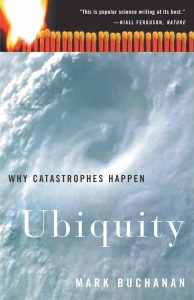
  • Ubiquity: Why Catastrophes Happen by Mark Buchanan

    November 8, 2023

    ·

    Ubiquity book coverBuy the Book: Print | eBook

    Ubiquity tells the story of dynamic complex systems. It explains how some systems in the world organize themselves on the edge of instability which can lead to catastrophic outcomes like earthquakes, forest fires, financial crashes, and more.

    The Notes

    Continue Reading…


  • Weekend Reads – 11/3/2023

    November 3, 2023

    ·

    Jon

    Quote for the Week

    There are economic agents who make large and predictable mistakes. For example, individuals who invest on their own characteristically make large and expensive mistakes. If we analyse individual transaction in which an individual investor bought a stock and sold another in a single day, it is safe to assume this transaction is not based on liquidity. What determines the individual’s behaviour is the belief that one stock will outperform the other. Now with modern technology we can easily analyse the outcomes of this single-day transaction a year later, and the results are quite astonishing. On average, the stock that a person sold did better than the stock they bought, but it’s not only that it did better — it did better by a large amount. The average is 3.4 percent. These results have been replicated many times over.

    This phenomenon leads to a very simple notion: there is an average cost of having an idea for an investor, and the average cost is about 3 percent, which is quite a lot. So, having ideas cost people money, and people have lots of ideas. Individual investors tend to churn their accounts, they tend to trade too much, and that they trade too much seems to be due over-confidence. They believe they know something that they do not know and this is one essential characteristic of human beings, which makes them different from rational beings. — Daniel Kahneman (source)

    Continue Reading…


  • Disciplined in the Little Things

    November 2, 2023

    ·

    Jon

    Investing success is simple. It takes a solid investment strategy built on a proven process repeated over the long run. But it can be undone if you don’t control your emotions.

    For instance, the perfect investment process is useless without the discipline to stick with it. Consistency matters, especially when the market is not cooperating.

    When times get tough, what do you do? Do you give in when bear market doomers grow loud and sell out of fear? When times get boring, do you cheat (trade) every now and then to keep things interesting? When the bull market is raging and everyone but you seems to be making money do you join in or keep plugging along because you know the process works?

    Discipline, or lack thereof, plays a big role in your returns earned over time. Yet, its importance is often overlooked. A great example of why is found in a story told by Walter Schloss. Continue Reading…


  • Weekend Reads – 10/27/23

    October 27, 2023

    ·

    Jon

    Quote for the Week

    It was the publication of E.L. Smith’s little book entitled, Common Stocks as Long-Term Investments. His study showed that, contrary to prevalent beliefs, equities as a whole had proved much better purchases than bonds during the preceding half-century. It is generally held that these findings provided the theoretical and psychological justification for the ensuing bull market of the 1920’s. The Dow Jones Industrial Average (DJIA), which stood at 90 in mid-1924, advanced to 381 by September 1929, from which high estate it collapsed — as I remember only too well — to an ignominious low of 41 in 1932.

    On that date the market’s level was the lowest it had registered for more than 30 years. For both General Electric and for the Dow, the high point of 1929 was not to be regained for 25 years.

    Here was a striking example of the calamity that can ensue when reasoning that is entirely sound when applied to past conditions is blindly followed long after the relevant conditions have changed. What was true of the attractiveness of equity investments when the Dow stood at 90 was doubtful when the level had advanced to 200 and was completely untrue at 300 or higher. — Ben Graham (source)

    Continue Reading…


Previous Page
1 … 35 36 37 38 39 … 232
Next Page

Join the library.

Access over 1,100 research papers, writings, transcripts, and more from the brightest minds in finance.

Learn More

Learning

  • Investor Library
  • Book Notes
  • Investor Quotes

Return Quilts

  • Asset Class Returns
  • S&P Sector Returns
  • International Stock Market Returns
  • Emerging Markets Returns
  • Historical Returns Data

Connect

  • Bluesky
  • Twitter
  • Facebook
  • RSS Feed
  • Home
  • About
  • Contact

© Novel Investor · All Rights Reserved · Terms of Use · Privacy Policy · Disclaimer