Novel Investor
  • Home
  • About
  • Invest with Me
  • Resources
  • Quarterly Reading – Winter 2026

    January 21, 2026

    ·

    Jon

    Here’s what I’ve been reading for the past three months:

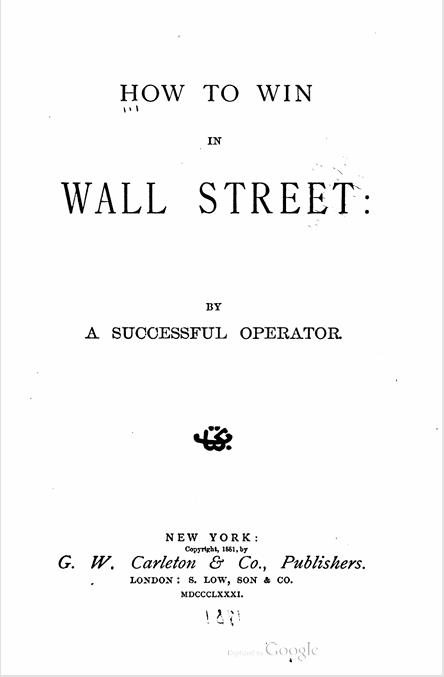
    • How to Win in Wall Street – George Goodman referenced this book in his classic The Money Game. Published in 1881, the author mixes in stories related to the period to discuss investing basics, warn about gambling, the need for patience, and more. He offers 9 rules to “win in wall street.” Most should sound familiar today.
    • A Week in Wall Street – An even older book, written in 1841. It takes a humorous, almost cynical, look at the inner workings of the early days of Wall Street.
    • The Great Salad Oil Swindle – Norman Miller tells the crazy story of Tino De Angelis and one of the largest cases of financial fraud in the 1900s. It involved vegetable oil, loans to buy vegetable oil futures, and an “inventory” of oil, used as collateral, that exceeded the total supply of vegetable oil in the U.S. Those that follow Warren Buffett’s early investments might recognize this story. The aftermath led to Buffett buying American Express.
    • Hedgemanship – The book is a byproduct of the rise of hedge funds in the 1960s. It explains hedge fund strategies that individual investors might employ. In turn, you get a history of hedge funds by Alfred Winslow Jones and others.

    Book notes from last quarter:

    • The Pleasure was All Mine by Fred Schwed Jr.
    Continue Reading…

  • Weekend Reads – 1/16/25

    January 16, 2026

    ·

    Jon

    Quote for the Week

    If you’re going to seek out volatility because that’s where opportunity is, you don’t want your entire portfolio to be volatile, you only want to make volatile bets within it. You have to be sure that there’s some systematic arrangement of the bets that you make so that the portfolio risk in the total portfolio is not as volatile as the individual components. One of Markowitz’s great insights was precisely that. That you can take a lot of high-risk bets—as long as they’re not correlated—and come out fine. I don’t see what’s fraudulent about trying to do that…

    As I said, the markets are macro-inefficient. They can go haywire. That is a matter that you deal with through your asset allocation in the first place, so that you don’t get killed if the totally unexpected hits you in the face…

    My own affairs are run that way because I know that extreme outcomes can happen and I don’t want to get killed. But that doesn’t mean that I’m not making bets in the middle of the portfolio somewhere. — Peter Bernstein (source)

    Continue Reading…

  • 2025: A Year in Returns

    January 14, 2026

    ·

    Jon

    Diversification is not just a defensive strategy but an offensive one too. 2025 was a perfect example, from the start, of how portfolios benefit from both.

    The defensive side stepped up early with the U.S. markets poor start and tariff panic in April. The offensive side took over with the recovery. Especially, international and emerging markets, which fared better than the U.S. market in April and went on to produce a blowout performance on the year.

    By the end of 2025, emerging markets led with a 34.4% total return (almost double the S&P 500 on the year). International markets followed closely behind at 31.9% total return.

    The last time emerging markets outpaced everything, was 2017. Prior to that, it was 2009 (then 2007, 2005, 2003).

    In fact, from 2000 to 2009 — while the S&P 500 experienced its lost decade averaging a 0.95% annual loss — emerging markets were only outpaced by U.S. REITs, by a slim margin (REITS at 10.6%/yr, EM at 10.1%/yr). The returns from emerging markets and REITs made up for the drag produced by U.S. stocks, in a diversified portfolio, over that 10-year period.

    Continue Reading…

  • Weekend Reads – 1/9/26

    January 9, 2026

    ·

    Jon

    Quote for the Week

    What the economists call fabrication or demand in use is inversely correlated with price. Or, more simply, you know, if gasoline prices go up, other things equal, you’re going to drive less. So price and demand are inversely correlated: basic economics. And that’s the way it is for things that are used. But in financial markets, it isn’t the case. That actually, demand is positively correlated with price. More people buy things when they go up; if stocks start to go up, more people want them than if they’re going down. The higher they go up, the greater the demand for them. That’s why you see people chasing mutual fund performance; it’s why you see the bubbles that you saw in technology and Internet stocks where all the money flowed in after they’d gone up a lot… It’s been very well established that demand follows price. — Bill Miller (source)

    Continue Reading…

  • Asset Class, Sector, and Global Market Quilts Updated for 2025

    January 7, 2026

    ·

    Jon

    The asset class, sector, international, and emerging markets quilts are up to date for 2025. Links to the updated versions are below:

    • Asset Class Returns
    • Sector Returns
    • International Market Returns
    • Emerging Market Returns

    You can also download copies here or grab the images below (screenshots work too). The historical data is updated and available for download as well.

    I’ll have the usual deeper dive for you next week.

    For now, the lesson of 2025 is not a new one. A home-biased portfolio carries the risk of falling short of a more diversified allocation. That was true for 2025. Allocations into U.S., international, and emerging market stocks produced a better return than a U.S. only allocation.

    Broadly, the major asset classes were positive on the year. Emerging and international stocks topped the list with total returns in excess of 30%. U.S. large caps finished the year at 17.9%. U.S. small caps earned 12.8%. High yield bonds, high grade bonds (U.S. Agg), cash (3-mo T-bills), and REITs were next, in that order.

    Continue Reading…

  • Weekend Reads – 12/12/25

    December 12, 2025

    ·

    Jon

    Quote for the Week

    The most important inheritance from the 1930s was simply the memory of it. The habits of mind developed during the terrible experiences of those years kept our business leaders from throwing caution to the winds and from forgetting the realities of risk. A good ten years had to pass before capital spending really took off, and it then languished again soon after the boom topped out in 1957…

    Although I just turned 50 in 1969, I was already an old man in the financial community. Similar trends were apparent in the corporate world as well, as leadership was beginning to pass to a generation for whom the Great Depression was something they had only read about in the history books, rather than a real experience. This naturally led to much more carefree attitudes toward risk. Indeed, the new breed were convinced that it was they who were moving the world, they who knew all the answers, they who were masters of the fate of all of us, when in fact the absolutely necessary precondition for their achievements was the sense of caution and care that the older generation had carried forward from the depression era.

    This is where this whole long story should drive itself home: the high profits that were the consequence of the caution and conservatism of the past were leading inexorably to overbuilding of capacity, excessive risk-taking, and burgeoning debt leverage. Just when we thought we were masters of our fate, we were preparing a fate much different from what we felt certain lay ahead…

    The euphoria of these businessmen was ultimately the cause of its own demise. — Peter Bernstein (source)

    Continue Reading…

1 2 3 … 229
Next Page

Join the library.

Access over 1,100 research papers, writings, transcripts, and more from the brightest minds in finance.

Learn More

Learning

  • Investor Library
  • Book Notes
  • Investor Quotes

Return Quilts

  • Asset Class Returns
  • S&P Sector Returns
  • International Stock Market Returns
  • Emerging Markets Returns
  • Historical Returns Data

Connect

  • Bluesky
  • Twitter
  • Facebook
  • RSS Feed
  • Home
  • About
  • Contact

© Novel Investor · All Rights Reserved · Terms of Use · Privacy Policy · Disclaimer