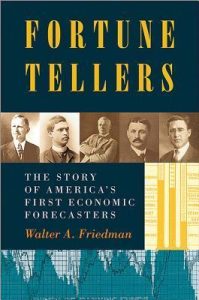
 Buy the Book:
 Fortune Tellers presents five biographies of prominent forecasters of the 1920s. Each one rode the wave of U.S. economic prosperity and market speculation only to fall from grace as their inability to see the future was realized.

-
Weekend Reads – 9/13/24
·
Quote for the Week
Something which at first appears random or unpredictable may actually be predictable. Claude Shannon and I built a machine to beat roulette. Roulette normally appears to be a random process. But, sometimes, way back, players exploited defects in roulette wheels. Maybe one of the frets or dividers between the pockets is a little loose, so some pockets would be preferred over other pockets, so the numbers would come up with frequencies that deviated from random to some extent. The machine we built was even more advanced, it predicted position and velocity of ball and rotor, and from that we were able to forecast what region of the wheel the ball would fall into. We got a big edge. The machine is now in the MIT museum. So this is an example where, if you have more information about something that appears to be random, it could turn into an edge.
That’s also how markets are. The problem is that, even though markets aren’t strongly efficient in the sense of EMH, it’s still difficult to find edges. By “edge,” I mean excess return after adjusting for risk, net of costs. Also, when an edge is discovered, the money that’s poured into it makes the edge go away, because it moves prices toward correct pricing. So, I don’t think EMH is quite the right mental framework for thinking about markets, but it’s a good start for almost everybody. — Ed Thorp
-
Wise Words on Passive Investing
·
The advantage of index funds is that they earn a market return for a minimal cost. That might not sound exciting to everyone but the alternative might be worse.
Why worse? Because beating the market is difficult. Recent studies show that most mutual fund managers fail to beat the market in any given year and underperform over time after fees.
This is not a new phenomenon either. Warren Buffett annually compared the performance of the four largest funds against the Dow in his partnership letters throughout the 1960s. He said, “The Dow as an investment competitor is no pushover, and the great bulk of investment funds in the country are going to have difficulty in bettering, or perhaps even matching, its performance.”
Ben Graham did the same. He noted, across several decades, the difficulty investment funds had in outperforming. The earliest (that I could find) was in the 1940s. Graham suggested buying the 30 stocks in the Dow as an alternative to investment funds. He even half-joked in 1974 that if institutions kept underperforming they were better off building S&P 500 portfolios: Continue Reading…
-
Weekend Reads – 8/30/24
·
Quote for the Week
As I see it, the fundamental problem in common stocks is the market’s injection of a large speculative element into the strongest and best companies by establishing an untenably high price for them. This has added greatly to the confusion between investment and speculation, because it is easy to tell oneself that the shares of a good company are always a sound investment, regardless of price. From this it was an easy step to calling everyone an investor who bought his shares outright, and finally to calling every Wall Street customer an investor — period.
My recent crusade has been to persuade Wall Street that it has made a mistake, and harmed itself, in suppressing the word “speculation” from its vocabulary. Speculation is not bad in itself; over speculation is. It is important that the public should have a fairly good idea of the extent to which it is speculating, not only when it buys a “hot issue” at a completely silly price, but even when it buys into a wonderful concern such as IBM at 70 times its highest recorded earnings. To my mind the most valuable contribution that security analysts could make to the art of investing would be the determination of the investment and speculative components in the current price of any given common stock, so that the intending buyer might have some notion of the risks he is taking as well as what profit he might make. — Ben Graham, 1963 (source)
-
The Physicist Who Made a Fortune on Electric Utilities
·
Alfred Lee Loomis wore many hats. He was an attorney, soldier, physicist, inventor, and briefly a Wall Street legend.
Upon graduating from Harvard Law School in 1912, Loomis took a job at Winthrop & Stimson practicing corporate law. He wore his attorney hat until World War I. He volunteered for the Army the moment the U.S. entered the war in 1917.
Loomis’s “inventiveness” and a written recommendation from his former boss, Henry Stimson, got him assigned to the Aberdeen Proving Grounds. He was given the role of head of the development and experimental department. Specifically, ballistics.
His first breakthrough was measuring the velocity of shells fired from a gun. His Aberdeen chronograph was a major improvement on what already existed at the time. It was reliable, portable, and could be quickly mass-produced. In other words, it was designed to be used in the war.
Loomis’s next breakthrough wouldn’t come about until WWII. He played a key role in the development of radar, sat in on the early meetings of the Manhattan Project, invented LORAN (short for long-range navigation), and helped develop ground-controlled approach, which helped pilots land in bad weather.
But it was his time between the two world wars when he made his impact on Wall Street. Continue Reading…
-
Weekend Reads – 8/23/24
·
Quote for the Week
The hedge fund known as “Long Term Capital Management” collapsed, through overconfidence in its highly leveraged methods, despite IQs of its principals that must have averaged 160. Smart, hard-working people aren’t exempted from professional disasters from overconfidence. Often, they just go around in the more difficult voyages they choose, relying on their self-appraisals that they have superior talents and methods.
It is, of course, irritating that extra care in thinking is not all good but also introduces extra error. But most good things have undesired “side effects,” and thinking is no exception. The best defense is that of the best physicists, who systematically criticize themselves to an extreme degree, using a mindset described by Nobel Laureate Richard Feynman as follows: “The first principle is that you must not fool yourself and you’re the easiest person to fool.” — Charlie Munger (source)