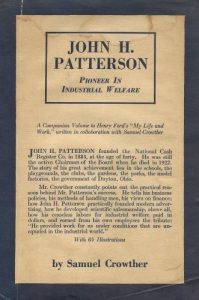
 Buy the Book: Print
John Henry Patterson was an American industrialist. He bought a floundering cash register company and turned it into a global success while pioneering advertising, sales, and other business practices still used today.

·
Buy the Book: Print
John Henry Patterson was an American industrialist. He bought a floundering cash register company and turned it into a global success while pioneering advertising, sales, and other business practices still used today.
·
Charlie Munger, Warren Buffett’s 95-year-old “sidekick,” shared some of his mental tricks to staying rational, and other bits of wisdom, in an interview at the end of January of this year.
The video was making the rounds on Twitter this week. If you’ve never had the experience, it’s worth watching.
For those who have listened to Charlie Munger more than a few times, much of it will sound familiar but it’s always a good reminder none the less. I’ve highlighted a few parts below. Continue Reading…
·
The advantage of market history isn’t so much to see how assets have performed but to see how people reacted to the performance.
Knowing what stocks or bonds returned over the last 10, 20, or 30 years can be helpful. It shows how a perfectly rational being would have performed over those periods.
What it doesn’t show is how an actual person might react to a sea change in technology near the end of the longest bull market in history. Or how that person might respond to a 22% drop in a single day. Or what that person might expect from their bond funds after the greatest 35-year performance ever. Or how they might react to a 5% interest rate spike — a roughly 50% drop in the 10-year bond price — over a measly 16 months. Continue Reading…
·
My second quarter reading is short on books but long on pages. It was dominated by another textbook with a couple of lengthy books thrown in.
Here’s what I’ve been reading the past three months: Continue Reading…
·
Sometimes beating the market isn’t all it’s cracked up to be. Just ask Ben Graham.
Graham set up his second fund, the Graham Joint Account, in 1926 after closing down the first fund he set up with Louis Harris, Grahar Corp., run from 1923 to 1925. Over the first three years, 1926 to 1928, Graham’s new fund would earn 25.7% annually against the Dow’s 20.2%. He handily beat the market on the way up.
And he beat it on the way down…
From 1929 to 1932, Graham’s fund lost 70% compared to the Dow’s 80% loss (a beating alright). If he was chasing relative returns, he succeeded.
But Graham knew he failed. He barely survived the worst four year period ever in the stock market.
Not surprisingly, it would leave a lasting impression on him. James Grant explained exactly what went wrong during a 2008 Graham and Dodd event: Continue Reading…
·
Had you fallen asleep in January and woke up today, you’d probably have a few questions about the virus and think nothing big happened in the stock market. Yet, everything happened.
The first half of 2020 can be summarized by one of the fastest market crashes ever and a quick and confusing recovery. In fact, all but one country saw it’s stock market fall month-to-month from January to February, then again from February to March. The one exception: China. It’s market rose slightly from January to February then fell from February to March. The global decline resulted from the reaction to a worsening situation with the virus.
Then magically, every country’s stock market reversed course and rose in April. Things deviated a little from there. Continue Reading…