
Nothing was the same after June 28, 1914. The assassination of Archduke Franz Ferdinand triggered a chain of events that led to WWI and closed the NYSE for months.
One month to the day of the assassination, Austria-Hungary declared war. Three days later, Henry Noble, president of the NYSE, closed the exchange. Other regional U.S. exchanges in Chicago, Baltimore, San Francisco, Philadelphia, and other cities followed suit. Most major exchanges around the world closed too.
Noble knew that wars demanded funds. Foreign investors could make a run on the exchange, selling securities to raise cash. The cash could then be converted into gold and shipped back to Europe.
That put the U.S., being on the gold standard, in a tricky spot. Depleting the U.S. gold reserves would put faith in the dollar and adherence to the gold standard at risk.
The belief is that William McAdoo, Treasury Secretary, pushed Noble to shutter the exchange to buy time. The chain of events continued to trigger the next day:
- June 28, 1914 – Archduke Ferdinand assassinated.
- June 29, 1914 – Dow closes 57.9.
- July 28, 1914 – Austria-Hungary declares war on Serbia. Dow closed 55.3.
- July 30, 1914 – Dow closes 51.7.
- July 31, 1914 – NYSE suspends trading (regional U.S. exchanges close too).
- August 1, 1914 – Germany declares war on Russia.
- August 3, 1914 – Germany declares war on France.
- August 4, 1914 – UK declares war on Germany.
- August 6, 1914 – Austria-Hungary declares war on Russia.
- August 12, 1914 – France and UK declare war on Austria-Hungary.
- September 6, 1914 – First battle of the Marne.
- October 24, 1914 – Estimated Dow low for the year.1
- November 2, 1914 – Russia declares war on Turkey.
- November 5, 1914 – France and UK declare war on Turkey.
- November 28, 1914 – NYSE reopens bond market.
- December 12, 1914 – NYSE reopens stock market with trading limitations.
- December 14, 1914 – Dow closes 56.8.
- January 4, 1915 – Dow closes 55.4.
- April 1, 1915 – NYSE allows unrestricted trading. Dow closes 61.1.
- July 1, 1915 – Dow closes 69.9.
- October 1, 1015 – Dow closes 90.9.
- December 14, 1915 – Dow closes 98.3.
Noble cut short any chance of a market panic as the news worsened. Had the NYSE stayed open, foreign investors panic selling securities to buy gold would have dragged prices lower. A portion of U.S. investors would have joined in. Short sellers would have compounded the selling pressure. Instead, everything stopped.
The Dow was relatively unchanged from when the NYSE closed in July to when it opened in December.
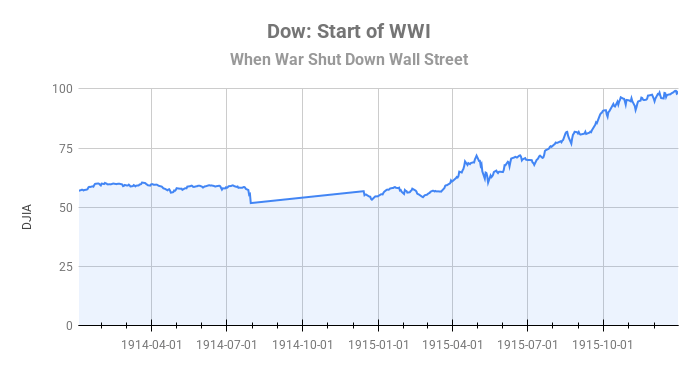
The flat line in the middle of the chart highlights the four and half months the NYSE was closed. It was the longest closure in NYSE history. And prevented investors from selling at the cusp of a massive market boom.
Forced holding is just as good as restraint in preventing investing mistakes when news gets scary. No overreaction. No panic selling. No forced selling from margin calls. No locking in permanent losses. No figuring out when to buy back in. The downside of overreacting to scary news is avoided.
On the other hand, there’s no deeply discounted stocks from panic selling either. Preventing behavioral mistakes means fewer opportunities for the few ready to pounce. Though, it worked out well for investors forced to hold on.
When the stock market reopened December 12, 1914, investors had four and a half months to reassess the business environment in war time. And business was good.
When the New York Stock Exchange closed a condition was created that really had no precedent in this country. Manufacturers wondered, merchants were perplexed, bankers blundered, and the public read the war bulletins. I venture to say that in August of 1914 hundreds of thousands of Americans believed that if the Stock Exchange were open for business they would find golden opportunities for investment. The average man — not speculators or gamblers but men who had savings — visioned to themselves purchases of good stocks at panic prices. They didn’t like to buy at the figures arbitrarily fixed by the Exchange Committee as the irreducible minimum, but the germ of the desire to buy good stocks at low prices was in a million minds. Much has been written about business conditions, exports of foodstuffs and munitions of war, the prospects of gaining the financial supremacy of the world, the triumphant rise of the dazzling hope that “dollar exchange” will become a world condition, the huge crops and high prices, the fact that for years this country had been doing business conservatively in the dread of a crash that never comes when everybody looks for it and prepares accordingly; and all these factors combined to getting paid for them; the East had become a vast arsenal, with factories running day and night at the most profitable prices in their history…
After the Stock Exchange reopened the papers were full of the accounts of the colossal orders booked by companies like the Bethlehem Steel, General Motors, Du Pont Powder and a dozen others. People’s thoughts were directed to big profits. The desire to share in those profits followed not only immediately but logically. That, in turn, called attention to the favorable conditions in other departments of trade and industry. Hence your bull market and hence your boom.2
Over the next 12 months, the Dow soared 73% (Dec. 14, 1914, to Dec. 14, 1915, not including dividends). The U.S. became the main food and war supplier for the Allies war effort. Companies like U.S. Steel and DuPont saw profits explode 5x and 10x respectively, in a year. Dividend payments did the same.
Closing the market succeeded on multiple levels. It prevented a panic. It kept the U.S. on the gold standard in a world where most countries were forced to abandon it and ensured the U.S. as the financial center of the world. Investors were forced to hold on and experience the massive bull market that followed.
WWI is the perfect example of why geopolitical events are hard to predict. The market reacts in unexpected ways during scary confusing times. Market closures are rare but the lesson from this one might be that investors benefit from a self-enforced trading suspension to avoid selling too soon on geopolitical news.
Sources:
- “More News from New Street: Uncovering Stock Prices During the 1914 Wall Street Shutdown,” Studies in Applied Economics, September 2014 — A black-market exchange emerged on New Street. It was limited in scale. Trading was cash only. Stock price data was not published in major newspapers. It’s estimated that most trades never went through. But the New Street market offered an intermittent perspective of stock prices, at least for the stocks being traded. Researchers estimate the unofficial low for the Dow was about October 24, 1914. ↩︎
- “Going Up!” by Edwin Lefevre, Saturday Evening Post, November 27, 1915 ↩︎
