
Worries about the negative effects of war and other events may have on your portfolio is common. But is it warranted?
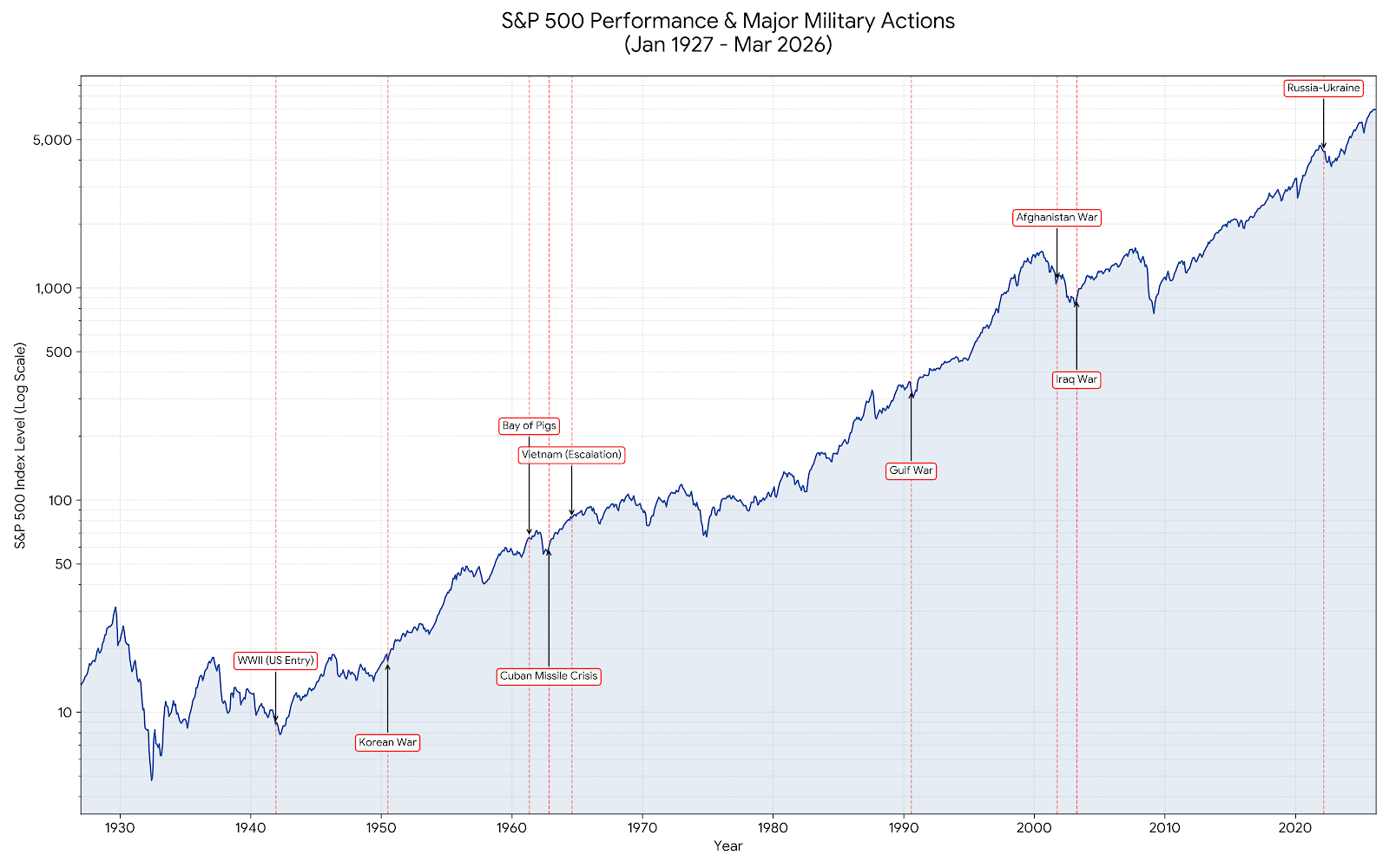
The chart below tells part of the story. It highlights the start of major wars going back to WWII.
(click to enlarge)
WWII is a good example of how markets react to shocking news. The war had been ongoing for two years, and the market was declining, before the US entered. When Pearl Harbor was bombed, the market fell 4.37% the day after, December 8, 1941. It fell another 3.23% the next day, when the US declared war on Japan.
The combined drop of those two days might seem significant but look at what followed. The market declined over the next four months then rose for the rest of the war.
The market’s immediate reaction to news of other wars and major military events has been mixed:
- The market fell 5.38% on news of the start of the Korean War but only fell 1.1% on Truman’s announcement to send US troops.
- The market rose 0.47% after the Bay of Pigs invasion was announced, then fell 0.72% and 0.52% over the next two days as more information was released.
- The Cuban Missile Crisis saw the market fall 2.67% on news of Russian buildup, only to rise 3.22% the next day and rose 2.16% when the dispute ended.
- The single day impact of the Gulf, Afghanistan, and Iraq Wars on the market was a 1.13% decline, a 0.008% decline, and a 0.002% rise, respectively (yes, those last two go out 3 decimal places).
As the chart shows, the longer-term impact of wars has mostly followed a similar pattern as WWII. And the initial news shock of war, on average, has had a muted impact on markets.
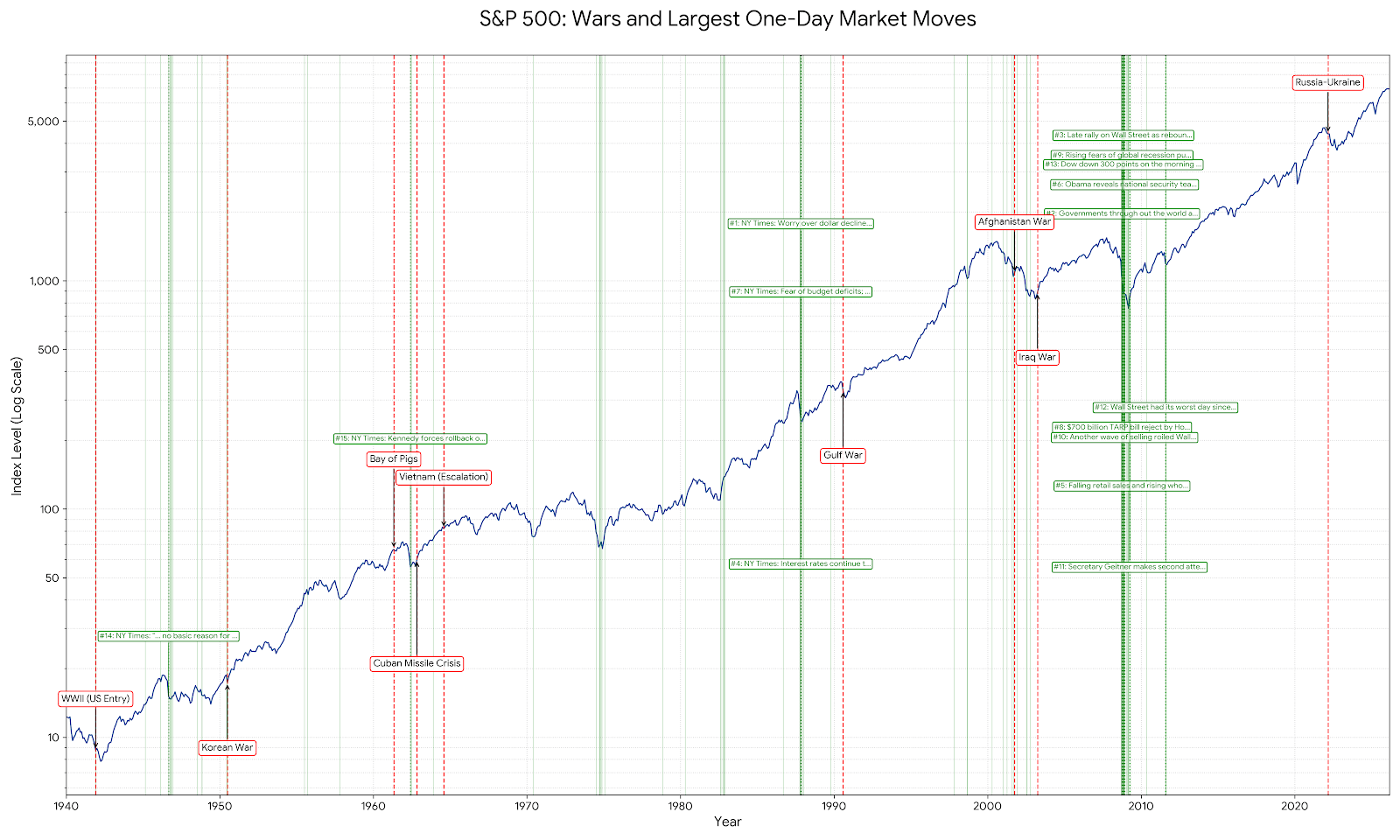
In fact, when you look at the biggest market moving days, only the news of the Pearl Harbor attack and the start of the Korean War make the list. News of war are rarely the cause of big market moves.
So, what does move markets? The paper “What Moves Stock Prices?” answered that question. Over the period of 1941 to 1987, the market’s reaction to major events was minimal.
President Roosevelt’s death, President Kennedy’s assassination, the Soviet invasion of Afghanistan, the Chernobyl meltdown, and more had little impact on markets. The market reaction wasn’t even consistently negative. On average, the market rose 1.46% on the news of important events.
Not to be deterred, the paper then looked at the 50 biggest daily market moves and worked backwards to see what news may have caused it. A follow up paper, “What Moves Stock Prices: Another Look” repeated the process for the period 1988 to 2012.
A chart of the 100 largest market moves, positive and negative, over the entire period (1941 to 2012) covered in both papers is below. The start date for wars, from the table above, are in red. The labeled green dashed lines show the top 15 largest market moves. The other green lines show the other 85 events.
You can find the corresponding market moves in the table at the end, with date, percentage change, and the “cause” of the move based on what was in the news. (Note: big market moves after 2012 are not shown.)
(click to enlarge)
As you probably notice, a few things stand out:
- Big market moves tend to cluster together. You’ll find big up days clustered around big down days and vice versa. The slew of green lines around the 2008 financial crisis is the perfect example.
- Some big events may explain the “cause” of big market moves.
- The majority of big market moves happen for no explainable news related reason. The reason may or may not emerge later, but it wasn’t obvious in the moment.
The news attempts to explain why the market did what it did on any particular day. Unfortunately, the story often falls short. The reason behind big market moves is more of a mystery than what the headlines claim.
The lesson is that, war or not, big market moves tend to cluster, sometimes happen for no newsworthy reason, and yet, the trajectory of the market has been erratic but upward over time. Long term investors need not worry.
101 Largest Daily Market Moves 1941 – 2012
| Rank | Date | Percent Change | Index | News |
|---|---|---|---|---|
| 1 | 10/19/1987 | -20.47% | S&P 500 | NY Times: Worry over dollar decline and trade deficit; Fear of US not supporting dollar. |
| 2 | 10/13/2008 | 11.49% | CRSP | Governments through out the world announce moves to support troubled banks. |
| 3 | 10/28/2008 | 9.53% | CRSP | Late rally on Wall Street as rebound in stocks defies latest economic news. |
| 4 | 10/21/1987 | 9.10% | S&P 500 | NY Times: Interest rates continue to fall; deficit talks in Washington; bargain hunting. |
| 5 | 10/15/2008 | -8.98% | CRSP | Falling retail sales and rising wholesale prices spikes fears of recession and erases Monday’s record rally. |
| 6 | 12/1/2008 | -8.94% | CRSP | Obama reveals national security team. NBER says US entered recession in December 2007. Bernanke warns of weak economic conditions |
| 7 | 10/26/1987 | -8.28% | S&P 500 | NY Times: Fear of budget deficits; margin calls; reaction to falling foreign stocks. |
| 8 | 9/29/2008 | -8.25% | CRSP | $700 billion TARP bill reject by House of Representatives. President Bush disappointed. |
| 9 | 10/9/2008 | -7.27% | CRSP | Rising fears of global recession purshed Wall Street into freefall. U.S. Treasury may take stakes in major banks. |
| 10 | 11/20/2008 | -7.01% | CRSP | Another wave of selling roiled Wall Street. Democrats say no to current plan for auto bailout telling to come back next month with a detailed plan. industry |
| 11 | 3/23/2009 | 6.91% | CRSP | Secretary Geitner makes second attempt at unveiling Obama Administration’s plan to deal with the banking crisis. Obama wants to expand clean energy effort. |
| 12 | 8/8/2011 | -6.87% | CRSP | Wall Street had its worst day since the 2008 financial crisis, as fearful investors reacted to the United States losing its coveted AAA credit rating. |
| 13 | 11/13/2008 | 6.80% | CRSP | Dow down 300 points on the morning reverses on new investor confidence and ends up 553. |
| 14 | 9/3/1946 | -6.73% | S&P 500 | NY Times: “… no basic reason for the assault on prices.”. |
| 15 | 5/28/1962 | -6.68% | S&P 500 | NY Times: Kennedy forces rollback of steel price hike. |
| 16 | 4/14/2000 | -6.63% | CRSP | Investors surprised by unexpected surge in inflation. Economy may be overheating. |
| 17 | 9/26/1955 | -6.62% | S&P 500 | NY Times: Eisenhower suffers heart attack. |
| 18 | 11/24/2008 | 6.61% | CRSP | Citigroup’s massive rescue package and President-elect Obama’s picks for his economic team pushed investors off the sidelines. |
| 19 | 8/31/1998 | -6.59% | CRSP | Stocks crashed today on fears of continuing financial turmoil in Russia and growing doubts about Asia. |
| 20 | 10/27/1997 | -6.53% | CRSP | Mini crash sparked by economic crisis in Asia (need more details) |
| 21 | 11/19/2008 | -6.39% | CRSP | Doubts raised about an immediate government bialout of the auto industry. Obama Administration plans major health care initiative next year. |
| 22 | 3/10/2009 | 6.34% | CRSP | The stock advance picked up speed after Rep. Barney Frank, D-Mass. and the head of the U.S. House Financial Services Committee, said that the SEC would restore the “uptick rule.” The SEC later confirmed that it could reinstate the rule as early as next month. |
| 23 | 11/21/2008 | 6.11% | CRSP | Dow Jones jumps on report that Barack Obama will nominate Timothy Geitner as new Treasury Secretary. |
| 24 | 10/22/2008 | -5.91% | CRSP | Recession fears overwhelmed world stock markets today as a number of large companies reported weak earnings in the third quarter and forecast worse to come. |
| 25 | 10/7/2008 | -5.79% | CRSP | Wall Street took another beating today on fears about the financial sector and doubts regarding the federal rescue plan. Fed Chairman Ben Bernanke said the financial turmoil may drag down economic growth well into next year. |
| 26 | 1/8/1988 | -5.54% | CRSP | Stocks staged one of their biggest retreats in history hammered by investors’ worries about the economy and the possibility of stricter regulation of financial markets. Rumors also circulated of a widening U.S. budget and trade deficits. |
| 27 | 1/20/2009 | -5.49% | CRSP | A large reported earnings miss by State Street bank today lead to renewed concern regarding bank stocks and exacerbated recession fears |
| 28 | 6/26/1950 | -5.38% | S&P 500 | NY Times: Outbreak of Korean War. |
| 29 | 11/12/2008 | -5.36% | CRSP | Treasury Secretary Paulson says the Government won’t buy mortgage assets from banks but will inject capital into them. |
| 30 | 10/13/1989 | -5.34% | CRSP | Stocks fell dramatically following a news story of the break-down of a $6.75 billion leveraged buyout deal for UAL Corporation. |
| 31 | 10/20/1987 | 5.33% | S&P 500 | NY Times: Investors looking for “quality stocks”. |
| 32 | 7/29/2002 | 5.32% | CRSP | Galvanized by hopes that the market’s worst days are over, investors on Monday bought stocks enthusiastically. Analysts believe investors, growing less woriied about earnings and corporate bookkeeping, are ready to buy again. |
| 33 | 1/3/2001 | 5.29% | CRSP | Citing signs of economic slowdown the Fed unexpectedly cut fed funds rate target to 6%, the discount rate was cut to 5.75%. |
| 34 | 12/16/2008 | 5.29% | CRSP | A record drop in the initial jobless claims and a strong manufacturing report helped the benchmarks register significant gains for the first time this week. Additionally, FedEx Corporation’s better-than-expected results helped bolster sentiment. |
| 35 | 9/9/1946 | -5.24% | S&P 500 | NY Times: Labor unrest in maritime and trucking industries. |
| 36 | 7/24/2002 | 5.23% | CRSP | The Dow Jones industrials stormed up as Wall Street cheered legal and legislative action on the corporate eithics scandals that fueled nine weeks of sharp losses. |
| 37 | 10/16/1987 | -5.16% | S&P 500 | NY Times: Fear of trade deficit; fear of higher interest rates; tension with Iran. |
| 38 | 8/9/2011 | 5.12% | CRSP | President Obama expressed confidence in U.S. Government finances following the first ever downgrade of the country’s AAA credit rating by Standard & Poor’s. |
| 39 | 9/17/2001 | -5.07% | CRSP | Stock markets reopen for the first time following the terrorist attack on September 11, 2001. |
| 40 | 11/5/2008 | -5.07% | CRSP | The market experienced the largest post election drop ever on the reported contraction of 157,000 jobs in October. |
| 41 | 8/4/2001 | -5.03% | CRSP | A slowdown in number of job losses to 42,000 and unchanged unemployment of 4.5 pecent indicated that economic deterioration might be turning into stagnation. The report led some investors to think this might discourage the Federal Reserve from continuing its aggressive campaign of cutting interest rates in an effort to avoid a recession. |
| 42 | 5/27/1970 | 5.02% | S&P 500 | NY Times: Rumors of change in economic policy. |
| 43 | 3/2/2009 | -4.98% | CRSP | Banking sector continues its downward spiral. AIG gets additional $30 billion in government aid. Saving rate rises to its highest level in 14 years. |
| 44 | 11/6/2008 | -4.91% | CRSP | The sell-off today occurred after major retailers posted the worst October sales in nearly 40 years and government reports showed labor costs rising and productivity slowing. |
| 45 | 9/8/1998 | 4.83% | CRSP | Stocks stormed higher Tuesday after Federal Reserve Chairman Alan Greenspan hinted in comments over the holiday weekend that a cut in interest rates might be possible. |
| 46 | 9/11/1986 | -4.81% | S&P 500 | NY Times: “…the stock surge happened for no fundamental reason.”. |
| 47 | 8/17/1982 | 4.75% | S&P 500 | NY Times: Foreign governments refuse to lower interest rates; crackdown on triple witching announced Interest rates decline. |
| 48 | 9/30/2008 | 4.66% | CRSP | The Dow jumped 485 points on bets that Congress will pass a version of the government’s $700 billion package, following Monday’s crushing defeat. |
| 49 | 5/29/1962 | 4.65% | S&P 500 | NY Times: Optimistic brokerage letters; institutional and corporate buying; suggestions of tax cut. |
| 50 | 10/30/2008 | 4.65% | CRSP | U.S. stocks rose on signs that central banks’ actions are bearing fruit. Gains came despite a Commerce Department report that the economy shrunk 0.3% in the third quarter. Investors anticipating another rate cut by the Fed. interest |
| 51 | 11/3/1948 | -4.61% | S&P 500 | NY Times: Truman defeats Dewey. |
| 52 | 10/9/1974 | 4.60% | S&P 500 | NY Times: Ford to reduce inflation and interest rates. |
| 53 | 9/19/2008 | 4.60% | CRSP | Stocks rallied Friday, with the Dow rising 369 points, as the government’s plan to help rescue banks from toxic mortgage debt soothed investors at the end of a gut-churning week on Wall Street. |
| 54 | 2/10/2009 | -4.60% | CRSP | Stocks slumped Tuesday, with the Dow industrials ending at a 3-month low, as the government’s bank rescue plan failed to reassure investors burned by the 14-month old recession. |
| 55 | 4/5/2001 | 4.59% | CRSP | Stock prices shot higher today after Dell Computer and Alcoa gave Wall Street its first really good earnings news in months. |
| 56 | 2/25/1945 | -4.57% | S&P 500 | NY Times: Weakness in economic indicators over past week. |
| 57 | 9/15/2008 | -4.57% | CRSP | Lehman files for bankruptcy. Merrill agrees to be sold to B of A. AIG in cash crunch. |
| 58 | 10/2/2008 | -4.57% | CRSP | Stocks tumbled Thursday as frozen credit markets and weak economic reports amplified jitters ahead of the House vote on the $700 billion bank rescue plan. Credit markets remained tight, with two closely watched measures of bank lending jitters at record highs. |
| 59 | 9/17/2008 | -4.55% | CRSP | Stocks plummeted Wednesday, with the Dow industrials falling 449 points in its second worst session of the year, as the government’s emergency rescue of AIG amplified fears about the stability of financial markets. |
| 60 | 12/5/2001 | 4.53% | CRSP | Bullish comments from executives in bellwether tech companies and a much better-than-expected reading on the U.S. service sector fueled speculation that the U.S. economy and corporate profits are on a faster track to recovery than once estimated. Jobless claims rose 9,000 more than expected. Existing home sales dropped 3.5% in July more than the expected 2.0%. Inflation jumped 0.5% compared to expected 0.2%. |
| 61 | 8/18/2011 | -4.53% | CRSP | Morgan Stanley put out a dismal forecast for the globlal economy. Asian stock markets extended their drop Tuesday amid renewed fears of deepening global recession. U.S. |
| 62 | 2/17/2009 | -4.53% | CRSP | stocks declined after Geithner’s bank rescue plan received a weak reception. |
| 63 | 8/11/2011 | 4.52% | CRSP | All three indexes surged about 4% on positive corporate earnings and positive labor market news. The Commerce Department released its July retail sales report, exceeding expectations. The report showed that retail sales rose 0.5%. |
| 64 | 10/15/2002 | 4.52% | CRSP | A trio of rosy earnings reports from market bellwethers Citigroup, Johnson & Johnson and General Motors sparked the latest advance. |
| 65 | 10/23/1957 | 4.49% | S&P 500 | NY Times: Eisenhower urges confidence in economy. |
| 66 | 5/10/2010 | 4.49% | CRSP | US stocks were sharply up today, and major European bourses surged, after European leaders agreed to a nearly $ 1 trillion rescue plan to avoid a major debt crisis and the Fed said it would provide loans overseas. |
| 67 | 4/20/2009 | -4.48% | CRSP | Fears surfaced that if the Government takes a bigger stake in major banks, this would be nationalizing the through their back doors. Citigroup was down big today on this news. banks |
| 68 | 10/29/1987 | 4.46% | S&P 500 | NY Times: Deficit reduction talks begin; durable goods orders increase; rallies overseas. |
| 69 | 9/18/2008 | 4.41% | CRSP | Wall Street rallied Thursday, finding momentum at the end of a tough session, on a CNBC report that the government is working on a more permanent solution to absorbing bad debt. |
| 70 | 11/5/1948 | -4.40% | S&P 500 | NY Times: Further reaction to Truman victory over Dewey. |
| 71 | 12/8/1941 | -4.37% | S&P 500 | Japanese bomb Pearl Harbor |
| 72 | 11/6/1946 | -4.31% | S&P 500 | NY Times: Profit taking; Republican victories in elections presage deflation. |
| 73 | 10/7/1974 | 4.19% | S&P 500 | NY Times: Hopes that President Ford would announce strong anti-inflationary measures. |
| 74 | 11/30/1987 | -4.18% | S&P 500 | NY Times: Fear of dollar fall. |
| 75 | 7/12/1974 | 4.08% | S&P 500 | NY Times: Reduction in new loan demands; lower inflation previous month. |
| 76 | 10/15/1946 | 4.01% | S&P 500 | NY Times: Meat prices decontrolled; prospects of other decontrols. |
| 77 | 10/25/1982 | -4.00% | S&P 500 | NY Times: Disappointment over Federal Reserve’s failure to cut discount rates. |
| 78 | 11/26/1963 | 3.98% | S&P 500 | NY Times: Confidence in President Johnson after Kennedy assassination. |
| 79 | 11/1/1978 | 3.97% | S&P 500 | NY Times: Steps by Carter to strengthen dollar. |
| 80 | 10/22/1987 | -3.92% | S&P 500 | NY Times: Iranian attack on Kuwaiti oil terminal; fall in markets overseas; analysts predict lower prices. |
| 81 | 10/29/1974 | 3.91% | S&P 500 | NY Times: Decline in short term interest rates; ease in future monetary policy; lower oil prices. |
| 82 | 11/3/1982 | 3.91% | S&P 500 | NY Times: Relief over small Democratic victories in House. |
| 83 | 2/19/1946 | -3.70% | S&P 500 | NY Times: Fear of wage-price controls lowering corporate profits; labor unrest. |
| 84 | 6/19/1950 | -3.70% | S&P 500 | NY Times: Korean War continues; fear of long war. |
| 85 | 11/18/1974 | -3.67% | S&P 500 | NY Times: Increase in unemployment rate; delay in coal contract approval; fear of new mid-East war. |
| 86 | 4/22/1980 | 3.64% | S&P 500 | NY Times: Fall in short term interest rates; analysts express optimism. |
| 87 | 10/31/1946 | 3.63% | S&P 500 | NY Times: Increase in commodity prices; prospects for price decontrol. |
| 88 | 7/6/1955 | -3.57% | S&P 500 | NY Times: Profit taking; continuation of previous week’s decline. |
| 89 | 6/4/1962 | -3.55% | S&P 500 | NY Times: Market optimism triggered by GM stock split. |
| 90 | 8/20/1982 | 3.54% | S&P 500 | NY Times: Congress passes Reagan tax bill; prime rate falls. |
| 91 | 12/3/1987 | -3.53% | S&P 500 | NY Times: Computerized selling; November retail sales low. |
| 92 | 9/19/1974 | 3.50% | S&P 500 | NY Times: Treasury Secretary Simon predicts decline in short term interest rates. |
| 93 | 12/9/1946 | 3.44% | S&P 500 | NY Times: Coal strike ends; railroad freight rate increase. |
| 94 | 6/29/1962 | 3.44% | S&P 500 | NY Times: “…stock prices advanced strongly chiefly’ because they had gone down so long and so far that a rally was due.”. |
| 95 | 9/5/1946 | 3.43% | S&P 500 | NY Times: “Replacement buying” after earlier fall. |
| 96 | 10/20/1987 | 3.33% | S&P 500 | NY Times: Dollar stabilizes; increase in prices abroad. |
| 97 | 1/27/1975 | 3.27% | S&P 500 | NY Times: IBM wins appeal of antitrust case; short term interest rates decline. |
| 98 | 10/6/1982 | 3.27% | S&P 500 | NY Times: Interest rates fall; several large companies announce increase in profits. |
| 99 | 7/19/1948 | -3.26% | S&P 500 | NY Times: Worry over Russian blockade of Berlin; possibility of more price controls. |
| 100 | 11/30/1982 | 3.23% | S&P 500 | NY Times: “…analysts were at a loss to explain why the Dow jumped so dramatically in the last two hours…”. |
| 101 | 12/9/1941 | -3.23% | S&P 500 | US declares war against Japan |
Sources:
- What Moves Stock Prices, Cutler, Poterba, Summers, 1988
- What Moves Stock Prices: Another Look, Cornell, 2012
Related Reading: