
Novel Investor
  • Home
  • About
  • Invest with Me
  • Resources
  • Weekend Reads – 1/30/26

    January 30, 2026

    ·

    Jon

    Quote for the Week

    Perhaps enough has been said to indicate the principal difficulties which beset the speculator who attempts to profit by the short swings of the stock. For practical purposes the occurrence of ripples and waves in the price movement is unpredictable. To attempt to trade on such movements is mere gambling with the odds against the trader by a considerable margin. It is astounding that thousands of otherwise intelligent persons persist in trying to make money in this way. Commonly accepted figures of somewhat dubious origin are frequently cited to show that 90% to 95% of all margin trades lose money in the stock market. The deep-seated gambling instinct, the well-founded belief that in widely fluctuating markets there must be opportunities for profit nevertheless bring fresh recruits to the brokerage offices in constant streams. A few of them ultimately learn the methods by which money may actually be made in the stock market. — Philip Carret (source)
    Continue Reading…

  • How to Win in Wall Street by A Successful Operator

    January 28, 2026

    ·

    Buy the Book: eBook

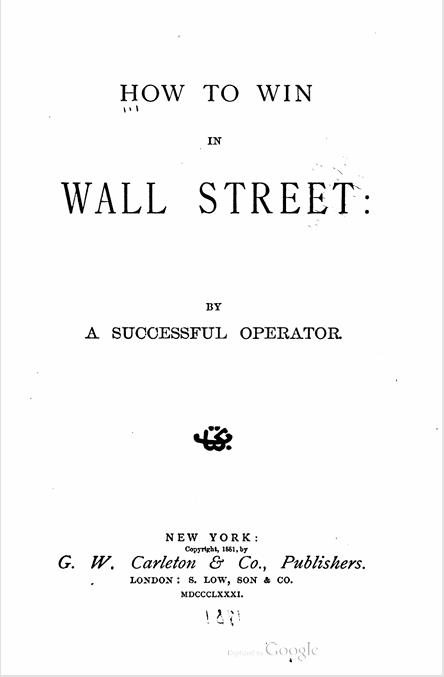
    Published in 1881, How to Win in Wall Street offers some historical context around U.S. financial markets, and the enduring role human nature plays within it, alongside timeless investing wisdom.

    How to Win in Wall Street book cover

    The Notes

    Continue Reading…

  • Weekend Reads – 1/23/26

    January 23, 2026

    ·

    Jon

    Quote for the Week

    We actually can see and indeed measure how badly investors do at timing. They’re their own worst enemy. As Warren Buffett says, the two greatest enemies of equity investors are expenses and emotions. You can see the expenses in the gap between the market return and fund returns, and the emotions in the gap between fund returns and investor returns. When you look at data on the origin of these shortfalls, it is staggeringly loaded toward the degree of fund specialization; in other words, the biggest gap between fund time-weighted returns and fund investor dollar-weighted returns is found in technology funds, telecommunications funds, aggressive growth funds. We did a study that covered six years, i.e., the last three years of the up market and the first three years of the down market. With the ups and downs taken together, the twenty-five largest sector funds actually returned about 5.5 percent per year, versus 3.7 percent for the twenty-five largest diversified funds. However, while the typical investor in the diversified mutual funds ran about 2 percent behind the funds themselves, the investors in these specialty funds fell short of the fund returns by about 14 percent a year, which, when compounded over six years, is a staggering shortfall of 59 percent. — John Bogle (source)

    Continue Reading…

  • Quarterly Reading – Winter 2026

    January 21, 2026

    ·

    Jon

    Here’s what I’ve been reading for the past three months:

    • How to Win in Wall Street – George Goodman referenced this book in his classic The Money Game. Published in 1881, the author mixes in stories related to the period to discuss investing basics, warn about gambling, the need for patience, and more. He offers 9 rules to “win in wall street.” Most should sound familiar today.
    • A Week in Wall Street – An even older book, written in 1841. It takes a humorous, almost cynical, look at the inner workings of the early days of Wall Street.
    • The Great Salad Oil Swindle – Norman Miller tells the crazy story of Tino De Angelis and one of the largest cases of financial fraud in the 1900s. It involved vegetable oil, loans to buy vegetable oil futures, and an “inventory” of oil, used as collateral, that exceeded the total supply of vegetable oil in the U.S. Those that follow Warren Buffett’s early investments might recognize this story. The aftermath led to Buffett buying American Express.
    • Hedgemanship – The book is a byproduct of the rise of hedge funds in the 1960s. It explains hedge fund strategies that individual investors might employ. In turn, you get a history of hedge funds by Alfred Winslow Jones and others.

    Book notes from last quarter:

    • The Pleasure was All Mine by Fred Schwed Jr.
    Continue Reading…

  • Weekend Reads – 1/16/25

    January 16, 2026

    ·

    Jon

    Quote for the Week

    If you’re going to seek out volatility because that’s where opportunity is, you don’t want your entire portfolio to be volatile, you only want to make volatile bets within it. You have to be sure that there’s some systematic arrangement of the bets that you make so that the portfolio risk in the total portfolio is not as volatile as the individual components. One of Markowitz’s great insights was precisely that. That you can take a lot of high-risk bets—as long as they’re not correlated—and come out fine. I don’t see what’s fraudulent about trying to do that…

    As I said, the markets are macro-inefficient. They can go haywire. That is a matter that you deal with through your asset allocation in the first place, so that you don’t get killed if the totally unexpected hits you in the face…

    My own affairs are run that way because I know that extreme outcomes can happen and I don’t want to get killed. But that doesn’t mean that I’m not making bets in the middle of the portfolio somewhere. — Peter Bernstein (source)

    Continue Reading…

  • 2025: A Year in Returns

    January 14, 2026

    ·

    Jon

    Diversification is not just a defensive strategy but an offensive one too. 2025 was a perfect example, from the start, of how portfolios benefit from both.

    The defensive side stepped up early with the U.S. markets poor start and tariff panic in April. The offensive side took over with the recovery. Especially, international and emerging markets, which fared better than the U.S. market in April and went on to produce a blowout performance on the year.

    By the end of 2025, emerging markets led with a 34.4% total return (almost double the S&P 500 on the year). International markets followed closely behind at 31.9% total return.

    The last time emerging markets outpaced everything, was 2017. Prior to that, it was 2009 (then 2007, 2005, 2003).

    In fact, from 2000 to 2009 — while the S&P 500 experienced its lost decade averaging a 0.95% annual loss — emerging markets were only outpaced by U.S. REITs, by a slim margin (REITS at 10.6%/yr, EM at 10.1%/yr). The returns from emerging markets and REITs made up for the drag produced by U.S. stocks, in a diversified portfolio, over that 10-year period.

    Continue Reading…

1 2 3 … 230
Next Page

Join the library.

Access over 1,100 research papers, writings, transcripts, and more from the brightest minds in finance.

Learn More

Learning

  • Investor Library
  • Book Notes
  • Investor Quotes

Return Quilts

  • Asset Class Returns
  • S&P Sector Returns
  • International Stock Market Returns
  • Emerging Markets Returns
  • Historical Returns Data

Connect

  • Bluesky
  • Twitter
  • Facebook
  • RSS Feed
  • Home
  • About
  • Contact

© Novel Investor · All Rights Reserved · Terms of Use · Privacy Policy · Disclaimer