
Novel Investor
  • Home
  • About
  • Invest with Me
  • Resources
  • How the Battle Over a Little Railroad Captured the 1929 Market Frenzy

    October 21, 2022

    ·

    Jon

    Everything aligned perfectly for Frank Taplin. He owned shares in a small railroad, controlling a strategic corridor, in the merger mania of 1929. The battle for Taplin’s little railroad is a story of the excesses of the late 1920s stock market frenzy.

    The New Era of the late 1920s saw demand for stocks like no other. Investment banks supplied the demand in innovative ways. One way was through the use of a holding company.

    A holding company is exactly like sounds. It produces nothing. It provides no services. It simply holds and votes the shares of other businesses. In return, the holding company issues shares to the public supplying the demand for more shares.

    One such holding company was the Allegany Corporation. It was created by the Van Sweringen brothers, with the help of J.P. Morgan and Company in January 1929. Its purpose was to hold railroad interests.

    The Allegany Corporation was unique in that it wasn’t offered to the public but to J.P. Morgan’s “preferred list.” It was a who’s who of men in power and influence in the country. J.P. Morgan offered shares at cost to those on the list, with the understanding that the stock would be trading on the public market, at a profit, in the very near future. No strings attached. Continue Reading…

  • Wise Words from Ed Thorp

    October 14, 2022

    ·

    Jon

    Ed Thorp’s journey to investing began in a casino. It started by questioning the conventional wisdom that the game couldn’t be beaten. Thorp proved it could.

    The game was blackjack. His strategy for counting cards gave the player an edge over the house. He published the strategy in Beat the Dealer, which became a best seller. It was proof that a tiny edge can compound a small bankroll into a fortune over time.

    Less well-known is that Thorp beat the game of roulette too. With the help of Claude Shannon, Thorp created a wearable computer that predicted where the ball would land. It gave them a 44% expected gain playing roulette.

    Thorp’s proclivity to question conventional wisdom pushed him toward markets. His early foray into investing was a hedging strategy using warrants, options, and convertible bonds and preferreds, which was written about in Beat the Market. He averaged 25% mostly investing for himself and friends and family.

    He started Princeton/Newport Partners in 1969. He continued his warrant strategy while adding an options formula — basically, Black-Scholes before Black and Scholes figured it out — along with a third strategy he could use depending on the situation. It became a race to stay ahead of academia until he closed up shop in 1989. Continue Reading…


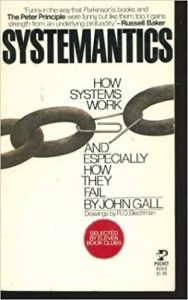
  • Systemantics: How Systems Work and Especially How They Fail by John Gall

    October 12, 2022

    ·

    Systemantics book coverBuy the Book: Print

    Systemantics humorously describes how complex systems work and why they are far from perfect. The author’s systems axioms, listing the possible flaws and failure points, are reasons why humility and skepticism, rather than confidence, are needed when dealing with systems.

    The Notes

    Continue Reading…


  • Quarterly Reading – Fall ’22

    October 7, 2022

    ·

    Jon

    Here’s what I’ve been reading for the past three months:

    • Deep Simplicity: Bringing Order to Chaos and Complexity – John Gibbin explains how simple rules often describe the complexity and chaos found in math, physics, biology, and more. The book was not an easy read at times — portions of it went over my head and I’m still working through it.
    • Successful Stock Speculation – The 1922 classic sits as an introduction to investing. The author, a stockbroker, presents some of the basic investing principles everyone should be aware of — especially today — before putting money to work in the market. (notes)
    • The Cycles of Speculation – Thomas Gibson recognized how investors bounced from one speculative frenzy to another throughout the 1800s with the rise and fall of the market cycle. He briefly describes the early cycles and the many errors investors made along the way. (notes)
    • Systemantics: How Systems Work and Especially How They Fail – John Gall humorously describes how complex systems work…or do not work. His long list of systems axioms highlight the many potential failure points in any complex system.
    • The Splendid and the Vile – Erik Larson tells the story of Winston Churchill’s early days of WWII during the London blitz. I struggled to find a book that held my interest over the past few months. This book came recommended, so I just started it.

    Continue Reading…


  • Seeking the Elusive Market Oracle

    October 5, 2022

    ·

    Jon

    What do fortunetellers, psychics, and stock market forecasters have in common? They all claim to know what happens next…for a price.

    But how good are they? Horrible! Yet some investors pay for it anyways. It’s a lesson investors can learn from history.

    Alfred Cowles was one of the first to put market forecasters to the test almost a century ago. He conducted two studies, the first in 1932 and again in 1944.

    The first study was based on the period from 1928 to 1932. Cowles first looked at how successful 20 insurance companies and 16 financial services were at picking stocks that would outperform the market. He next looked at the accuracy of 25 financial publications in predicting the movements of the markets. He also included the 26-year record of the editor of the Wall Street Journal, Peter William Hamilton.

    The results were not surprising. Continue Reading…


  • Lighter Note: Cartoons of Bear Markets

    September 30, 2022

    ·

    Jon

    Editorial cartoons present a snapshot of things that stood out as important in the past. Most are political in nature. Every so often, something major happened in the stock market that drew the attention of the country and cartoonists captured the moment in a funny way.

    Bear markets and crashes were always a big draw and the 1900s produced many. A selection is covered by the cartoons below.

    The first came in 1901. Cartoonists captured the speculation and panic caused by the attempted corner of the Northern Pacific Railway. The corner led to one of the largest short squeezes ever, forced short sellers to sell other holdings, and created a panic on Wall Street.

    "The Bottom Dropped Out" - A bear climbs atop a Wall Street barrel, with the bull market contents spilling out the bottom.
    New York Daily – May 10, 1901

    Continue Reading…


Previous Page
1 … 50 51 52 53 54 … 232
Next Page

Join the library.

Access over 1,100 research papers, writings, transcripts, and more from the brightest minds in finance.

Learn More

Learning

  • Investor Library
  • Book Notes
  • Investor Quotes

Return Quilts

  • Asset Class Returns
  • S&P Sector Returns
  • International Stock Market Returns
  • Emerging Markets Returns
  • Historical Returns Data

Connect

  • Bluesky
  • Twitter
  • Facebook
  • RSS Feed
  • Home
  • About
  • Contact

© Novel Investor · All Rights Reserved · Terms of Use · Privacy Policy · Disclaimer