
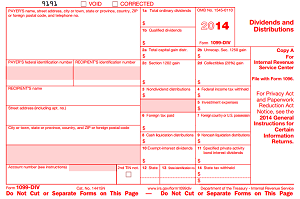
 The IRS has different tax forms for every type of income imaginable. With investing, that can quickly get complicated and lead to mistakes. At the very least, you should have a basic idea of what the tax forms do and which forms to expect each year. That alone will give you a better picture of your tax costs, allowing you to build a more tax efficient portfolio.
Investment income comes in three forms: earned interest, dividends, and capital gains. Each is taxed differently. Earned interest is regular income subject to federal income tax while dividends and capital gains has its own tax rates.
You’ll get separate tax forms for each income type. But there’s a good chance you’ll get multiple forms for each investment too. For instance, TD Ameritrade sends me a consolidated 1099 every year for the stocks and ETFs I own, which is just a 1099-INT, 1099-DIV, and 1099-B rolled into one big statement. Below are the more common tax forms you’ll receive for investment income. Continue Reading…
 Dividends are the big reason investors turn to
  The headlines are full of market anomalies this time of year. In December it’s the Santa Claus Rally. January it’s the ever original January Effect. After this weekend you’ll see the Super Bowl Indicator. Then comes Sell in May. It’s a seasonal thing, offering a break from the back and forth between stock market corrections and bubble headlines we’ve seen more of these past five years.
 Last week I dug into