Buy the Book: Print
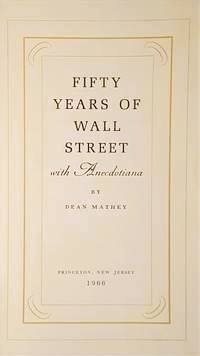
Dean Mathey was an investment banker on Wall Street. His autobiography primarily relays his experience and lessons from his start selling bonds in 1912 through the Great Depression.

·
Buy the Book: Print
Dean Mathey was an investment banker on Wall Street. His autobiography primarily relays his experience and lessons from his start selling bonds in 1912 through the Great Depression.
·
Continue Reading…The only thing certain on the fortieth anniversary of the 1929 debacle is that some day, without fail, there will be another such disaster.
The reason is that the stock market is inherently unstable, the instability being related to its superbly orchestrated ability to attract people with a promise of effortless riches, give them a taste of such gains, give them the promise of a great deal more gain, persuade them that it is rewarding their financial acuity or that of the people who are managing their money, and then, usually, after overcoming some preliminary setbacks, which greatly adds to the general state of confidence, destroy these illusions in one mortal thud. What is necessary for a new disaster is only for the memories of the last one to fade and no one knows how long that takes. — John Kenneth Galbraith (source)
·
Here’s what I’ve been reading for the past three months:
·
Continue Reading…This investment management business, when stripped down to its bare essentials, is really quite simple. Now, why do I say that? Well, I think if we took the group here today and divided you up into smaller groups of four, or five, or six and asked you to talk about what’s really important in managing a portfolio that has a very long time horizon, I think that almost all the groups would come to very similar conclusions. If you’re investing with a long time horizon, having an equity bias makes sense; stocks go up in the long run…
The other thing that I think would come out of the discussions is that diversification is important. Anybody whose read a basic finance text, as a matter of fact, I think anybody who thinks about investments in a common sense fashion knows that diversification is an important fundamental tenet of portfolio management. As a matter of fact, Harry Markowitz called diversification a “free lunch.” We spend all our time in Intro. Econ. figuring out there is no such thing as a free lunch but Markowitz tells us that diversification is a free lunch… For any given level of risk, you can increase the return; sounds pretty good. That’s pretty simple, right? Two tenets, an equity bias for portfolios with a long time horizon and diversification. — David Swensen (source)
·
2026 started out well for global markets. Then March hit. And chaos ensued.
How well were things going? Through February 2026, most global markets were positive. In fact, only seven country indexes sat at a loss on the year at the end of February.
So, 40 country indexes were positive. South Korea lead with a 56.4% total return in the first two months. Twelve other emerging market countries were up double-digits. Only five of the remaining eleven had losses no worse than -5.8%.
Norway led developed markets with a 20.2% total return through February. Eight other developed countries were up double-digits. Only two of the rest — Ireland and Denmark — had losses for the year at that point.
Broadly, international and emerging markets led through the first two months. MSCI EM returned 14.9% through February. International followed with a 10.1% total return. US REITs were up 10.5%. US small caps gained 6.2%. Even the S&P 500 was positive, barely, at 0.7% at the end of February, with eight of eleven sectors positive and five of those eight sitting at double-digit returns.
Then came March.
All broad indexes fell. US small caps, large caps, international, and emerging markets were down. Only US REITs and small caps were still positive by the end of March. Inside the S&P 500, all but one sector was down.
Continue Reading…·
Continue Reading…Investing is about making decisions with your money. All of those decisions are probabilistic. As former Treasury Secretary (and maybe future Chairman of the Fed) Robert Rubin emphasizes in his new book, nothing is certain – except uncertainty – and decision procedures need to reflect that. In a recent speech, Fed Chairman Greenspan makes much the same point, and elaborates on the difference between the most likely outcome and low probability but high impact outcomes.
Decision procedures and outcomes also need to be clearly distinguished. A decision is not bad or wrong because the outcome turns out badly. And a good decision is not the same as one that turns out well. A decision is bad if the process that engendered it was bad, regardless of the outcome. Bad outcomes — losing a lot of money in an investment — can happen even if the process is sound; and good outcomes can occur even if the process is lousy. A market that is mostly efficient can distribute outcomes all over the place. — Bill Miller (source)