
Novel Investor
  • Home
  • About
  • Invest with Me
  • Resources
  • John Maynard Keynes’s Investment Policy

    March 20, 2019

    ·

    Jon

    After managing King’s College investment funds for almost 14 years, John Maynard Keynes decided to run a post-mortem on his investment results.

    He had stats for three indexes and three other institutions to compare to his results. And he had a unique set of experiences to draw from thanks to shifting ideas on what a best investment policy should be.

    The period he analyzed ran from January 1929 to December 1938. Despite the terrible starting point, the results were clear. Whatever he was doing, was working.
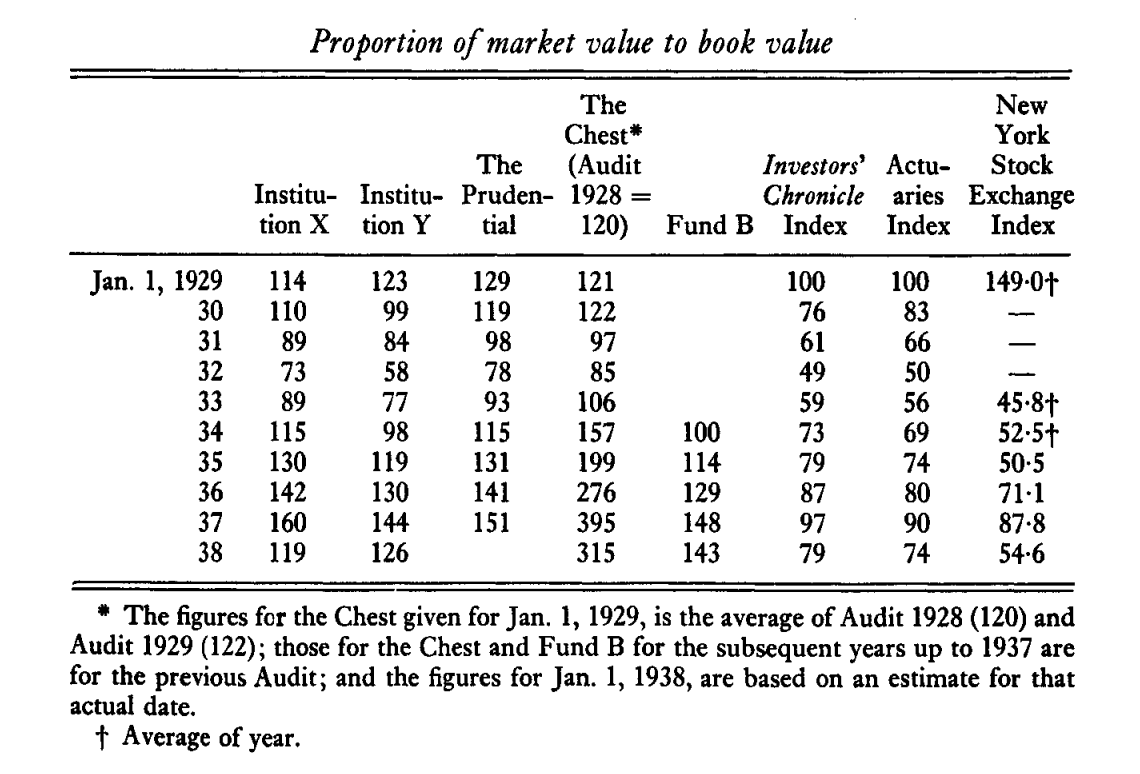
    Keynes Kings College Fund Results for 1929 to 1938

    (Keynes managed The Chest and Fund B for the College shown in the image above.)

    He relayed the lessons from his experiences and the post-mortem in a memo to the Estates Committee in May 1938. Continue Reading…


  • Seth Klarman: What If Everyone was a Securities Analyst?

    March 15, 2019

    ·

    Jon

    Seth Klarman offered up a simple thought experiment. What if everyone was a securities analyst, would the market finally be efficient?

    Klarman’s thought experiment came in a response to Louis Lowenstein’s Searching for Rational Investors in a Perfect Storm. Lowenstein was questioning the existence of rational actors, purported by EMT, amid the Dotcom rubble. It’s reminiscent of Buffett’s The Superinvestors of Graham and Doddsville.

    Klarman’s criticism of efficient markets is no surprise. He and his clients have thrived off of the inefficiencies for several decades.

    His criticism gets to the root cause of why. Emotions. He tacks on an additional important point that probably gets overlooked by many. Brainpower has limits when you mix money with emotions. Continue Reading…


  • Lessons from The Zurich Axioms

    March 13, 2019

    ·

    Jon

    Few people understand risk in a way that makes it actually rewarding. That’s the message offered in The Zurich Axioms. The book lays out 12 Axioms that play off this idea.

    In some cases, the Axiom runs counter to typical investor behavior. In others, it runs counter to popular thinking. And some are obvious. I guarantee you won’t agree with all of them, but it should, at least, give you something to think about.

    These are the lessons from a few Axioms that stood out (check out the notes linked below or read the book for the full list).

    Axiom #1: Worry is not a sickness but a sign of health. If you’re not worried, you are not risking enough.

    In investing, most people want a risk-free reward. Yet, risk and reward are intertwined. No matter how hard you try to remove one, it affects the other. Not many get that. Continue Reading…


  • The Zurich Axioms by Max Gunther

    March 13, 2019

    ·

    The Zurich AxiomsBuy the Book: Print | eBook

    The Zurich Axioms is a book about managing risk and reward. Twelve Axioms define how to think about risk and uncertainty in such a way that you’re more likely to be rewarded than not.

    The Notes

    Continue Reading…


  • Lessons in Down Markets

    March 8, 2019

    ·

    Jon

    Before the financial crisis, there was the 1980s real estate bust. The southwest part of the country was particularly hit hard.

    Along with the bust, came the S&L crisis, many bank failures, and for one company, Trammell Crow, a post-mortem on the numerous mistakes different partners made during the boom times. In 1989, a memo was sent asking partners “to reflect upon the environment which lead to the collapse of the Southwest real estate markets.” The replies were pieced together into over a 100-page list, consisting mostly of mistakes made during the period.

    If you work in commercial real estate or study it, it’s a great resource. Being real estate, excess leverage is a recurring theme. Diworsification is another mistake that pops up often. There’s the typical behavioral stuff too — overconfidence, overoptimism, greed, FOMO, etc. — that always surface in hindsight.

    It’s interesting how booms, universally, push people to reach for things, lower their standards (while raising expectations), chase more and more investments (instead of staying focused on their top ideas), or do deals because money’s available. That belief that if they don’t do it, someone else will, and they’ll miss out, is like sitting on a time bomb with a hidden countdown during a boom. Continue Reading…


  • Charlie Munger’s Uncommon Sense

    March 6, 2019

    ·

    Jon

    Charlie Munger has a system that flips things on their head in a way that makes complete sense. He refers to it as inversion, and when combined with avoidance, it works wonders.

    For example, instead of studying successful people in the hopes of also being successful, study what it takes to be unsuccessful and do the opposite. You may never be a huge success, but your chance of total failure decreases dramatically. And by studying unsuccessful people, you avoid any problems of confusing success with the role luck played in some people’s lives.

    Munger explains his system like this:

    My system in life is to figure out what’s really stupid and then avoid it.

    Last week I finished transcribing the Daily Journal Meeting held a few weeks back. Examples of Munger’s system of inversion and avoidance run throughout, which are highlighted below, along with a couple of other important lessons that stood out. Continue Reading…


Previous Page
1 … 100 101 102 103 104 … 233
Next Page

Join the library.

Access over 1,100 research papers, writings, transcripts, and more from the brightest minds in finance.

Learn More

Learning

  • Investor Library
  • Book Notes
  • Investor Quotes

Return Quilts

  • Asset Class Returns
  • S&P Sector Returns
  • International Stock Market Returns
  • Emerging Markets Returns
  • Historical Returns Data

Connect

  • Bluesky
  • Twitter
  • Facebook
  • RSS Feed
  • Home
  • About
  • Contact

© Novel Investor · All Rights Reserved · Terms of Use · Privacy Policy · Disclaimer