
Novel Investor
  • Home
  • About
  • Invest with Me
  • Resources
  • Wise Words from John Neff

    April 22, 2022

    ·

    Jon

    Vanguard might be known for its low-cost index funds but it carries a slew of actively managed funds too. In fact, one of the best investors ever managed Vanguard’s Windsor Fund for 31 years.

    John Neff’s career at Vanguard began in 1964 until his retirement in 1995. Under his watch, Winsdor Fund outperformed the S&P 500 23 out of 31 years with a 13.7% annual return. That’s 3% better than the S&P 500 over the same period. Even better, he earned a 20% annual return on his own portfolio over the 10 years following his retirement.

    More impressive is the fact that Neff believed his pay should be tied to his ability to beat Windsor’s benchmark. He convinced John Bogle to add an incentive-based fee structure to Windsor’s already low fees.

    Windsor charged a 0.16% fee with an incentive-based fee that swung up or down 0.10% based on performance. If Windsor beat the S&P 500 the fee bumped up to 0.26% but if it fell short, the fee dropped to 0.06%. It wasn’t a pure beat either. Neff needed to beat the S&P 500’s trailing three average return by 1.2% to hit that incentive.

    Neff had a value investing discipline. He was known as a low-P/E investor. It often led him to neglected cyclical stocks where selling was inevitable. However, his perfect stock provided dividend yield plus growth. A high total return at a low P/E multiple was his goal. Continue Reading…

  • Asset Allocation Drives Returns

    April 20, 2022

    ·

    Jon

    Sometimes it’s good to get back to the basics. The basics of investing are simple: a bias toward stocks, diversification, and a long time horizon. A portfolio tilted toward a diverse basket of stocks provides the engine for long-term growth.

    Yet, investors have a knack for over-complicating investing by trying to do too much. The reason is due to three tools at our disposal. David Swensen described these tools as asset allocation, market timing, and security selection.

    In theory, the tools allow us to “add value” and improve our returns. But only one does any real work. In fact, the other two are a net negative. Continue Reading…


  • How the South Sea Bubble Burst

    April 14, 2022

    ·

    Jon

    The South Sea Bubble got its name from the South Sea Company. Its soaring stock price generated an enthusiastic buying spree in the early 1700s but the company is only part of the story. Hundred of smaller companies created around the same time kept the bubble inflated.

    Between 1719 and 1720, numerous joint-stock companies were formed to take advantage of investor enthusiasm. A handful were legitimate concerns in insurance. Some were based on new innovations like “Puckle’s Machine Gun” and different fishery projects.

    The majority were schemes to take advantage of investors’ ignorance. Some of the wilder concerns involved “extracting silver from lead,” “trading in human hair,” “a wheel for a perpetual motion,” and “a subscription advertised, and actually opened, for an undertaking, which shall in due time be revealed.”

    Somehow, investors ate it up.

    But the directors of the South Sea Company had a problem. They needed to prop up their stock and saw the smaller issues as competition. They wanted a monopoly on investor capital. They reasoned that if investors dumped their money into these new companies, no money would be left to pump up South Sea stock. Continue Reading…


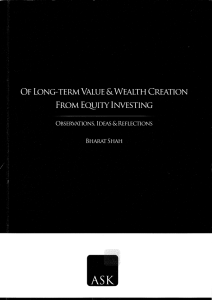
  • Of Long-Term Value & Wealth Creation from Equity Investing by Bharat Shah

    April 13, 2022

    ·

    Of Long Term Value book coverBuy the Book: PDF

    Bharat Shah breaks down compounding machines. He points out the characteristics that drive companies to compound over long periods of time and the characteristics investors need to profit from them.

    The Notes

    Continue Reading…


  • The Importance of Slugging Percentage in Investing

    April 8, 2022

    ·

    Jon

    Probably the most widely followed stat in baseball is batting average. It measures a player’s success rate for each at-bat. Whether they get a single or a home run, a hit is a successful at-bat.

    The average batting average in Major League Baseball is .250. So the average player gets a hit one out of every four at-bats. The best baseball players hit a little better than a .300 batting average. A .400 average is the holy grail that hasn’t been achieved since Ted Williams did it in 1941.

    Except, in baseball, not all hits are equal. And with such a low success rate, what the player does with each at-bat becomes important. That’s where slugging percentage comes in.

    Slugging percentage measures a player’s ability to hit extra-base hits. A single is one base, a double is two bases, and so on. It measures the average bases earned per at-bat which you get by taking the total number of bases earned divided by total at-bats.

    So if a player wants a high slugging percentage, they need to hit doubles or better fairly often. And a high slugging percentage tends to lead to scoring runs, which is how you win games.

    What does this have to do with investing? Continue Reading…


  • Fred Schwed Jr.: The Dream Market

    April 6, 2022

    ·

    Jon

    Fred Schwed Jr.’s classic, Where are the Customers’ Yachts? was first published in 1940. The title was borrowed from a quip William Travers made in the late 1800s.

    As the story goes, Travers was with some friends in Newport to watch a boat race. After learning several boats were owned by Wall Street brokers, he asked, “Where’s the customer’s yachts?”

    Schwed’s book was one of the first to mix humor with finance to warn people of Wall Street’s shortcomings…starting with the title. Wall Street has a history of enriching itself at the customer’s expense. But he didn’t stop there. He knocked Wall Streeters for their continual need to predict the future — and continuously getting it wrong.

    However, the book wasn’t the first time Schwed blasted Wall Street for its shortcomings. A short piece, he wrote, in the March 1939 issue of Forum and Century magazine offered a glimpse of what was to come.

    Schwed went after Wall Street for the endless confidence in knowing what happens next, the ignorance of uncertainty, the endless search for patterns in the market, CEOs playing the blame game, and the customers for being gullible. Continue Reading…


Previous Page
1 … 58 59 60 61 62 … 233
Next Page

Join the library.

Access over 1,100 research papers, writings, transcripts, and more from the brightest minds in finance.

Learn More

Learning

  • Investor Library
  • Book Notes
  • Investor Quotes

Return Quilts

  • Asset Class Returns
  • S&P Sector Returns
  • International Stock Market Returns
  • Emerging Markets Returns
  • Historical Returns Data

Connect

  • Bluesky
  • Twitter
  • Facebook
  • RSS Feed
  • Home
  • About
  • Contact

© Novel Investor · All Rights Reserved · Terms of Use · Privacy Policy · Disclaimer