
Novel Investor
  • Home
  • About
  • Invest with Me
  • Resources
  • Lessons from Charlie Munger at the Daily Journal Meeting

    March 5, 2021

    ·

    Jon

    Charlie Munger held court at the Daily Journal Annual Meeting last week. He answered questions for almost two hours. These were a few lessons to take away from it.

    On behavior in market booms.

    You get crazy booms. Remember the Dotcom boom? When every little building in Silicon Valley rented at a huge price and a few months later, about a third of them were vacant. There are these periods in capitalism and I’ve been around for a long time and my policy has always been to just ride them out…

    In fact, what shareholders actually do is a lot of them crowd in to buying stocks on frenzy, frequently on credit because they see that they’re going up, and of course that’s a very dangerous way to invest. I think that shareholders should be more sensible and not crowd into stocks and buy them just because they’re going up and they like to gamble.

    The risk in the ensuing stock crash is that emotions trigger a host of actions that feel just as right as when stock prices were rising but ultimately end up being costly. It’s a story repeated throughout history. Continue Reading…

  • Lessons from the 2020 Berkshire Letter

    March 3, 2021

    ·

    Jon

    Warren Buffett’s annual letter to shareholders was released this past weekend. Like previous letters, it’s filled with several lessons and great reminders for investors. Let’s dive in.

    Even the Best Investor Makes Mistakes

    The final component in our GAAP figure – that ugly $11 billion write-down – is almost entirely the quantification of a mistake I made in 2016. That year, Berkshire purchased Precision Castparts (“PCC”), and I paid too much for the company. No one misled me in any way – I was simply too optimistic about PCC’s normalized profit potential…

    I believe I was right in concluding that PCC would, over time, earn good returns on the net tangible assets deployed in its operations. I was wrong, however, in judging the average amount of future earnings and, consequently, wrong in my calculation of the proper price to pay for the business. PCC is far from my first error of that sort. But it’s a big one.

    Every investor loves to tout their winners. Nobody likes to talk about their losers. Well, almost nobody. Continue Reading…


  • The Coffee Can Approach

    February 26, 2021

    ·

    Jon

    The coffee can portfolio is a strategy built on one decision. You buy a stock. That’s it. It eliminates the difficult task of selling.

    Robert Kirby envisioned the strategy after a client approached him. He had worked with the client for about a decade when she called. Her husband had suddenly died and she wanted to add his portfolio to hers so Kirby could manage it. As Kirby looked over her husband’s portfolio he was somewhat shocked and surprised by it. The husband not only cloned his wife’s portfolio but handily outperformed it.

    Every time Kirby made a recommendation to buy a stock for the wife’s portfolio, the husband followed it too. Each time, he invested about $5,000 into the stock. But when Kirby made the recommendation to sell, the husband ignored it. Every time he bought a stock, he tossed the stock certificates into a safe deposit box and did nothing.

    After a decade, with a growing pile of stock certificates, the husband’s portfolio became a weird mix of stocks. Many were worth less than the original $5,000 investment. A few were worth more. A lot more in fact. A handful were in excess of $100,000 and one small investment in Xerox exceeded $800,000. Continue Reading…


  • Foiling Mr. Market

    February 24, 2021

    ·

    Jon

    This imaginary person out there — Mr. Market — is kind of a drunken psycho. Some days he gets very enthused and some days he gets very depressed. – Warren Buffett

    I like the way Warren Buffett simplifies Mr. Market. On any given day, Mr. Market can quote great prices or terrible prices. You can get caught up in his manic depressive behavior or you can ignore it. You can see the market as a tool to use or it can be a tool that uses you. It’s your choice.

    Ever since Ben Graham offered up the first iteration of the Parable of Mr. Market, others have stepped up with their own versions. Charley Ellis has a more descriptive version I also like: Continue Reading…


  • Wise Words on Surviving Bull Markets

    February 19, 2021

    ·

    Jon

    Investing is a balancing act between the fear of missing out and fear of losing. Bull market optimism often makes it easy to forget losing is possible. It’s infectious. And the side effects can be costly.

    Because greed, envy, and over-optimism around bull markets can lead to excesses in a portfolio. The stock portion grows in size, as markets rise, in relation to the rest of the portfolio. This can add to your returns in the short term. It may even tempt you to move money out of whatever is underperforming to put it into stocks. But both cases adds risk that can blow up when you least expect it.

    This brings us back to the balancing act. It’s a trade-off. Gains against losses. Reward against risk. You don’t get one without the other. In fact, an excess of one means the other isn’t far behind.

    So protection from losses is a critical piece of a portfolio. It needs to be weighed at all times. Especially in bull markets, when profits are easy to come by and losing seems impossible.

    Because the long history of markets suggests that the current bull market is far more likely to end, like all the rest, than go on indefinitely. It’s best to prepare for that eventuality the further it drags on. Not doing so can be disastrous.

    Finding the perfect balance is never easy but it means weighing the odds, diversifying, keeping the downside in mind, and not letting over-optimism infect your investment decisions.

    Of course, it helps to keep some of the advice below in mind: Continue Reading…


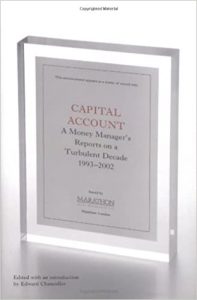
  • Capital Account: A Money Manager’s Reports on a Turbulent Decade 1993-2002 by Marathon

    February 17, 2021

    ·

    Capital Account book coverBuy the Book: Print

    Capital Account is a selection of reports by Marathon Asset Management. The reports introduce their capital cycle approach to investing and explain the impact the cycle had on businesses, markets, and investors during the late 1990s bubble.

    The Notes

    Continue Reading…


Previous Page
1 … 73 74 75 76 77 … 233
Next Page

Join the library.

Access over 1,100 research papers, writings, transcripts, and more from the brightest minds in finance.

Learn More

Learning

  • Investor Library
  • Book Notes
  • Investor Quotes

Return Quilts

  • Asset Class Returns
  • S&P Sector Returns
  • International Stock Market Returns
  • Emerging Markets Returns
  • Historical Returns Data

Connect

  • Bluesky
  • Twitter
  • Facebook
  • RSS Feed
  • Home
  • About
  • Contact

© Novel Investor · All Rights Reserved · Terms of Use · Privacy Policy · Disclaimer