
Novel Investor
  • Home
  • About
  • Invest with Me
  • Resources
  • When Investment is Most Businesslike

    April 29, 2026

    ·

    Jon

    Samual Curtis Johnson had an idea. This wasn’t new. He had many ideas throughout life. But at age 53, he gave his idea a try. He started a parquet floor business in 1886.

    Within two years, he had a small but thriving flooring business. He also had a customer base that wanted a better way to take care of their new floors. Soap and water ruined the floor finish and shellacs chipped and were a pain to deal with. His customers wanted something better.

    With a little experimentation and a bathtub, Johnson created a floor wax. He gave it away, as an added service, with every new floor sold. What Johnson had done, though he didn’t know it yet, was diversify his business.

    Soon, people he never sold new floors to, wanted to buy his floor wax. A happy accident turned a parquet floor company into a wax company that sold parquet floors. And another idea sprung from that. What if the wax could be used for things other than floors?

    Continue Reading…
  • Weekend Reads – 4/24/26

    April 24, 2026

    ·

    Jon

    Quote for the Week

    Volatility matters on only two levels. First, if two portfolios have equal average returns, the portfolio with the lower volatility will earn the higher compound return. On the other hand, investors understand this phenomenon – either intellectually or intuitively – and tend to price volatile securities accordingly. The second consideration in volatility is much more important: when is the owner of the principal of the fund going to disburse that principal? A fund that is tied up in perpetuity could fluctuate all over the place without any consequences whatsoever. It is my impression that too many funds with long horizons are managed as though they were going to be disbursed in the next couple of years, largely because volatility makes people uncomfortable – which is irrelevant to the conditions on which a rational decision should rest. Fear of volatility can be costly to long-run returns and can unnecessarily constrain the freedom of managers to do their best. — Peter Bernstein (source)

    Continue Reading…

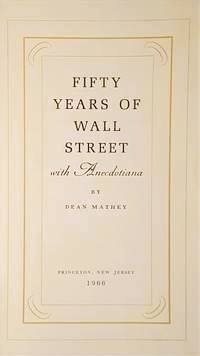
  • Fifty Years of Wall Street with Anecdotiana by Dean Mathey

    April 22, 2026

    ·

    Buy the Book: Print

    Dean Mathey was an investment banker on Wall Street. His autobiography primarily relays his experience and lessons from his start selling bonds in 1912 through the Great Depression.

    Book cover for Fifty Years of Wall Street

    The Notes

    Continue Reading…

  • Weekend Reads – 4/17/26

    April 17, 2026

    ·

    Jon

    Quote for the Week

    The only thing certain on the fortieth anniversary of the 1929 debacle is that some day, without fail, there will be another such disaster.

    The reason is that the stock market is inherently unstable, the instability being related to its superbly orchestrated ability to attract people with a promise of effortless riches, give them a taste of such gains, give them the promise of a great deal more gain, persuade them that it is rewarding their financial acuity or that of the people who are managing their money, and then, usually, after overcoming some preliminary setbacks, which greatly adds to the general state of confidence, destroy these illusions in one mortal thud. What is necessary for a new disaster is only for the memories of the last one to fade and no one knows how long that takes. — John Kenneth Galbraith (source)

    Continue Reading…

  • Quarterly Reading – Spring 2026

    April 15, 2026

    ·

    Jon

    Here’s what I’ve been reading for the past three months:

    • Hedgemanship – The early success of hedge funds run by Alfred Winslow Jones and others, brought about copycats and increased interest. This book covers that early success and presents under the guise that you too can invest like a hedge fund without hiring a hedge fund manager. However, the author points out that even some hedge fund managers are not great at being hedge fund managers, so it’s not quite as easy he makes it sound.
    • Stocks and Stock-Jobbing in Wall Street – This brief pamphlet sits as guide to the market back in 1848. The author, “a reformed stock gambler,” offers the ins and outs of Wall Street including a warning about “fancy stocks” — the hot stocks of the day — that traded at ridiculous multiples but had little to no value.
    • The Essence of a Family Enterprise – This book is a collection of essays reflecting on the S.C. Johnson & Son’s 100th anniversary in 1986. It outlines the principles and philosophies that made this family-owned business such a success.
    • Fifty Years of Wall Street with Anecdotiana – Dean Mathey worked in Wall Street following a brief tennis career and chaired Princeton’s investment committee starting in the late 1920s for 34 years. I was lucky enough to find a rare copy of this, his autobiography. He covers the period from 1912 to the early 1960s. Though, notably, his focus is the first half of the 50-year period.
    • New Levels in the Stock Market – Among those who believed the market cycle was obsolete in the late 1920s was Charles Amos Dice. He was a professor at Ohio State University and published this book in 1929. The NY Times even gave it a nice writeup two weeks before the crash. According to J.K. Galbraith, Dice had complete faith in the “new era” economy. Galbraith’s mention drove me to dig it up and I’ll have more once I finish reading.
    Continue Reading…

  • Weekend Reads – 4/10/26

    April 10, 2026

    ·

    Jon

    Quote for the Week

    This investment management business, when stripped down to its bare essentials, is really quite simple. Now, why do I say that? Well, I think if we took the group here today and divided you up into smaller groups of four, or five, or six and asked you to talk about what’s really important in managing a portfolio that has a very long time horizon, I think that almost all the groups would come to very similar conclusions. If you’re investing with a long time horizon, having an equity bias makes sense; stocks go up in the long run…

    The other thing that I think would come out of the discussions is that diversification is important. Anybody whose read a basic finance text, as a matter of fact, I think anybody who thinks about investments in a common sense fashion knows that diversification is an important fundamental tenet of portfolio management. As a matter of fact, Harry Markowitz called diversification a “free lunch.” We spend all our time in Intro. Econ. figuring out there is no such thing as a free lunch but Markowitz tells us that diversification is a free lunch… For any given level of risk, you can increase the return; sounds pretty good. That’s pretty simple, right? Two tenets, an equity bias for portfolios with a long time horizon and diversification. — David Swensen (source)

    Continue Reading…

1 2 3 … 234
Next Page

Join the library.

Access over 1,100 research papers, writings, transcripts, and more from the brightest minds in finance.

Learn More

Learning

  • Investor Library
  • Book Notes
  • Investor Quotes

Return Quilts

  • Asset Class Returns
  • S&P Sector Returns
  • International Stock Market Returns
  • Emerging Markets Returns
  • Historical Returns Data

Connect

  • Bluesky
  • Twitter
  • Facebook
  • RSS Feed
  • Home
  • About
  • Contact

© Novel Investor · All Rights Reserved · Terms of Use · Privacy Policy · Disclaimer