
Novel Investor
  • Home
  • About
  • Invest with Me
  • Resources
  • 2011 Summer Tax Tips

    August 24, 2011

    ·

    Jon

    Back to School Tax TipsI’m a big believer in the idea that as tax payers, it is our civic duty to pay the lowest taxes possible.  I’m not suggesting tax evasion, jail time shouldn’t be a possible side effect here.  But if the tax system offers a possibility to lower your taxes, take advantage of it.

    If you disagree, you’re more than welcome to donate as much as you like.  I use Turbotax to keep mine as low as possible.  That’s because the over complexity of the current tax system it’s nearly impossible to keep up with all the yearly changes.

    So with that in mind, here are two potential tax savings opportunities to keep in mind come tax time.  The first, if you’ve had to move due to work, you may be able to deduct some of those moving expenses.  The second, with the annual back-to-school exodus, there are several credits and deductions available that may help offset those yearly costs. Continue Reading…

  • Mutual Funds: Another Resource For Finding Great Stocks

    August 18, 2011

    ·

    Jon

    There are many ways you can go about finding great quality stocks.  You could use newsletters, newspapers, business channels, or screen for stocks.  Some of those can become a bit overwhelming, which is why research sites come in handy so often.  You go through their recommendations, read the how’s and why’s, and decide if you want to invest or not.

    The goal, here, is to find unconventional sources that offer a glimpse of stocks that could make you money.  One of those options is to use mutual funds to find great stock recommendations.

    Most mutual funds are actively managed.  Each is set up to specifically fit into a unique category (i.e. Dividend Income, Small-Cap Equity, Equity Income) or sector (i.e. Energy, Health Care, REIT).  The fund managers and staff behind them are paid to research and invest in the best stocks that fit those categories.  Finally, a mutual fund is required to report it’s holdings and finding that information is as easy as heading to the fund company website.

    The “Top 10 Holdings”

    A good place to start is at a mutual fund company’s website, which should contain all the information you need and more.  You can go through each mutual fund individually to find stock ideas or head directly to a specific fund if you already know the type of stock you’d like.

    Read through the description of the fund, to make sure it fits your investment strategy and then head to the “Top Ten Holdings” section which can be found in the summary.  This is exactly what it sounds like, the ten largest holdings in that fund.  But it should also have a “% of total assets” and “as of date” listed as well.  Both are very important. Continue Reading…


  • Breaking News! Market Trends Higher Long Term

    August 9, 2011

    ·

    Jon

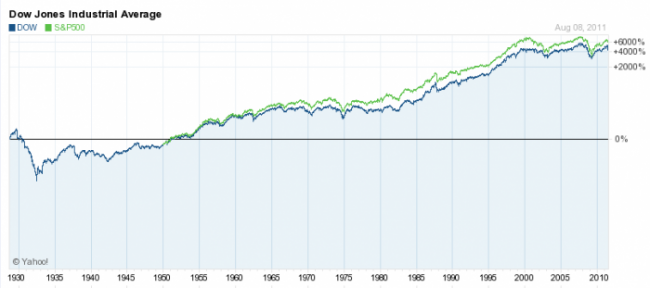
    After decades of study, our research shows that the stock market actually does go up from time to time.  In fact it has been happening since at least the 1930s, possibly earlier.  We have yet to find an infinitely downward moving market, but we’re still looking.


    Don’t Minimize The Long Term

    Watching the news, there’s a tendency to lose sight of the big picture on your investments.  For most of us, our investing strategy doesn’t have a time span of minutes, hours, days, or even weeks.  It’s usually a much longer time horizon of years or decades for some.  Which is easily overlooked when the market drops 500 or 1000 points in a day or two. Continue Reading…


  • Investing After The Debt Debacle

    August 1, 2011

    ·

    Jon

    Anytime government issues overwhelm business news for as long as the debt ceiling crisis has, protecting your money should be a concern.  Washington says that they have the votes to push the debt deal through.  The deal would take the worst case scenario, debt default off the table.  But until it happens everything is in limbo (at the time of this writing the debt ceiling vote hadn’t happened).

    Throughout this debt debacle, several economic indicators have been released showing signs of a slowing economy.  The current debt deal will only limit the governments ability to further additional economic growth.  Which leaves the economy’s savior to jobs.  If only the powers that be in Washington can find a way to agree on spurring job growth.  Which is highly doubtful after watching their total lack of cooperation with the debt deal.

    Until job hiring improves, and we shouldn’t expect significant changes for at least a year or more, we can expect slow economic growth through the November 2012 elections.  So the big question is where should you be investing your money?  With a timeline of 12-18 months,  safety is the quick answer.

    The 3% Plus Dividend Yield

    The goal here is getting a better return on your money than you would in treasury bonds.  The 10-year treasury bond is sitting at less than a 3% yield.  You’re not risking much by investing in a stock, mutual fund, or ETF that has a dividend yield of 3% or more.  Reinvest those dividends and compounding returns will only help the cause. Continue Reading…


  • The Debt Ceiling Raise And Your Money

    July 22, 2011

    ·

    Jon

    If your paying attention to political and business news, it appears that almost everyone thinks that a debt ceiling raise must happen.  Including many elected officials in Washington.  Which is a rarity that both parties actually agree on something these days.  So why hasn’t the debt ceiling raise been put to a vote already?  Because, unfortunately, both parties feel it’s absolutely necessary to tie the debt ceiling raise to a new budget cuts proposal.  Which has done nothing to move the budget proposal along.  Instead, it has held the markets and your investments hostage, putting them at risk if the government can’t issue new debt to pay it’s bills. Continue Reading…


  • Investing In Index Funds

    July 14, 2011

    ·

    Jon

    Index FundIndex funds have, arguably, been touted as the best investment for the average investor.  They have consistently outperformed the majority of the actively managed mutual funds.  Over the long term broad stock market index funds have averaged an annual return of about 8%.  Unfortunately many investors have taken these points to assume an index fund is a safer investment.  Which is far from the truth.

    You’ve most likely come across index funds as an option in a retirement plan, at a fund company’s website or seen them offered through your online broker.  Almost every fund family offers several different index funds.  But not all index funds are equal.

    What Is An Index?

    An index is a group of stocks used to represent a portion of the stock market.  If you’ve heard of the Dow, Nasdaq, S&P 500, Russel 2000, or Wilshire 5000 you’ve heard of an index.  Which are all used to measure a portion of the markets performance.

    The most well known index, the Dow is an index of 30 large companies that are believed to mimic the overall market.  The S&P 500, however, is an index of 500 companies that offers a representation of the overall markets performance. Continue Reading…


Previous Page
1 … 224 225 226 227 228 … 232
Next Page

Join the library.

Access over 1,100 research papers, writings, transcripts, and more from the brightest minds in finance.

Learn More

Learning

  • Investor Library
  • Book Notes
  • Investor Quotes

Return Quilts

  • Asset Class Returns
  • S&P Sector Returns
  • International Stock Market Returns
  • Emerging Markets Returns
  • Historical Returns Data

Connect

  • Bluesky
  • Twitter
  • Facebook
  • RSS Feed
  • Home
  • About
  • Contact

© Novel Investor · All Rights Reserved · Terms of Use · Privacy Policy · Disclaimer