
Novel Investor
  • Home
  • About
  • Invest with Me
  • Resources
  • Lessons from Keynes the Investor

    March 27, 2019

    ·

    Jon

    In one volume in the 30 volume set that makes up The Collected Writings of John Maynard Keynes lies practically everything you need to know about Keynes the investor. The entire volume is a collection of economic articles and correspondence, but it’s the first chapter that is the most informative.

    That’s where you learn about his performance history both personal and professional, his economic views around some major historical events, and how he thought about investments and markets at the time.

    The history alone makes it interesting. But because it’s Keynes, that chance to critique an economist’s investment performance makes it appealing on another level.

    Arguably he makes it difficult to do. He didn’t have a great start but he learned quickly and finished strong…for the most part. His professional track record was great, running the Chest Fund and advising for two insurance companies and several investment trusts.

    His personal account was easier to criticize, as the first lesson shows. Continue Reading…

  • John Maynard Keynes on Concentration

    March 22, 2019

    ·

    Jon

    I shared Charlie Munger’s take on concentrated portfolios a few weeks ago. For similar reasons, I thought I’d share John Maynard Keynes’s view on it as well.

    Keynes’s reasoning comes as a response to criticism from Francis Scott for taking a too large position in Elder Dempster stock. He initially explained his reason for buying like so:

    …finding a security which was good, which we had not got and of which a large block could actually be purchased — an accumulation of circumstances I had not come across for months — I lost my head. I was also suffering from my chronic delusion that one good share is safer than ten bad ones, and I am always forgetting that hardly anyone else shares this particular delusion.

    Pointed as that last sentence is, it shows that the unpopularity of concentrated portfolios is nothing new.

    Even more, it shows how a majority of people can see one thing as risky while others don’t and both can make a sensible argument to their correctness. Scott replied with his opposing view, which fits the argument against concentration still used today. Continue Reading…


  • John Maynard Keynes’s Investment Policy

    March 20, 2019

    ·

    Jon

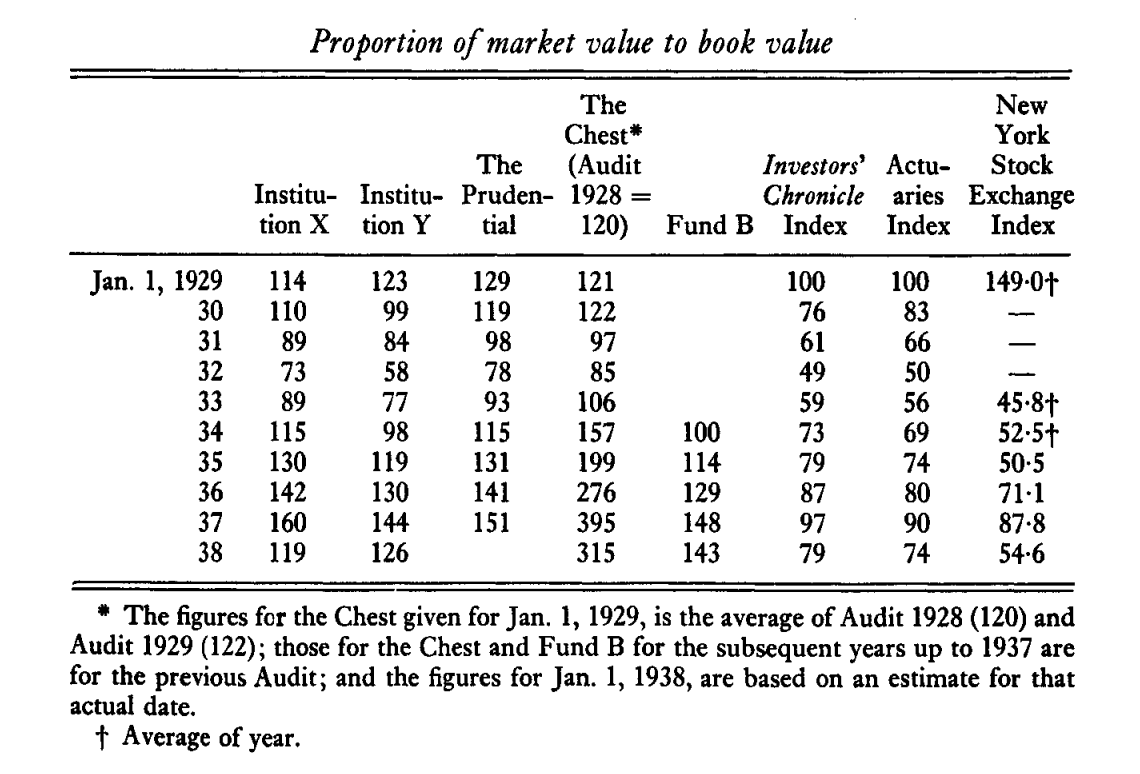
    After managing King’s College investment funds for almost 14 years, John Maynard Keynes decided to run a post-mortem on his investment results.

    He had stats for three indexes and three other institutions to compare to his results. And he had a unique set of experiences to draw from thanks to shifting ideas on what a best investment policy should be.

    The period he analyzed ran from January 1929 to December 1938. Despite the terrible starting point, the results were clear. Whatever he was doing, was working.

    Keynes Kings College Fund Results for 1929 to 1938

    (Keynes managed The Chest and Fund B for the College shown in the image above.)

    He relayed the lessons from his experiences and the post-mortem in a memo to the Estates Committee in May 1938. Continue Reading…


  • Seth Klarman: What If Everyone was a Securities Analyst?

    March 15, 2019

    ·

    Jon

    Seth Klarman offered up a simple thought experiment. What if everyone was a securities analyst, would the market finally be efficient?

    Klarman’s thought experiment came in a response to Louis Lowenstein’s Searching for Rational Investors in a Perfect Storm. Lowenstein was questioning the existence of rational actors, purported by EMT, amid the Dotcom rubble. It’s reminiscent of Buffett’s The Superinvestors of Graham and Doddsville.

    Klarman’s criticism of efficient markets is no surprise. He and his clients have thrived off of the inefficiencies for several decades.

    His criticism gets to the root cause of why. Emotions. He tacks on an additional important point that probably gets overlooked by many. Brainpower has limits when you mix money with emotions. Continue Reading…


  • Lessons from The Zurich Axioms

    March 13, 2019

    ·

    Jon

    Few people understand risk in a way that makes it actually rewarding. That’s the message offered in The Zurich Axioms. The book lays out 12 Axioms that play off this idea.

    In some cases, the Axiom runs counter to typical investor behavior. In others, it runs counter to popular thinking. And some are obvious. I guarantee you won’t agree with all of them, but it should, at least, give you something to think about.

    These are the lessons from a few Axioms that stood out (check out the notes linked below or read the book for the full list).

    Axiom #1: Worry is not a sickness but a sign of health. If you’re not worried, you are not risking enough.

    In investing, most people want a risk-free reward. Yet, risk and reward are intertwined. No matter how hard you try to remove one, it affects the other. Not many get that. Continue Reading…


  • The Zurich Axioms by Max Gunther

    March 13, 2019

    ·

    The Zurich AxiomsBuy the Book: Print | eBook

    The Zurich Axioms is a book about managing risk and reward. Twelve Axioms define how to think about risk and uncertainty in such a way that you’re more likely to be rewarded than not.

    The Notes

    Continue Reading…


Previous Page
1 … 100 101 102 103 104 … 233
Next Page

Join the library.

Access over 1,100 research papers, writings, transcripts, and more from the brightest minds in finance.

Learn More

Learning

  • Investor Library
  • Book Notes
  • Investor Quotes

Return Quilts

  • Asset Class Returns
  • S&P Sector Returns
  • International Stock Market Returns
  • Emerging Markets Returns
  • Historical Returns Data

Connect

  • Bluesky
  • Twitter
  • Facebook
  • RSS Feed
  • Home
  • About
  • Contact

© Novel Investor · All Rights Reserved · Terms of Use · Privacy Policy · Disclaimer