
 The best advice I’ve ever heard regarding investing is if you don’t understand the investment don’t put your money into it. Similar advice can be said about stocks and is the philosophy of some of the greatest money managers. If you don’t understand how the company makes money, don’t buy the stock. It’s a pretty simple idea, but often overlooked.
By knowing how a company makes money, it becomes much easier to understand what will help and hurt a company when the facts change. Higher oil prices, for instance, may be good for an oil company, but bad for transportation companies.
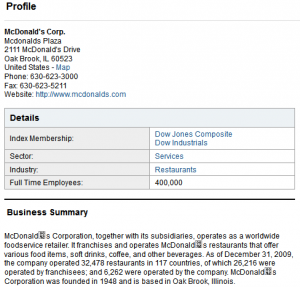
If we are researching McDonald’s Corp. (NYSE: MCD), the next step is to find out how the company makes money. Head on over to your favorite research site and look for the company profile section. Digging through this information is the best place to start your research. Continue Reading…
 You see the terms large cap, mid cap, and small cap when describing a company, mutual fund, or ETF. What do they actually mean? How do they impact an investment strategy?
 Have you ever had the small misfortune to wake up, take a shower, but have no hot water, or where you’re driving to work, only to get a flat. You hope these problems are just a quick fix. But when they’re not, you know it’s going to cost more than you want to spend. The good news is you have an emergency fund set aside just for these situations, right.
 The tax filing deadline is fast approaching. If you haven’t filed your taxes yet, you’re not alone. According to the IRS, about 25% of all taxpayers wait till the last two weeks to file their taxes. For those sitting in that 25%, you have until the deadline of Monday, April 18 to file your taxes this year.
 The 2010 IRA contribution deadline is fast approaching. With only a few weeks left, you still have time to make your 2010 contributions. If you have done any retirement planning in the past, a traditional or Roth IRA plays a role in achieving your retirement goals.