 Get the Letters:
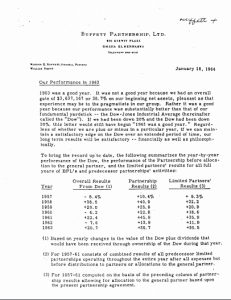
 The Buffett Partnership Letters are classic reading for any value investor. Readers get an inside view of Warren Buffett’s investment philosophy — seeing where it did and did not evolve — early in his career.

-
Buying the Bottom?
·
Howard Marks has been on a tear with his memos lately. In the latest, out this week, he answers the important question, “Should I wait for the bottom?”
In short, the answer is no. Since bottoms are only found out after the fact, buying on the downswing offers more opportunities than the alternative — waiting for some “all clear” signal.
The old saying goes, “The perfect is the enemy of the good.” Likewise, waiting for the bottom can keep investors from making good purchases. The investor’s goal should be to make a large number of good buys, not just a few perfect ones. Think about your normal behavior. Before every purchase, do you insist on being sure the thing in question will never be available lower? That is, that you’re buying at the bottom? I doubt it. You probably buy because you think you’re getting a good asset at an attractive price. Isn’t that enough? And I trust you sell because you think the selling price is adequate or more, not becaue you’re convinced the price can never go higher. To insist on buying only at bottoms and selling only at tops would be paralyzing…
The bottom line for me is that I’m not at all troubled saying (a) markets may be considerably lower sometime in the coming months and (b) we’re buying today when we find good value. I don’t find these statements inconsistent.
With as fast as the market’ moved in the past two weeks, the question might be updated to: “Did I miss the bottom?” Continue Reading…
-
Warren Buffett on Portfolio Construction
·
Warren Buffett used a three-bucket approach in his portfolio during his partnership days. It’s a nice example of how to think about portfolio construction.
Each of Buffett’s buckets filled a role in meeting his long term objective. That objective can be broken down into two parts:
- Beat the Dow by 10% over the long term.
- Outperform in bear markets while matching performance during bull markets.
The only way he achieves either objective is by building a portfolio that looks nothing like the Dow. How did he do it?
First, he used a conservative deep value strategy. Stocks selling at a deep discount, with a wide margin of safety, offered a lot of room to be wrong on valuation but still make money.
With that strategy as a base, the three buckets did the rest — what he called Generals, Workouts, and Controls: Continue Reading…
-
Quarterly Reading – Spring ’20
·
My first quarter reading began with my head in a textbook until a vacation and this lockdown freed up time for more interesting books. Thankfully, I finished the textbook, along with the course, before the lockdown kicked in.
Here’s what I’ve been reading the past three months: Continue Reading…
-
Lombard Street: A Description of the Money Market by Walter Bagehot
·
First published in 1873, Walter Bagehot describes the intricacies of the money market and, more importantly, the necessary response when managing a financial crisis.
The Notes
-
Warren Buffett: Market Pricing, Not Timing
·
Everyone wants to know what happens next. That’s the nature of market crashes. When will it end? Was that the bottom? What if it falls further?
The questions are asked a hundred different ways and the only good answer is: “I don’t know.” But that’s not what you’ll hear.
Instead, everyone also has an opinion. Many will go out of their way to express it. The trouble starts when people listen and act on it.
Warren Buffett dealt with this situation in 1966. The Dow had a rough six months to start the year. It declined from 969.26 to 870.10. That’s a loss of 8.7% after dividends, a tame decline compared to 2020. A few of his partners felt obligated to tell him what would happen next. This was his response: Continue Reading…
 Buy the Book: