
Novel Investor
  • Home
  • About
  • Invest with Me
  • Resources
  • Philip Carret on Forecasting Market Swings

    September 11, 2019

    ·

    Jon

    There’s a long history of market timing methods that work some of the time. Yet, the search for the holy grail strategy to get in and out of the market before every turn has been a failed endeavor. That hasn’t stopped people from searching or trying the latest and greatest method that worked twice in a row.

    I’ve been reading a series of articles written by Philip Carret in 1926-27. Buffett was a big fan of his (so I did some digging). Carret would base a book on the series — The Art of Speculation — titled with the same name.

    Despite the title, Carret was a value investor. He would go on to found one of the first mutual funds in 1928, ran it for the next 55 years while beating the market in the process. He also had a solid understanding of market history, market cycles, and the tendencies of its participants.

    In one article, he points out why market timing methods fail eventually and how difficult forecasting can be. Continue Reading…
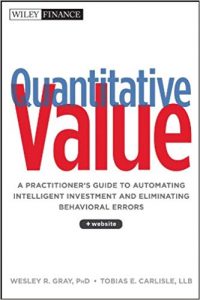

  • Quantitative Value by Wesley Gray & Tobias Carlisle

    September 9, 2019

    ·

    Quantitative ValueBuy the Book: Print | eBook

    All investors are susceptible to behavioral mistakes that then leads to poor returns. Gray and Carlisle create a quantitative value strategy that exploits the typical investors’ flaws while building temperament into their model.

    The Notes

    Continue Reading…


  • Galbraith: ’29 Financial Innovation Run Amok

    September 6, 2019

    ·

    Jon

    John Kenneth Galbraith kicked off 1987 with a warning of excessive speculation in the stock market. Black Monday came nine months later. A 22% loss for the Dow. The worst single-day drop in market history.

    Was it prescience or luck? Who cares. Galbraith, as usual, offered a history lesson worth learning.

    He specifically covers four parallels between 1929 and 1987.

    1. Speculation, euphoria, and greed take hold
    2. Financial innovation run amok, fueled by debt
    3. Inevitable punishment of those previously viewed as financial “geniuses”
    4. Policy changes meant to “stimulate the economy” just flowed into the market

    The second is worth highlighting because of the long history of financial innovation run amok.

    By the late ’20s, companies were creating companies out of thin air, issuing bonds and a minority of the stock to the public. The newly created companies had no other purpose but to own stock.

    But it didn’t end there. The new company would create a company, issue a minority of stock to the public, and the process would repeat all the way down. Investment trusts would do the same. The entire process drove the market. And easy access to leverage magnified it.

    The “innovation” was seen as ingenious at the time, yet looking back it all seems ridiculous. As Galbraith concludes — we prematurely ascribe genius to anyone associated with large amounts of money. It’s a repeated trend that gets investors into trouble. Continue Reading…


  • Chuck Akre’s Three-Legged Stool

    August 30, 2019

    ·

    Jon

    What would you rather have: $1 million in a month (31 days) or a penny that doubles every day for 31 days?

    What about $2 million in a month versus the doubling penny? $5 million?

    It’s a fun math puzzle that explains compounding. If you do the math, the penny takes a while to get rolling.

    Ten days in, the doubling penny only sits at about $5. At 18 days, it finally passes $1,000. It clears $100,000 on day 25. Then the real impact kicks in. Over the last six days, it eclipses $1 million by a factor of 10. As investment analogies go, it’s a good one. Time is a fundamental ingredient for investing success.

    I was reminded of the puzzle because Chuck Akre used it to kick off a presentation on his investment process. Compounding plays an important part of his process, just as it does in everyone’s.

    Only Akre looks for companies that compound at a high rate of return over a long period of time. He uses the concept of a three-legged stool to explain how he does it: Continue Reading…


  • Keynes Reviews “Common Stocks as Long Term Investments”

    August 28, 2019

    ·

    Jon

    Once upon a time, bonds were considered the best investments in all the land. Stocks were speculative and risky. Bonds were “safe.”

    As luck would have it, Edgar Lawrence set out to test a theory and happened upon an interesting result. Lawrence originally thought that stocks did better during periods of inflation, bonds during periods of deflation.

    It turned out stocks did better under both periods because retained earnings, reinvested back into a business, would grow more earnings and the business would appreciate in value. It naturally created a compounding effect that showed up in the stock price over time.

    Of course, this is common knowledge today but it was a new idea at the time. Lawrence published his results in a book titled Common Stocks as Long Term Investments, with little fanfare, at first.

    But John Maynard Keynes helped popularize it with a review written in May of 1925. The book would go on to be, at least partially, blamed for the stock bubble and burst of 1929 (what started as a sound premise devolved to chasing price action). Here are the highlights of Keynes’s review: Continue Reading…


  • Bogle’s Biggest Mistake

    August 23, 2019

    ·

    Jon

    John Bogle talked about his biggest mistake during a 2006 interview.

    A unique set of circumstances — starting with the “Go-Go” Sixties and ending with the brutal 1973 – 1974 bear market — led him to put his cost matters hypothesis to the test and change the investing landscape forever.

    It’s an interesting story with a happy ending and a few lessons strung throughout.

    Here’s Bogle: Continue Reading…


Previous Page
1 … 93 94 95 96 97 … 233
Next Page

Join the library.

Access over 1,100 research papers, writings, transcripts, and more from the brightest minds in finance.

Learn More

Learning

  • Investor Library
  • Book Notes
  • Investor Quotes

Return Quilts

  • Asset Class Returns
  • S&P Sector Returns
  • International Stock Market Returns
  • Emerging Markets Returns
  • Historical Returns Data

Connect

  • Bluesky
  • Twitter
  • Facebook
  • RSS Feed
  • Home
  • About
  • Contact

© Novel Investor · All Rights Reserved · Terms of Use · Privacy Policy · Disclaimer