Novel Investor
  • Home
  • About
  • Invest with Me
  • Resources
  • How to Avoid Losses in Your Investing by FPS

    April 10, 2024

    ·

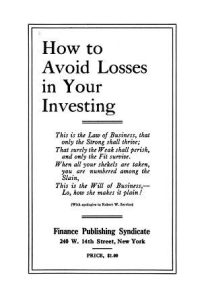
    Book cover for How to Avoid Losses in Your InvestingBuy the Book: eBook

    The book, published in 1920, shows how little human nature changes in markets, especially around speculation, gambling, and greed. It also offers historical context on how markets operated pre-SEC and warns about the dangers of widespread leverage that led to the 1919 to 1921 crash and the 1929 bubble and bust a decade later.

    The Notes

    Continue Reading…


  • Weekend Reads – 4/5/24

    April 5, 2024

    ·

    Jon

    Quote for the Week

    There certainly are good reasons for selling, but they have nothing to do with the fear of making mistakes, experiencing regret and looking bad. Rather, opportunities for intelligent selling should be based on the outlook for the investment and they have to be identified through hardheaded financial analysis, rigour and discipline.

    Most economies, companies and markets benefit from positive underlying trends. If investors use poor judgment and reduce market exposure through ill-conceived selling, they will fail to participate fully in those trends. That’s a cardinal sin in investing. It’s even more true of selling things in desperation after their prices have fallen, turning negative fluctuations into permanent losses and dismounting from the miracle of the long-term compounding of returns. What’s clear to me is that as opposed to selling for reasons of psyche, simply being invested is by far “the most important thing.” — Howard Marks (source)

    Continue Reading…


  • 2024: Q1 Returns

    April 3, 2024

    ·

    Jon

    Global markets kicked off 2024 right where they left off last year…for the most part. 34 of the 47 developed and emerging markets continued their streak from last year.

    That’s not to say the returns were all positive. 30 of the 34 markets added to their 2023 gains, with further gains over the last three months. 4 markets added to last year’s losses. The 13 remaining markets changed course, turning gains into losses or vice versa.

    That said, three months tell us very little about how the rest of the year plays out. It tells us even less about how markets will perform in the long run. Three months are a blip on the time horizon for any long-term investor. So don’t put too much weight on returns year to date.

    As noted in prior quarterly market updates, month-to-month market swings, if anything, show that returns don’t always come easy to investors. While markets have generally been uneventful this year, building on last year’s momentum, they rarely stay quiet for long. Surprises do pop up that offer investors a chance to earn those long-run returns. Continue Reading…

  • Weekend Reads – 3/29/24

    March 29, 2024

    ·

    Jon

    Quote for the Week

    Hindsight occurs when a surprising event takes place and the surprise is very brief, replaced almost immediately by a need to make sense of it. The individual has learned something from the event. For example, if there were two football teams that you considered equally-matched, and one of them trumps the other 5-0, they are no longer equally strong in your mind. One of them is clearly better than the other. This makes sense of their victory. It also makes it virtually impossible for you to re-construct that, earlier, you thought they were equal.

    Now, we think that the team that actually won “had to win.” Why did it have to win? Because it won. It won because it was stronger. How do we know it is stronger? Because it won. This is hindsight. It has a huge effect on our thinking, it has a huge effect on investing behaviour, and it has a very pernicious effect, in that it teaches us something quite wrong about the nature of reality…

    Now, an example of that, of course, is the Great Recession. There are many people who predicted the Great Recession – there are many more now than there were then. The film The Big Short was based on a book, written by Michael Lewis. The book really invites you to hindsight. There are a few people – they are obviously very clever people, and they knew that the market was going to crash. And you can’t help but get the feeling that the people who didn’t know the market was going to crash were either fools or knaves. Intelligent people saw the recession coming. But in fact, and that is a well-known fact, many highly intelligent and well-informed people did not anticipate the crash. The conclusion is that the crash was not quite as predictable as it now appears. It now appears highly predictable, in hindsight.

    So, the pernicious effect of hindsight is that we get the sense, after the fact, that an event was predictable, so we get the sense that the world is predictable. We think the world makes sense, and that exaggeration of the coherence, consistency and predictability of the world means that we deny the real uncertainty with which we are faced in existence. And this denial of uncertainty in turn produces irrational action. — Daniel Kahneman (source)

    Continue Reading…


  • Quarterly Reading – Spring 2024

    March 27, 2024

    ·

    Jon

    Here’s what I’ve been reading for the past three months:

    • Invention and Innovation: A Brief History of Hype and Failure — Vaclav Smil digs through the history of invention to focus on the failures — the innovations that started out promising but ended disastrously, that were the next big thing but fell far short of the hype, or have been overhyped for decades but are still more science fiction than reality — and the lessons that can be learned from it. (notes)
    • To Engineer is Human: The Role of Failure in Successful Design — Engineering design, going back to building the pyramids, has been a process of learning from repeated failed designs that lead to improvement and success. The similarities between engineering and investing come through in the reading. Notes to come.
    • How to Avoid Losses in Your Investing — Written in 1920, this short book covers all the ways you can lose money — speculating, gambling, margin, the wrong broker, and more. You can lose money the same way today. It’s a reminder of how little has changed with investing in over a century.
    • Poor Charlie’s Almanack — I read a prior edition of Poor Charlie’s Almanack years ago. The new edition is an excuse to slow read the book again again. A free version can be found here.

    Continue Reading…


  • Weekend Reads – 3/22/24

    March 22, 2024

    ·

    Jon

    Quote for the Week

    One of the major differences between behavioural economics and standard economics, is that, in standard economics, the individual agent is supposed to be driven or motivated by the utility of future wealth and discounted future wealth and present wealth. In behavioural economics, agents are supposed to be motivated by something else: gains and losses.

    This juxtaposition of gains and losses on the one side and wealth on the other is interesting. Gains and losses are temporary — they are events. Wealth, on the other hand, is a state. It is a broader way of looking at things. In fact, what dominates our behaviour is much more immediate than considerations of wealth. It is consideration of gains and losses. That is the essential idea of both behavioural economics and behavioural finance. A fully rational agent has a broad view – it has a long horizon. But a basic finding, well replicated in psychology and decision theory, is that people are myopic and that they weigh immediate consequences much more than delayed. There is in fact brain research that indicates that there are special brain circuits that respond to relatively immediate consequences, and other brain circuits that react to more delayed consequences, and we tend to be more rationale about the more delayed consequences than about the immediate consequences. — Daniel Kahneman (Source)

    Continue Reading…


Previous Page
1 … 29 30 31 32 33 … 232
Next Page

Join the library.

Access over 1,100 research papers, writings, transcripts, and more from the brightest minds in finance.

Learn More

Learning

  • Investor Library
  • Book Notes
  • Investor Quotes

Return Quilts

  • Asset Class Returns
  • S&P Sector Returns
  • International Stock Market Returns
  • Emerging Markets Returns
  • Historical Returns Data

Connect

  • Bluesky
  • Twitter
  • Facebook
  • RSS Feed
  • Home
  • About
  • Contact

© Novel Investor · All Rights Reserved · Terms of Use · Privacy Policy · Disclaimer