
Part of investing is discerning between what will change and what will stay the same when digging for opportunities. History hints at the answers.
Study a little history and you’ll recognize obvious changes over the past century due to innovation, new business creation, and more that created massive opportunities for investors that recognized it and held on.
However, one thing stands out that has changed the least — human nature. The behavior of other investors creates massive opportunities, but it requires learning a different lesson then everyone else.
Because it never fails that investors learn the wrong lessons in bull markets. The reason behind it is simple.
A new batch of investors join the queue each year. Add to that the existing portion of investors yet to experience a full market cycle. Toss in a few more who have the experience of only mild market swings compared to history and you get some interesting lessons learned.
Our pattern seeking ability falls short of scientific when it comes to making money in markets. The downside is we see patterns in random or noisy data leading to faulty assumptions and ill-conceived decisions.
“Buy the dip,” for example, becomes a recurring mantra in bull markets once a market drop and quick rally happens twice in a row. A third time almost assures the belief in easy gains. A fourth seals it. Complacency and risk-taking follow.
The desire to get rich quick never goes away. Concentrated portfolios, borrowing to buy stocks, and betting on options may boost returns until the market dips to the point you can no longer stomach the losses.
An extreme example is the 1929 bull market. Three big corrections and swift recoveries in June and December 1928 and March 1929, confirmed investors’ beliefs that market prosperity was here to stay and Wall Street insiders would ensure it.
Then October 28th and 29th wiped out 21% of the Dow in two days. Investors were shaken but held onto the mantra. The market slid for two weeks, bottomed on November 13th, and another rally began.
The recovery was proof to many that the worst was over. President Hoover, Irving Fisher, John D. Rockefeller, Henry Ford, and others agreed. Prosperity was here to stay. The economy was safe. The market was back to its bullish ways. The rally extended to April 1930.
It was piously believed in those days that the American public had ‘learned a great lesson’ in the disaster of the preceding autumn, yet apparently to hundreds of thousands of people the lesson of the disaster was that the bright thing to do was to buy early and sell at the top. — Frederick Lewis Allen
Bear market rallies feel like bull market rallies until they fall short. It teases hope of a recovery, fizzles out, and drops the market to a lower low.
The bear market rally that began on November 13, 1929, was the first of many that offered moments of false hope over the next three years. The market dipped again in mid-April 1930.
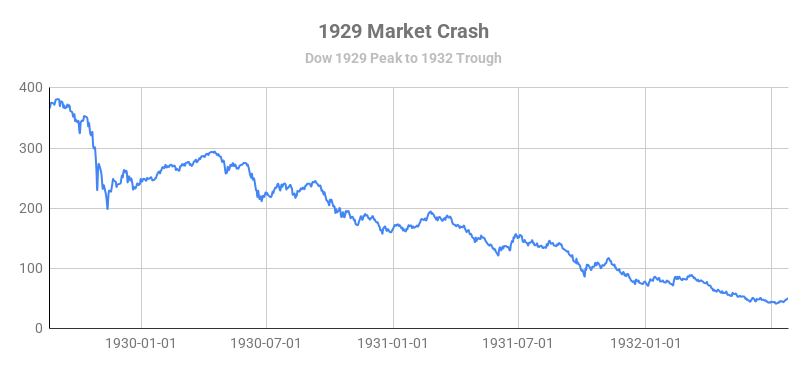
When the bottom finally struck on July 8, 1932, all hope was gone. Five rallies of 10% or more, including three in excess of 20%. Rallies big enough to keep hope alive but not big enough to overcome the growing pessimism and fear. It was the worst in market history, but other notable bear markets followed a similar pattern as the chart above.
The 1973 bear market was a two-year-long slide that tanked the market 51%. The 2000 market drop ended the Dotcom boom with a 54% fall that dragged into 2002. Lesser bear markets that turned the wrong lessons into painful lessons are strung out in between.
What doesn’t change is that we learn the wrong lessons in bull markets. Those incorrect lessons lead to complacency, illusion of easy gains, and excessive risk-taking when, in fact, caution is warranted. The best time to prepare your portfolio for losing money is when you’re making it.
Source: The Lords of Creation
Related Reading: