
2022 ended with fears of a recession, rising interest rates, and higher and rising inflation costs. It was the first year in a long time where both stocks and bonds were down. “Experts” predicted more of the same.
2023 proved them wrong. A diversified portfolio, made up of broader asset classes, returned 12.8% for the year. US, International, and Emerging Market indexes, broadly, were up double digits. In fact, the S&P 500 even set a new all-time high!
Bonds performed well. Even cash — via ultrashort-term treasuries — earned a respectable 5% on the year. In other words, 2023 was a great year overall — for those who stuck with it.
Years like 2023 are why investors should not put much weight into market or economic predictions. Markets are noisy in the short run. Pessimism is fleeting. Discipline is key to surviving it.
Markets have a knack for recovering after a loss. The US market, in particular, has a 100% recovery rate. It doesn’t always happen the next year, but it does happen.
Markets are resilient. Investors should take comfort in that. The discipline to hold tight is as big a contributor to long-run returns as your portfolio’s makeup, if not more so.
A note before getting to the 2023 numbers. The asset class, sector, international markets, and emerging market return quilts are up-to-date through for 2023. Hit the links for each one.
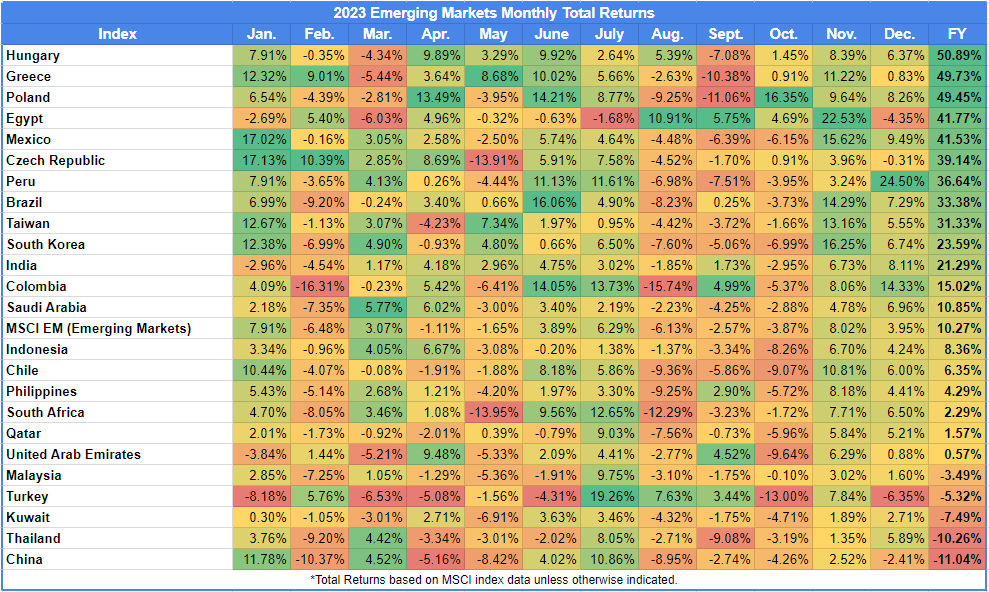
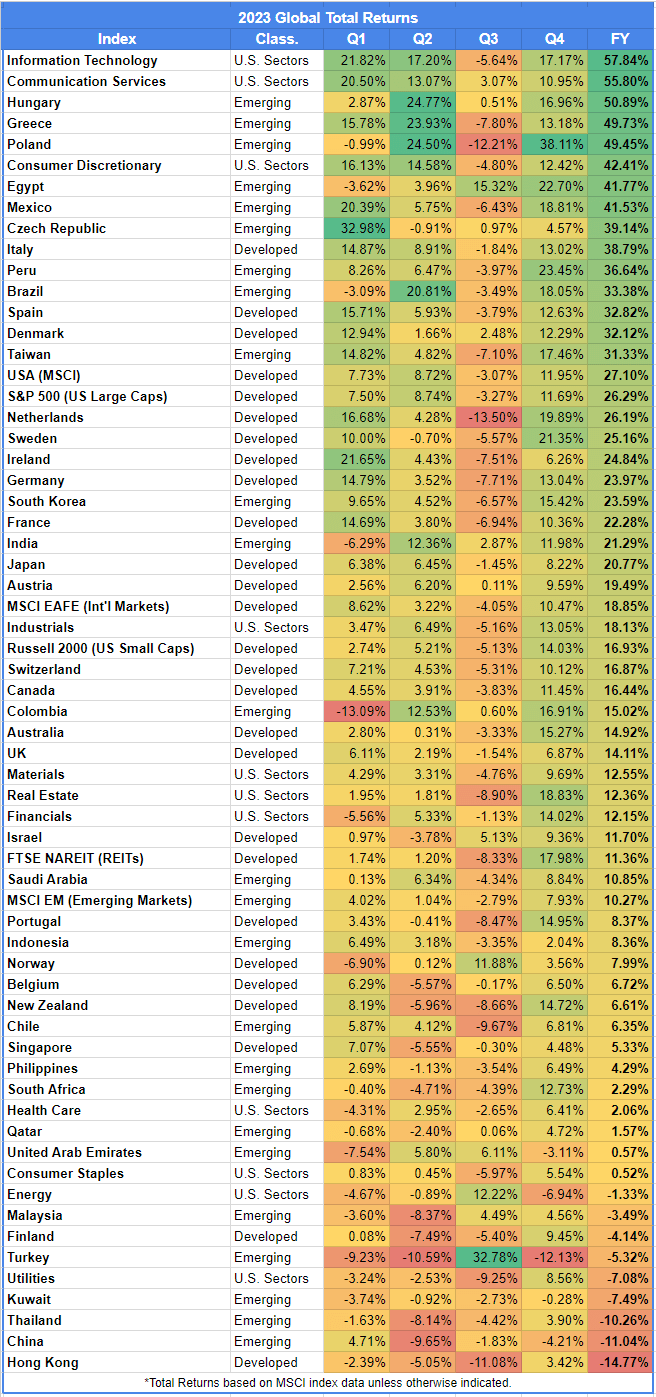
There are four tables below. The sector, developed, and emerging market tables break down 2023 returns by month. The global returns table shows 2023 returns by quarter.
Broader lessons:
- The stock market is not the economy. Economic data look backward. The stock market looks forward. 2023 is the perfect example of why investors should not confuse the two. Especially when doomsayers predict economic disaster. The market does a decent job of estimating where the business landscape will be over the next 6 to 12 months. Rearranging your portfolio because of macroeconomic worries (recessions, inflation, etc.) can leave you worse off than if you had done nothing.
- Markets move fast and when you least expect it. You can try to time the bigger moves but you’ll likely fail more often than succeed. Or you can sit tight in a diversified portfolio knowing it’s exposed to potential opportunities before they arise.
- Annual returns paint a smoother picture of what investors endure throughout the year. The weekly, monthly, and quarterly returns show how wild markets fluctuate in the short run. And 2023 is one of many years investors experience to earn long-term returns.
Lighter highlights:
- 19 out of 21 developed markets ended 2023 with a positive return. 10 of 21 had returns greater than 20%! Italy topped the list with a 38% return on the year. Finland and Hong Kong were the two exceptions with a loss.
- 19 out of 24 emerging markets ended the year positive. 11 of 24 had returns greater than 20%. 9 of 24 had returns greater than 30%. 5 of 24 had returns greater than 40%! Malaysia, Turkey, Kuwait, Thailand, and China were the exceptions with a loss.
- Markets finished strong to end the year. Only 3 markets experienced a loss in the fourth quarter of 2023 — UAE, Turkey, and China. All emerging markets. Energy was the lone U.S. sector with a fourth-quarter loss.
- Every developed market saw gains in November and December. Every emerging market saw gains in November and all but three saw gains in December. Energy was, again, the lone sector with losses in the last two months of the year.
- Of the three best-performing sectors of 2023 — Info Tech, Communication Services, and Consumer Discretionary — only one surpassed its 2021 high. Consumer Discretionary and Communication Services have yet to recover from the losses since 2021.
- The US market (S&P 500) had a phenomenal run over the last 15 years. From 2009 to 2023, it’s returned 13.97% annually. That’s a total return of 610.9%. It’s also the 3rd best-performing stock market over that period. Only Denmark and Taiwan performed better.
- Denmark was the best-performing market from 2009 to 2023 with a 15.94% annual return. That’s an 819.9% total return over the period.
- Every developed market had a positive annualized return over the last 15 years (2009 to 2023). All but one emerging market had a positive annualized return. Greece was the lone outlier. It’s down 88% over the last 15 years (-13.19% annual return over the period).
- China’s 11.04% loss is the third year of losses for the market. It lost 21.80% in 2022 and lost 21.64% in 2021. Only one emerging market has experienced four consecutive losing years — Thailand — since 1988.
Click the tables to enlarge.


Related Reading:
2022: A Year in Returns
2021: A Year in Returns