
There are four earnings calls each year that have a critical impact on a stock. These events coincide with what is known as earnings season. A time where companies release their quarterly earnings results to the public. A company’s earnings can drive it’s stock price up or down. But how do we know how good an earnings release really is?
Earnings are so important that a whole sub industry has been created just to study a company’s future earnings potential. Analysts, as their called, release an earnings forecast or estimate, which can have a big impact on a stock price. I use the term “forecast” loosely, analysts like weathermen, can often be wrong. That being said, a the stock price is tied to how well a company’s earnings compare to the average analysts estimate. If a company beats the estimates, the stock usually rises in value. And does the opposite if it fails to meet the estimates.
The Analyst Estimate
An analyst is charged with studying an industry and the publicly traded companies within it. Companies in the same industry do business in similar ways, have similar products and services, and tend to react similarly to economic changes. By studying these things, the analyst can make an educated guess to a companies future earnings, provide a stock rating, and a potential target stock price if their estimates are achieved.
If you own stocks or have a brokerage account, you’ll come across analyst estimates being revised, upgraded, updated, initiated, downgraded and the stock price will move entirely on these changes. This happens because the market is starving for information. Continue Reading…
 One of the hardest things to do with money in the market, is to hold on for the ride. The easy way out is to simple sell everything and curse the day you thought you could make money in the market. I’m not surprised that some people may feel this way. I think too often, people expect their money to only go up. But after ’08, I wouldn’t blame you for taking your money and going home.
 It seems that hacking data networks has become the new fad recently. With companies like Google, Sony, Nintendo, Lockheed Martin, and most recently Citibank, it appears that, with the exception of Lockheed Martin, the attackers are going after customer data. All this coming at a time when the internet is experiencing an evolution to a wireless, mobile (or cloud) network.
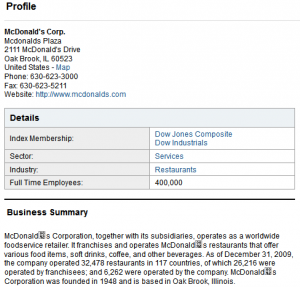 The best advice I’ve ever heard regarding investing is if you don’t understand the investment don’t put your money into it. Similar advice can be said about stocks and is the philosophy of some of the greatest money managers. If you don’t understand how the company makes money, don’t buy the stock. It’s a pretty simple idea, but often overlooked.
 You see the terms large cap, mid cap, and small cap when describing a company, mutual fund, or ETF. What do they actually mean? How do they impact an investment strategy?