Get the Book: eBook
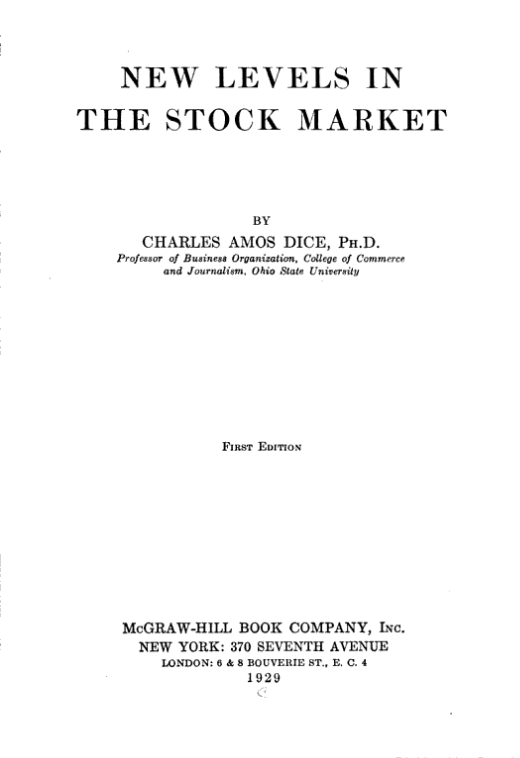
Charles Amos Dice argued the case for why the “new era” view on the 1929 stock market was warranted and a permanent feature of the market. He was wrong, of course, but the optimism of the time is captured in the book.

·
Get the Book: eBook
Charles Amos Dice argued the case for why the “new era” view on the 1929 stock market was warranted and a permanent feature of the market. He was wrong, of course, but the optimism of the time is captured in the book.
·
Continue Reading…It was the publication of E.L. Smith’s little book entitled, Common Stocks as Long-Term Investments. His study showed that, contrary to prevalent beliefs, equities as a whole had proved much better purchases than bonds during the preceding half-century. It is generally held that these findings provided the theoretical and psychological justification for the ensuing bull market of the 1920’s. The Dow Jones Industrial Average (DJIA), which stood at 90 in mid-1924, advanced to 381 by September 1929, from which high estate it collapsed — as I remember only too well — to an ignominious low of 41 in 1932.
On that date the market’s level was the lowest it had registered for more than 30 years. For both General Electric and for the Dow, the high point of 1929 was not to be regained for 25 years.
Here was a striking example of the calamity that can ensue when reasoning that is entirely sound when applied to past conditions is blindly followed long after the relevant conditions have changed. What was true of the attractiveness of equity investments when the Dow stood at 90 was doubtful when the level had advanced to 200 and was completely untrue at 300 or higher. — Ben Graham (source)
·
Irving Fisher had a lot going for him during the 1920s. He was the best-selling author of How to Live, a book on healthy living. He was a successful inventor of what is best described as a precursor to the Rolodox. He was the most popular economist in the U.S.
Fisher was a Yale professor who came up with several theories that advanced the study of economics. One of his theories was the Equation of Exchange which measured the velocity of money. Velocity was the average number of times a dollar was used to buy goods in a given year.
Fisher believed his equation could be used to forecast future swings in prices and the economy. He only needed to prove his theory against reality. Studying reams of data going back about 15 years, Fisher found that a rapid increase in velocity led to a downturn the following year.
His findings were published in two articles in 1912 and 1913. His first forecasts were included in both. He accurately predicted an economic expansion in 1912 and a recession in 1913.
That early success, and praise for his mathematical approach, drove a desire for a wider audience. The Index Number Institute was born. Its purpose was to sell weekly access to Fisher’s index numbers and other economic data to newspapers. Fisher hoped business managers and investors would then use the data to anticipate changes in the economy and the stock market.
Continue Reading…·
Continue Reading…Those who believe in the permanence of tempestuous seasons will view life as a succession of short runs, where noise dominates signals and the frailty of the basic parameters makes normal too elusive a concept to worry about. These people are pessimists who see nothing in the future but clouds of uncertainty. They make decisions based only on the short distance ahead that they can see.
Those who live by regression to the mean spend their time entirely differently. They expect the storm to pass, so that one day the ocean will be flat. On that assumption, they can make the decision to ride out the storm. They are optimists who see the signals by which they will steer their ships toward that happy day when the sun shines through.
My own view of the matter is a mixture of these two approaches. Hard experience has taught me that chasing noise leads me to miss the main trend too often. At the same time, having lived through the bond yield/stock yield shift of the late 1950s and the breakthrough of bond yields into the stratosphere beyond 6 percent in the late 1960s — just to mention two such shattering events out of many — I look with suspicion at all main trends and all those means to which variables are supposed to regress. To me, the primary task in investing is to test and then retest some more the parameters and paradigms that appear to govern daily events. Betting against them is dangerous when they look solid, but accepting them without question is the most dangerous step of all. — Peter Bernstein (source)
·
Some of the biggest US companies have had a great run over the last decade. The performance has been so good that some of the biggest companies outperformed the S&P 500 and rekindled concerns around market concentration. Is this recent occurrence unique to today or backed by history?
Henrik Bessembinder answered that questions with his latest research into “do nothing” portfolios. One of the things he looked at was the performance of concentrated portfolios in the largest S&P 500 stocks compared to the overall index.
Bessembinder broke down the largest stocks into four market cap-weighted portfolio buckets: the single largest stock, 10 largest stocks, 50 largest, and 100 largest. Each portfolio was rebalanced each year into its corresponding number of largest stocks starting in 1971. Returns where then calculated through 2025 and compared to a portfolio of all S&P 500 stocks.
The results are below.
Continue Reading…·
Continue Reading…There are some principles that people need to learn. One is to look widely. Be open-minded about every form of investing in every nation. Don’t let yourself get misled by trying to limit yourself to one area.
Our second principle would be diversification. Of course, nobody knows what tomorrow will bring, so it’s not wise to put too many eggs in one basket. Nobody should ever have over half of their total investments in one nation, over half their investments in one industry, and perhaps no more than one fifth of their investments in one corporation, so a worldwide search is better than a local search. Diversification is a safety factor that is essential because we should be humble enough to admit we can be wrong. — John Templeton (source)