
 One of the hardest things to do with money in the market, is to hold on for the ride. The easy way out is to simple sell everything and curse the day you thought you could make money in the market. I’m not surprised that some people may feel this way. I think too often, people expect their money to only go up. But after ’08, I wouldn’t blame you for taking your money and going home.
People saw 30%, 40%, even 50% or more losses in less than a year. Something most people never experienced and for some, should never have been in that position. It’s one of the major faults with a 401k. Even though many people have a good understanding of how to invest, there’s even more that don’t, yet are pushed into it blindly by their own retirement plans.
The stock market isn’t built for everyone. To paraphrase Warren Buffett, people who can’t handle a 50% loss in their stock’s value, shouldn’t own stocks. There has to be an emotional disconnect between you and your money. It’s the only way to maintain sanity. But is easier said than done.
When the market collapsed in Oct. ’08 most people eventually took their money and ran. Fear set in, which caused a bigger sell off, causing even more fear, and more selling. Until it finally bottomed in March ’09 with the Dow around 6500. People took the pain all the way down until they couldn’t take it any longer. They finally got out of the market, but it was at the worst time possible. Right near the bottom. Continue Reading…
 It seems that hacking data networks has become the new fad recently. With companies like Google, Sony, Nintendo, Lockheed Martin, and most recently Citibank, it appears that, with the exception of Lockheed Martin, the attackers are going after customer data. All this coming at a time when the internet is experiencing an evolution to a wireless, mobile (or cloud) network.
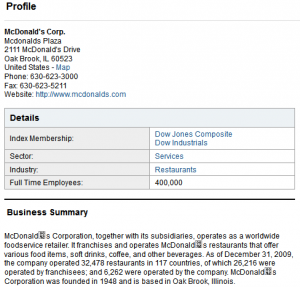 The best advice I’ve ever heard regarding investing is if you don’t understand the investment don’t put your money into it. Similar advice can be said about stocks and is the philosophy of some of the greatest money managers. If you don’t understand how the company makes money, don’t buy the stock. It’s a pretty simple idea, but often overlooked.
 You see the terms large cap, mid cap, and small cap when describing a company, mutual fund, or ETF. What do they actually mean? How do they impact an investment strategy?
 Have you ever had the small misfortune to wake up, take a shower, but have no hot water, or where you’re driving to work, only to get a flat. You hope these problems are just a quick fix. But when they’re not, you know it’s going to cost more than you want to spend. The good news is you have an emergency fund set aside just for these situations, right.