Novel Investor
  • Home
  • About
  • Invest with Me
  • Resources
  • 2026: Q1 Returns

    April 8, 2026

    ·

    Jon

    2026 started out well for global markets. Then March hit. And chaos ensued.

    How well were things going? Through February 2026, most global markets were positive. In fact, only seven country indexes sat at a loss on the year at the end of February.

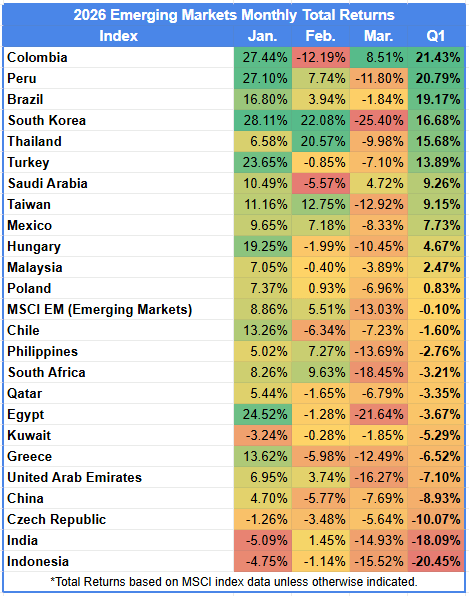
    So, 40 country indexes were positive. South Korea lead with a 56.4% total return in the first two months. Twelve other emerging market countries were up double-digits. Only five of the remaining eleven had losses no worse than -5.8%.

    Norway led developed markets with a 20.2% total return through February. Eight other developed countries were up double-digits. Only two of the rest — Ireland and Denmark — had losses for the year at that point.

    Broadly, international and emerging markets led through the first two months. MSCI EM returned 14.9% through February. International followed with a 10.1% total return. US REITs were up 10.5%. US small caps gained 6.2%. Even the S&P 500 was positive, barely, at 0.7% at the end of February, with eight of eleven sectors positive and five of those eight sitting at double-digit returns.

    Then came March.

    All broad indexes fell. US small caps, large caps, international, and emerging markets were down. Only US REITs and small caps were still positive by the end of March. Inside the S&P 500, all but one sector was down.

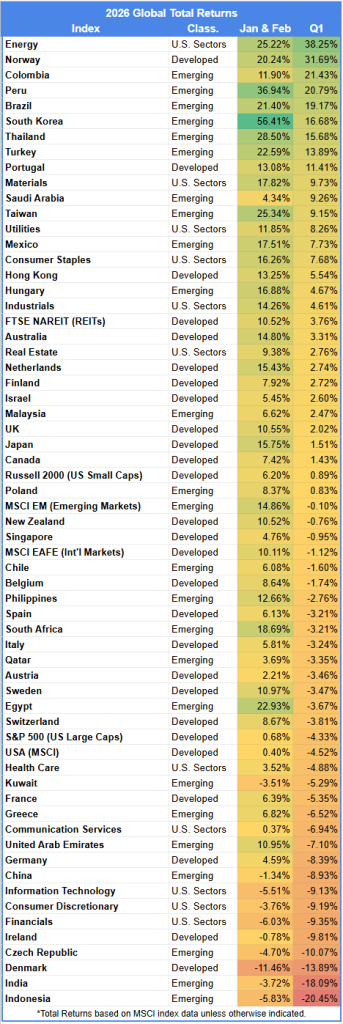
    Changes at the country level were similar. Only three country indexes rose in March. The rest fell. 25 out 47 country indexes were negative at the end of March compared to 7 of 47 at the end of February. You can see the stark difference in performance through February versus through March in the last table below.

    The first quarter of 2026 is a good reminder that things can change quickly in markets. Of course, we’ve learned in prior years that markets may recover just as quickly.

    There’s no telling what the future holds. And drastic changes to your portfolio are rarely a good idea. Especially, based on a single month of poor market performance. Doing so, may leave you wanting on the off chance a similar quick recovery happens this time too.

    Besides, diversification protects your portfolio from these market moving events. It’s not perfect protection but you see how it works in the index tables below. The portion of the index that moves in a positive direction counterbalance some of the negative moves.

    And whenever the recovery kicks in, diversification means your portfolio is already positioned to benefit on the upside too.

    A quick note before the quarter highlights: The asset class, sector, international, and emerging market returns are up to date through March 31, 2026. Hit the links for each.

    Four tables are below. The US sector, developed markets, and emerging markets performance tables are broken down by month. The final table shows returns through February compared to the 2026 Q1 returns for all three.

    Here are a few highlights that stood out:

    • March was a rough month for every country and sector…with four exceptions. The US energy sector, Norway, Columbia, and Saudi Arabia gained in March. Everything else showed losses.
    • Energy was the best performing sector in the first quarter. It’s 38.3% gain is the largest single-quarter gain for the sector since Q1 2022 (a 39.0% gain).
    • Energy was the best performing sector through February as well.
    • The three worst performing sectors for Q1 — Financials, Consumer Discretionary, and Info Tech — were the only sectors with losses through February. Financials and Info Tech experienced losses in each month of Q1.
    • Sector performance for the quarter ranged from 38.3% to -9.4%, a 47.7-percentage point swing. Exclude energy and the range was only 19.1-percentage points. Energy had an oversized impact on the S&P 500’s return to start the year.
    • Norway was the best performing country to start the year. Energy companies currently make up 29% of its index, with one of those companies accounting for a 14% weighting.
    • Norway’s 31.7% return for Q1 fell just short it’s 35.9% total return for 2025. Big returns can happen in a few months, a single year, or may take multiple years to earn.
    • The South Korean index experienced 20+ percentage point moves in each month of Q1 — 28.1% gain, 22.1% gain, and 25.4% loss. Emerging markets can be volatile.
    • Denmark, Indonesia, and New Zealand are the only three indexes with two consecutive losses going into 2026. All three extended that streak with Q1 losses.
    • Denmark and Indonesia are both down over 30% since 2023. New Zealand is only down 2% over the same period. Not all losing streaks are the same.
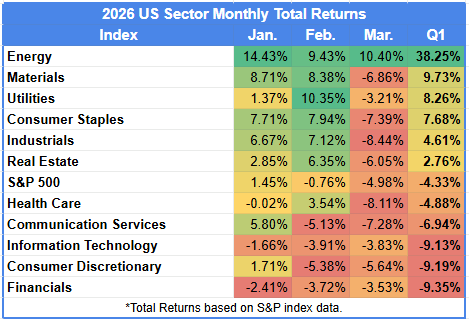
    Table showing US sector returns by month for the first quarter of 2026.
    Table showing developed markets returns by month for the first quarter of 2026.
    Table showing emerging markets returns by month for the first quarter of 2026.
    Table showing global markets returns for January and February 2026 versus the first quarter of 2026.

    Related Reading:

    • 2025: A Year in Returns
    • 2025: Q3 Returns

  • Weekend Reads – 4/3/26

    April 3, 2026

    ·

    Jon

    Quote for the Week

    Investing is about making decisions with your money. All of those decisions are probabilistic. As former Treasury Secretary (and maybe future Chairman of the Fed) Robert Rubin emphasizes in his new book, nothing is certain – except uncertainty – and decision procedures need to reflect that. In a recent speech, Fed Chairman Greenspan makes much the same point, and elaborates on the difference between the most likely outcome and low probability but high impact outcomes.

    Decision procedures and outcomes also need to be clearly distinguished. A decision is not bad or wrong because the outcome turns out badly. And a good decision is not the same as one that turns out well. A decision is bad if the process that engendered it was bad, regardless of the outcome. Bad outcomes — losing a lot of money in an investment — can happen even if the process is sound; and good outcomes can occur even if the process is lousy. A market that is mostly efficient can distribute outcomes all over the place. — Bill Miller (source)

    Continue Reading…

  • Asset Class, Sector, and Global Market Quilts Updated for Q1 2026

    April 1, 2026

    ·

    Jon

    I’ve updated the asset class, sector, international, and emerging markets quilts through the first quarter of 2026. Find links to each version below:

    • Asset Class Returns
    • Sector Returns
    • International Market Returns
    • Emerging Market Returns

    You can also download copies here or grab the images below. I’ll have a deeper dive into the numbers next week.

    Every so often, something happens that nobody expected, including markets. It was not priced in. It wasn’t even considered. But it forces markets to reassess what the majority believed would happen over the next 12 months or so.

    That’s 2026 in nutshell so far. The market impact of the war in Iran and $100 oil prices has been more volatile markets yet somewhat subdued returns so far.

    Broadly, the range in asset class returns on the year is small. REITs with a 4% total return at the high end. Large caps (S&P 500) at -4% at the low end.

    Continue Reading…

  • Weekend Reads – 3/27/26

    March 27, 2026

    ·

    Jon

    Quote for the Week

    A lot of people think long-term investing is three weeks from next Wednesday, but when I talk about long-term investing I mean 5, 10, 20 years. During that length of time the market can experience ups and downs due to what I call “background noise.” Events occur – hurricanes, wars, political instability, currency and bank crises – that make investors nervous and cause market volatility. It does get nasty at times, but it shouldn’t cloud investors’ judgments about thinking long-term. The key organ here is your stomach. Everyone has the brainpower, but not everyone has the stomach for it…

    If you’re going to need money within 12 months to pay for a wedding or put a down payment on a house, the stock market is not the place to be. You can flip a coin over where the market is headed over the next year. I have no idea whether the next 1,000 points for the Dow or Nasdaq will be in positive or negative territory. But if you’re in the market for the long haul – 5, 10, or 20 years – then time is on your side and you should stick to your long-term investment plan. I would argue that the next 10,000 and 20,000 points for the market will be up. That’s been the long-term trend. The bottom line is to have a responsible plan for your investments and know what you own and why you own it. There’s too much at stake not to. — Peter Lynch (source)

    Continue Reading…

  • Hedgemanship by Conrad W. Thomas

    March 25, 2026

    ·

    Buy the Book: Print

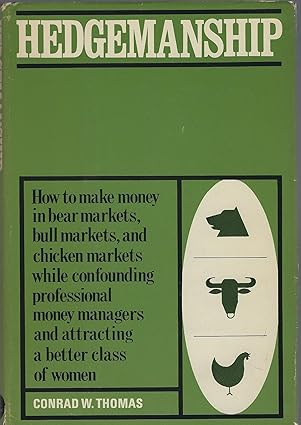
    Hedgemanship provides an account of the rise in popularity of hedge funds in the 1960s. The early success of Alfred Winslow Jones, the basic hedge fund philosophy, and the losses in the 1969 bear market are covered.

    Hedgemanship by Conrad W. Thomas, book cover

    The Notes

    Continue Reading…

  • Weekend Reads – 3/20/26

    March 20, 2026

    ·

    Jon

    Quote for the Week

    I regard my property largely as a trust. It is not mine absolutely. I take care of it on much the same principle as you would foster a valuable animal left in your charge. Of course my attitude in the premises was inherited. My father believed that the money left to one should be given over undiminished to the next generation. That also is my idea.

    He believed that one who inherited property had the right to spend the income it yielded, but not to waste the principal.

    About all that can be said is that my investments have been carefully chosen and have turned out well as a rule. A fortune cannot be built up around any fixed idea or, in other words, without the exercise of plain common sense. I buy when things are low and no one wants them. I keep them, just as I keep a considerable number of diamonds on hand, until they go up and people are anxious to buy. That is the general secret of business success. One thing, however, has been wrongly attributed to me, and that is speculating. I never speculate. Such stocks as belong to me were purchased simply as an investment, never on a margin. — Hetty Green, 1905 (source)

    Continue Reading…

1 2 3 … 233
Next Page

Join the library.

Access over 1,100 research papers, writings, transcripts, and more from the brightest minds in finance.

Learn More

Learning

  • Investor Library
  • Book Notes
  • Investor Quotes

Return Quilts

  • Asset Class Returns
  • S&P Sector Returns
  • International Stock Market Returns
  • Emerging Markets Returns
  • Historical Returns Data

Connect

  • Bluesky
  • Twitter
  • Facebook
  • RSS Feed
  • Home
  • About
  • Contact

© Novel Investor · All Rights Reserved · Terms of Use · Privacy Policy · Disclaimer