 Buy the Book: Print
Fred Schwed delivers a cynical, sarcastic, insiders perspective on the business of Wall Street. His book stands as a timeless warning to investors and speculators alike.

·
Buy the Book: Print
Fred Schwed delivers a cynical, sarcastic, insiders perspective on the business of Wall Street. His book stands as a timeless warning to investors and speculators alike.
·
Transformative innovation creates an explosion of new businesses followed by a surge of extinctions. Picking the winners is hard.
Warren Buffett tried to teach this lesson to a group of business leaders in 1999. To say it was well received would be an understatement.
None of the new Dot-com royalty cared to listen to an old man, out of touch with the new reality, saying most of their companies were doomed to failure. To them, no price was too high to pay for their good idea. It was a twisted view born out of the excesses in rising stock prices.
In the end, Buffett was right. But at the time, all he had was an argument built around common sense, facts, and history. Here’s how he relayed it in a speech at the Sun Valley Conference in July 1999: Continue Reading…
·
We can point out the errors to be avoided much more successfully than we can lay out a course of positive action.
G.C. Selden wrote that line in 1912. It fits Munger’s idea of inversion: figure out the best ways to lose money, then avoid doing those things. It’s a common-sense way to improve returns.
I came across this idea twice this week (it happens every week, really) from century-old sources. Selden covered the usual suspects — over-optimism, enthusiasm, stubbornness, fear, anger, greed — before summarizing his book on investor psychology. Continue Reading…
·
G.C. Selden’s timeless book describes the influence human nature has on markets and what investors/traders must do to overcome potential behavioral errors to be successful. It’s as relevant today as it was when it was published in 1912.
·
Howard Marks releases a new memo based on often used phrase “this time is different.” He highlights nine ideas, each a different form of those four words, that come up often today. His response to two ideas is worth highlighting.
The first is on the idea that we don’t have to have a recession.
When I hear people talk about the possibilities that the Fed will prevent a recession, I wonder whether it’s even desirable for it to have that goal. Per the above, are recessions really avoidable or merely postponable? And if the latter, is it better for them to occur naturally or be postponed unnaturally? Might efforts to postpone them create undue faith in the power and intentions of the Fed, and thus a return of moral hazard? And if the Fed wards off a series of little recessions, mightn’t that just mean that, when the ability to keep doing so reaches its limit, the one that finally arrives will be a douzy?
The push to minimize volatility in cycles — markets, business, economy — was the main theme that came out of the financial crisis. It’s not a new theme either. Except, what people really want, is what everyone wants — the upside without the downside that comes with it. It never works out that way, but it doesn’t stop people from trying again and again… Continue Reading…
·
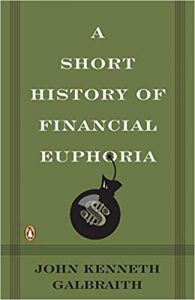
John Kenneth Galbraith journeys through the recurring theme of speculative mania and financial ruin inherent in markets, His big picture view describes the common features associated with most euphoric episodes.
 Buy the Book:
  Buy the Book: