
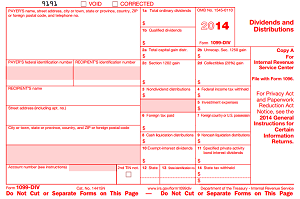
Investors with taxable accounts have a bigger pile of tax forms to deal with every year. Form 1099-DIV is one form you get when your investments pay out dividends and distributions. If you’re like me, it means you spend a little more quality time with tax software each year. Or, maybe you pass it off to your accountant. But do you really understand what is reported in each box of a 1099-DIV? Do you know how it affects your taxes or your investments?
Unfortunately, not all dividends and distributions are taxed the same. And it’s not always easy to figure out. I use TurboTax for help when I get stuck. Regardless, you should still understand what is reported on the 1099-DIV, the tax consequences of each box, and how it might affect your investments. In turn, it might even help you build a more tax efficient investment strategy and lower your taxes in the long run. Continue Reading…
 Dividends tend to get lumped as one single form of investment income. But the IRS doesn’t see it that way, dividing the tax on dividends into two types: ordinary and qualified dividends.
  The IRS has different tax forms for every type of income imaginable. With investing, that can quickly get complicated and lead to mistakes. At the very least, you should have a basic idea of what the tax forms do and which forms to expect each year. That alone will give you a better picture of your tax costs, allowing you to
  Dividends are the big reason investors turn to