
Novel Investor
  • Home
  • About
  • Invest with Me
  • Resources
  • Wise Words from Michael Price

    July 28, 2021

    ·

    Jon

    Michael Price is a lesser-known investor, with a unique approach to investing. He got his start in 1975 at Mutual Shares and went on to produce a market-beating track record.

    Max Heine started a small fund company in 1949. He set up a single no-load fund called Mutual Shares to invest money for friends and family. But it wasn’t your typical mutual fund. Heine had a unique approach to racking up big returns for his investors. He went anywhere he could find value.

    Under Heine’s tutelage, Price learned how to find dollars for fifty cents. He’s followed Heine’s playbook ever since.

    Their philosophy begins and ends with the preservation of capital. It’s accomplished through strict discipline to portfolio construction. A portion of the portfolio is always invested in assets that move independently of the market because it helps to reduce drawdowns.

    It’s not for everyone either. Price’s strategy requires a particular set of skills and a strong stomach because it often takes him places, like bankruptcies, that few investors want to go.

    Over the years, Price has shared more about his and Max Heine’s investment approach. Continue Reading…
  • Double Counting: Earnings Growth and Multiple Expansion

    July 23, 2021

    ·

    Jon

    In the long run, a company’s stock price reflects its growth in earnings. But when we dissect the long run into short runs, we see how investor psychology drives prices.

    That short-run driver manifests itself in the P/E multiple. Multiple expansion can have an oversized impact on stock prices in bull markets.

    Apple is a good example.

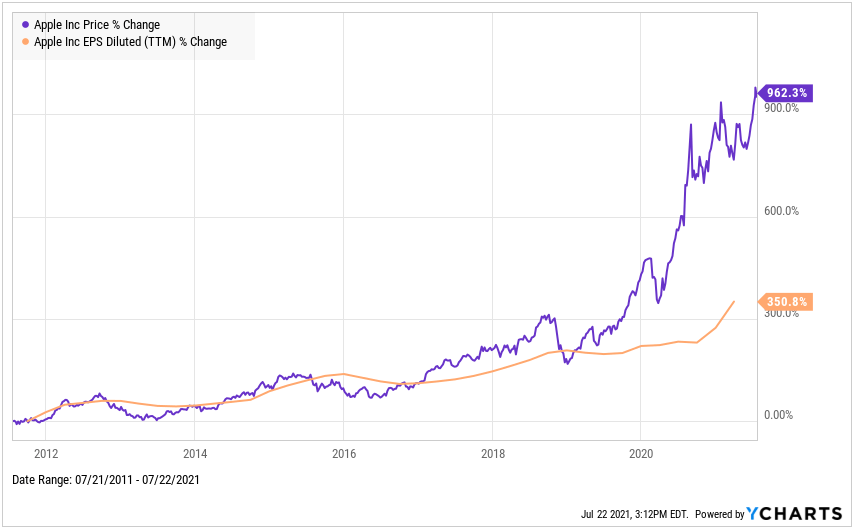
    Apple EPS Growth vs Stock Priced-price

    The chart shows the change in Apple’s earnings per share (EPS) and stock price over the last 10 years. Early on, the stock price tracked the growth in EPS fairly closely. Something happened after 2019 to change that.

    Here’s Apple’s P/E ratio over the same period. Continue Reading…


  • In Search of Compounders

    July 21, 2021

    ·

    Jon

    Finding companies that compound for decades has become the ultimate investment strategy. It’s also one of the hardest. The trouble is hindsight tends to obscure how difficult it may be.

    A recent study by Henrik Bessembinder offers some insight into the difficulties investors face investing in compounders. He studied 25,775 stocks between 1973 to 2020 to find the most persistent “winners” of the bunch.

    Bessembinder looked for companies that grew 5x, 25x, 125x, and 625x after its stock price reached a low point. Returns included reinvested dividends when applicable.

    He found that:

    Of these, 11,442, or 44.39%, achieved a 5x multiple relative to a prior low point at some time during the 48-year sample period. Among those that reached a 5x multiple, 3,306 stocks went on to achieve a 25x multiple relative to the same prior low point. The stocks that reached 25x comprised 12.38% of the full sample and 28.89% of those that achieved a 5x multiple. A total of 955 stocks achieved a 125x multiple. The stocks that reached 125x comprised 3.71% of the full sample… The stocks that reached a 625x multiple comprised 1.05% of the full sample…

    In addition, 29% of the stocks that grew 5x went on to hit 25x. Of those that reached 25x, 29% hit 125x. And of the 125x, 28% hit 625x! At each hurdle, almost a third of the compounders went on to hit the next hurdle.

    There are few things we can learn from his study. Continue Reading…


  • Wise Words From Marty Whitman

    July 16, 2021

    ·

    Jon

    Marty Whitman was a no-nonsense investor influenced by Graham & Dodd. With value principles as his base, he delivered a track record that beat the market by 2.3% over two decades.

    In November 1990, he started Third Avenue Management and its flagship the Third Avenue Value Fund. He ran the fund until he stepped down in March 2012 at age of 87. He produced an 11.1% annual return for his shareholders (versus the S&P 500’s 8.8%). But that performance doesn’t really do him justice.

    The 2008 financial crisis was a turning point for Whitman’s fund. Prior to 2008 — 1991 to 2007 — the fund earned a 15.7% annual return versus 11.4% for the S&P. Then 2008 hit. The fund lost 45.6% (the S&P 500 lost 37%). Redemptions followed. He underperformed by about 5% per year over the next three years.

    A few years after he stepped down in 2012, he explained the poor performance: Continue Reading…


  • Investing Wisdom Worth Learning

    July 14, 2021

    ·

    Jon

    John Bogle once said, “Learn every day, but especially learn from the experiences of others. It’s cheaper!” It’s true. It is cheaper. It’s also a great way to learn.

    About the only downside is that experiencing it ourselves tends to drive the point home much better. Losing money will do that. But it usually happens at a snail’s pace compared to the speed with which anyone can dedicate to learning from others.

    The fun part is John Bogle said that at the end of a meeting of the minds. Charley Ellis gathered seven legends to share their thoughts and experiences on investing. Their lessons are timeless and worth revisiting as a reminder of what matters.

    On Behavior

    I would recommend being humble. Be open-minded, and do not be conceited. — John Templeton

    ***

    Humility is an enormously important quality. You can’t win without it. Survival, in the end, is where the winners are by definition, and survival begins with humility. — Peter Bernstein Continue Reading…


  • A Lesson on Value

    July 9, 2021

    ·

    Jon

    Value strategies aren’t for everyone. The biggest reason is you have to do the opposite of what most investors do in order to outperform.

    That’s hardly a bold statement, but after testing a number of value metrics one thing stood out. Obviously, there are benefits to buying undervalued stocks. The long-term outperformance is clear.

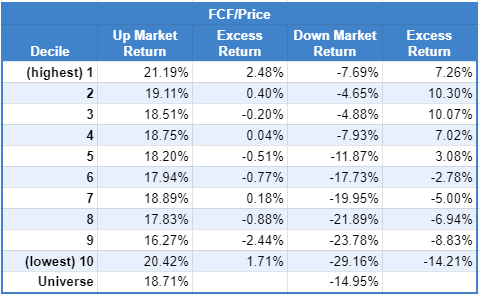
    But what might surprise most people is that value’s outperformance, on average, overwhelmingly comes during down markets. Here’s an example.

    FCF/Price Excess Return

    Here’s another one. Continue Reading…


Previous Page
1 … 67 68 69 70 71 … 233
Next Page

Join the library.

Access over 1,100 research papers, writings, transcripts, and more from the brightest minds in finance.

Learn More

Learning

  • Investor Library
  • Book Notes
  • Investor Quotes

Return Quilts

  • Asset Class Returns
  • S&P Sector Returns
  • International Stock Market Returns
  • Emerging Markets Returns
  • Historical Returns Data

Connect

  • Bluesky
  • Twitter
  • Facebook
  • RSS Feed
  • Home
  • About
  • Contact

© Novel Investor · All Rights Reserved · Terms of Use · Privacy Policy · Disclaimer