It’s a short list this quarter. Here’s what I’ve been reading the past three months: Continue Reading…

-
2021 Q1: Sector Breakdown
·
A year ago this month, the market experienced one of the fastest crashes ever. It was followed by one of the fastest recoveries but the recovery wasn’t uniform.
2020 saw technology, consumer discretionary, communication services, and materials sectors as the biggest winners. Financials, real estate, and energy struggled.
That appears to have changed…so far. That should come as no surprise either. With markets, old trends die. New trends are formed. Last year’s winners can become this year’s losers. The death of value can be resurrected.
The only certainty with markets is change. Investors expecting things to stay the same are sure to be disappointed.
A couple of quick points before diving into the results: Continue Reading…
-
The Trouble with Timing the Bull
·
Market timing is fraught with problems. Specifically, it doesn’t work.
Ben Graham addressed the risk of adding a timing component to your strategy in Security Analysis. He points out two important problems that lead to poor timing in a bull market.
One is a problem that comes with selling. The other is failing to know when not to buy.
Here’s what he had to say: Continue Reading…
-
Enough: True Measure of Money, Business, and Life by John Bogle
·
Bogle’s Enough draws from a lifetime of wisdom to reflect on the excesses of a financial system that led to the 2008 crisis and reminds readers of the benefits of a less greedy, long-term, client-first system (society) where success in life is defined by more than just money.
The Notes
-
Peter Bernstein: The Importance of Staying Power
·
The behavioral side of investing gets a lot of attention while the personal finance side often gets less than it deserves. That’s because how defensive you are with your finances helps determine how aggressive you can be with your portfolio. Put simply, it’s easier to roll with the market’s punches when everything outside your portfolio is in financially sound shape.
Peter Bernstein dwells on the impact of being wrong on investments because the consequences can go beyond losses. The nature of investing guarantees everyone will be wrong sometimes. That means unexpected gains in some cases (being wrong isn’t all bad) and losses in others.
How quickly you can recover from losses will have a big impact on your long-term wealth. There’s an obvious psychological hurdle to recovering from losses but the state of your finances impacts your ability to recover too. Bernstein calls it “staying power.” Continue Reading…
-
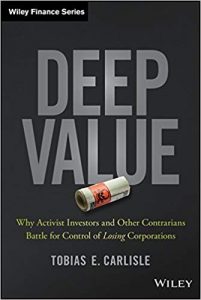
Deep Value by Tobias Carlisle
·
Deep Value explains, through numerous case studies and backed by data, why the counterintuitive approach of a traditional (deep) value strategy uncovers the most promising investment opportunities with limited risk.
The Notes
 Buy the Book:
  Buy the Book: